
 Need help?
Do you have a question about the Extech Instruments MD10 and is the answer not in the manual?
Safety guidelines for children, unattended materials, battery removal, and disposal.
Warnings regarding electrocution risk and safe probe handling.
Steps for using the probe tip, interpreting the blue light, and operating the flashlight.
Information on detector sensitivity, false triggers, and testing through coverings.
Instructions for opening the battery compartment and inserting batteries.
Guidelines for proper disposal of used batteries and end-of-life equipment.
The Extech Instruments Model MD10 is a magnetic field detector designed for testing various components that utilize magnetic fields. Its primary function is to detect AC/DC magnetic fields and permanent magnets, making it a versatile tool for professionals working with electrical and mechanical systems.
The MD10 is capable of testing solenoid valves found in pneumatic and hydraulic control equipment, which are crucial for regulating fluid flow and pressure in industrial applications. It can also be used to test relays with coils, which are essential electrical switches that control circuits. Furthermore, the device is suitable for examining electrically controlled solenoid valves in vehicles, machinery, and oil burners, helping to diagnose issues related to their operation. Another application includes testing audio speaker coils, which are fundamental to sound reproduction. The detector's ability to respond to both AC/DC magnetic fields and permanent magnets ensures comprehensive testing across a wide range of magnetic components.
The MD10 is designed for ease of use, incorporating several features to facilitate efficient and safe operation. Before using the device, users are advised to read, understand, and follow all safety rules and operating instructions provided in the manual. A crucial safety measure is to always test the Magnet Detector on a known live circuit to verify its proper operation before use, mitigating the risk of electrocution. Users should also keep their hands and fingers on the body of the probe and away from the probe tip to ensure safety.
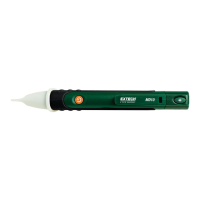
To operate the MD10, the user presses and holds the test switch (3) and slowly approaches the testing area with the probe tip (1). When a magnetic field is detected, the blue probe light (2) will illuminate. The illumination pattern provides an indication of the field's strength: a solid light signifies a strong magnetic field, while a flickering light indicates a weaker field. This visual feedback allows for quick assessment of the magnetic presence.
The device also includes a built-in flashlight (7) for convenience in dimly lit environments. To switch on the flashlight, the user presses and holds the flashlight switch (6). Releasing the button turns the flashlight off. If the flashlight does not switch on, users should check the batteries, which are housed in the battery compartment located on the rear of the MD10 (8).
A notable feature of the MD10 is its high sensitivity. It is designed to detect even subtle magnetic fields. The manual notes that static electricity, stray magnetic fields, or other energy sources may occasionally trigger the sensor randomly, which is considered normal operation. However, strong magnetic fields will consistently yield a fixed indication. An important practical advantage is that it is not necessary to unscrew the test object from its mounting on the equipment to perform a test. A magnetic coil can even be tested through its protective covering, saving time and effort in diagnostic procedures.
Proper maintenance, particularly regarding battery handling, is emphasized to ensure the longevity and safe operation of the MD10. The device requires two AAA 1.5V batteries for power. Battery installation involves sliding open the battery door compartment (8) while gently prying up/out at the pocket clip (4) using a small screwdriver in the pocket clip access hole (5). After inserting the two AAA batteries, the door should be replaced.
Safety guidelines for battery usage are clearly outlined. Users are advised not to leave batteries and packing material unattended, as they can pose a danger to children. If the device is unused for an extended period, the batteries should be removed to prevent potential damage from leakage. Expired or damaged batteries can cause cauterization upon contact with the skin, so suitable hand gloves should be used when handling them. It is also crucial to ensure that the batteries are not short-circuited and never to dispose of batteries by throwing them into a fire.
Environmental responsibility is also highlighted in the maintenance instructions. Users are explicitly instructed never to dispose of used batteries or rechargeable batteries in household waste. As consumers, users are legally required to take used batteries to appropriate collection sites, such as retail stores where batteries were purchased, or other designated collection points. Similarly, the instrument itself should not be disposed of in household waste. The user is obligated to take end-of-life devices to a designated collection point for the disposal of electrical and electronic equipment, promoting responsible recycling and waste management.
 General
| Type | Handheld Metal Detector |
|---|---|
| Adjustable Sensitivity | Yes |
| Audible Alert | Yes |
| Power Supply | 9V Battery |
| Operating Temperature | 32°F to 122°F (0°C to 50°C) |
| Visual Alert | Yes |
| Detection Depth (Coin-sized Object) | 4" (10cm) |

 To Next Page