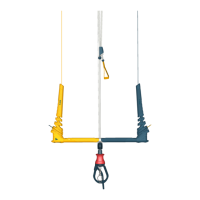
SAFETY
Choose your spot according to your level
The choice of a good spot is a prerogative for a safe
learning. The best spot is not necessarily the spot
where you nd the most kites. If you just started or if
you do not control your kite properly, the best spot is
often the least crowded one.
The water and wind conditions also vary, advanced
kitesurfers often look for strong wind and good
waves where beginners should be looking for calm
waters and softer winds. When rst starting out it is
recommended to look for a place with fairly shallow
waters.
Choose an obstacle free area
Check that the space on your sides and downwind
from you is free of obstacle: no houses, no trees, no
cars or jetties.
Under no circumstances should you be riding near
electrical posts and wires, or near an aireld or even
near a harbor.
Wind direction
Never ride in strong offshore wind. The wind can die
at any moment or a line can break. In offshore wind
it is harder to swim back to shore, the wind and the
current pushing away from the beach.
It is not recommended to ride when the wind is on-
shore especially for beginners as the wind pushes
directly onto the beach. This will make your learning
harder: you will not be able to do good runs and go
up wind, and you will end up on the sand very quickly.
This will also be more risky as any gust could send
you onto the sand and your kite may fall violently onto
the sand.
Therefore always ride while the wind is side or side-
on, this will let you go downwind while keeping a safe
position in case of an emergency.
The area down the wind
Be cautious and check that there are no obstacles
going down wind. You should always consider room
for error. Keep in mind that the risk is to go down
wind, beginner or not.
There is always a risk of breaking a line, losing your
board, or breaking your harness… therefore the
beach down the wind should always be accessible.
Think that you may have to walk back alongside the
beach (check that there are no rocks, cliffs, fences, or
jetties blocking your way).
If you are just starting out or if you cannot entirely
control your kite, be careful as to where you stand
on the spot: if the spot is big enough, it is better to
stand upwind from other kites to avoid crossing your
lines with theirs. It is less tricky for you and them, this
will allow you to concentrate on your ying and less
on others.
RULE N°3 - CHOOSE YOUR PRACTICE SPOT
OBSERVE LOCAL LAWS & REGULATIONS REGARDING KITESURF ANDAUTHORIZED AREAS.
RULE N°4 - SAFETY SYSTEMS
• Do not use your kite without a safety system. There
are 2 safety systems: the main release system = Quick
Release, which instantly reduces the power of the kite,
and the disconnecting release system = Safety Leash,
which allows you to separate completely from the kite.
Indeed, once the main release is activated, the Leash
still connects you to your kite, thanks to a safety line.
• Rinse your safety systems with fresh water after
each use, while operating the release handles, to
remove any sand or obstructionsl that may have been
stuck inside.
• Regularly inspect your safety systems to check
that each part is still in good condition. If any doubt,
replace the safety system or contact your local dealer.
• Familiarize yourself with the correct use of your
safety systems. Pick a clear spot to practice releasing
the kite.
• Regularly check the correct functioning of the safety
systems: activate each release device at least once
before and after each use.
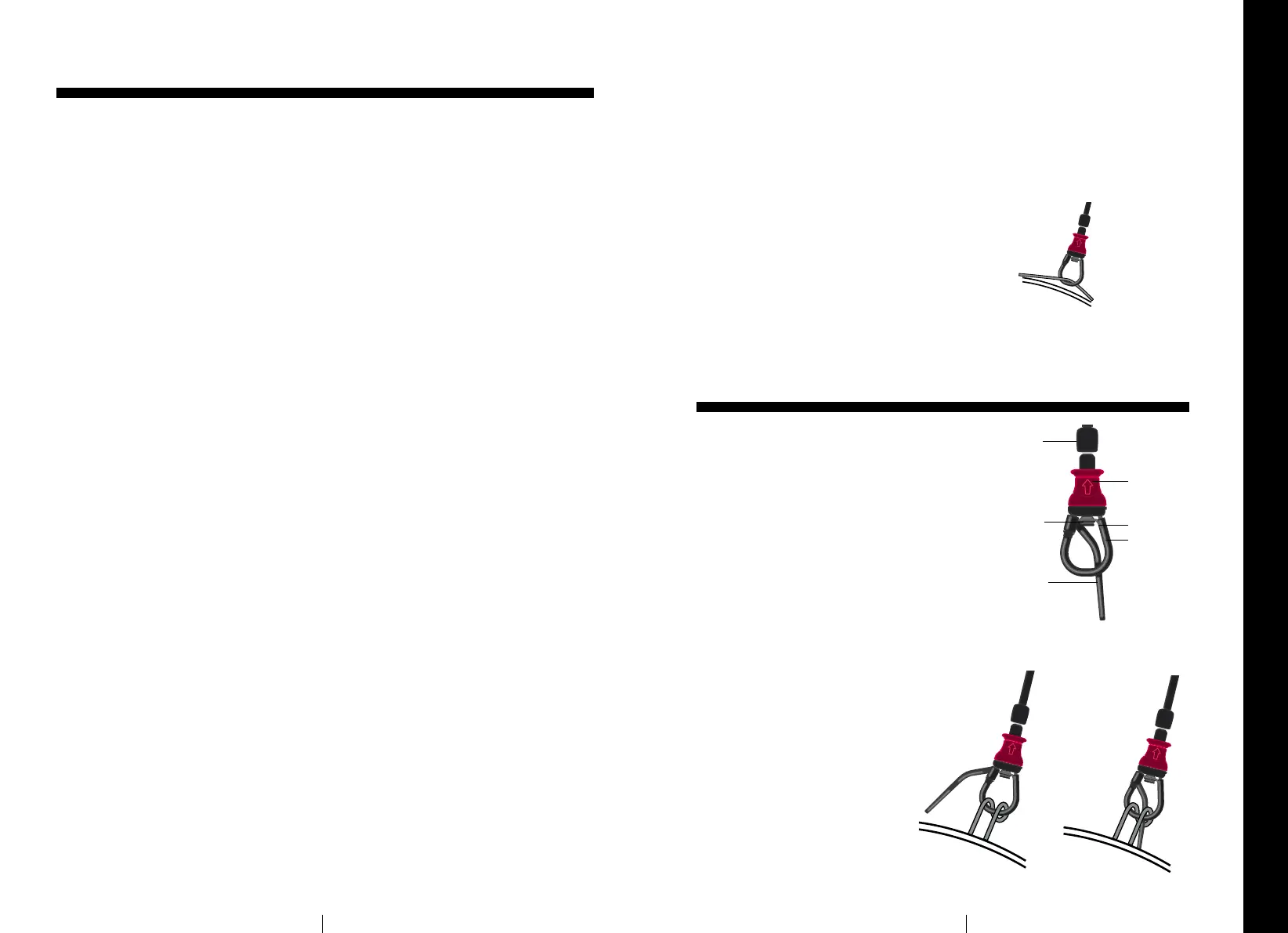
Release handle
Life Line swivel
Life Line ring
Chicken Loop
The new F-ONE quick-release has been
designed to work effectively in most of
the critical situations and can be triggered
under load but also when the lines are
slack. A stopper at the top holds the
kitebar to make sure the system works
even when the bar is pushed towards the
rider and blocked in the lowest position. Its
new push-away system enables to trigger
the release with minimal force.
QUICK-RELEASE
HOW TO HOOK YOURSELF
Finger
Manual swivel
• Under no circumstances can safety procedures
be discovered during an emergency. The use of
safety systems requires training from, a certied
instructor or a kite school.
• Mechanical testing is carried out considering a
user’s maximum weight of 120kg. While there is
no minimum required weight for a user to safely
practice kiting and testing the safety systems, it
is recommended for any user under 35 kg to not
engage with said kiting activities.
• F-ONE safety systems are compatible with
most harnesses on the market. In particular:
systems comprising an open hook, systems
comprising a non-deformable circular ring with
an internal diameter of 24.5 mm minimum,
systems comprising a rope or strap, if its length
is suitable, i.e. is not too tight so that the chicken
loop is not pressed against the harness ; but
enough not to twist around the Chicken Loop.
• WARNING : it can be extremely dangerous to
use F-ONE safety systems in a different manner
than intended
Contact your local dealer in any doubt.
Step 1: Slide the Chicken Loop into the harness
hook.
Step 2: Insert your nger into the opening of
the harness hook provided for this purpose.
You are hooked up to your kite.
Harness hook
1 2
18
19


 To Next Page
 Loading...