7 6
8
3 1
5 4
2
Cassette recorder motor connections should be connected to pins 1 and 7 without connection to the 12V
o/p of the receiver (pin 6). The cassette’s motor control is usually provided by means of a small jack socket.
Reverse connections if cassette motor fails to work, The power supply of the cassette, or the cassettes
batteries should not exceed 12V. Pin 6 and 1 can be connected together to provide a squelch switched 12v
o/p on pin 7. Current is limited to 50 mA with the receiver’s normal power supply or 1A if a 1.5A power
supply is used to power the receiver and the external socket.
The audio connection to the cassette is be made by connecting pins 4 and 5 of the receiver to pins 1 and 4
of the cassette’s din socket, and a ground connection should be made from pin 2 of the receiver to pin 2 of
the cassette. If the cassette has a
jack socket (sometimes labled ‘mic’), pins 4 and 5 of the receiver should be
connected to the centre of the jack and a ground connection should be made between pin 2 of the RD500
and the body of the jack. An open ended cassette lead can be provided by Fairhaven.
RS232 and PC keyboard socket.
Black Ground (metal rim)
RS232 TX 7 6 RS232 RX
to 25 way D, pin 3 to 25 way D, pin 2
8
Audio interface 3 1 Clock (PC Kbd)
To 25 way D, pin 6
(See decode)
Vcc (PC Kbd) 5 4 Ground (common)
3
Data (PC Kbd)
8 NBFM audio
7. RECEIVER SYSTEM
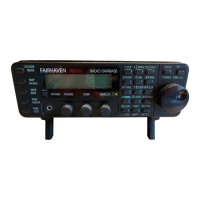
The RD500 is designed as a high performance dual conversion
AM/SSB/FM/Synchronous receiver, with I.F’s at IF 45.000MHz and 455KHz.
It has a versatile processor system with 60K of program ROM and up to 2M
bytes of RAM, which gives the receiver the ability to store entire scanning
directories.
Tuning
It has a low noise PLL tuning system which gives smooth continuous
tuning without periodic plops. It has both digital and analogue phase


 To Next Page