7
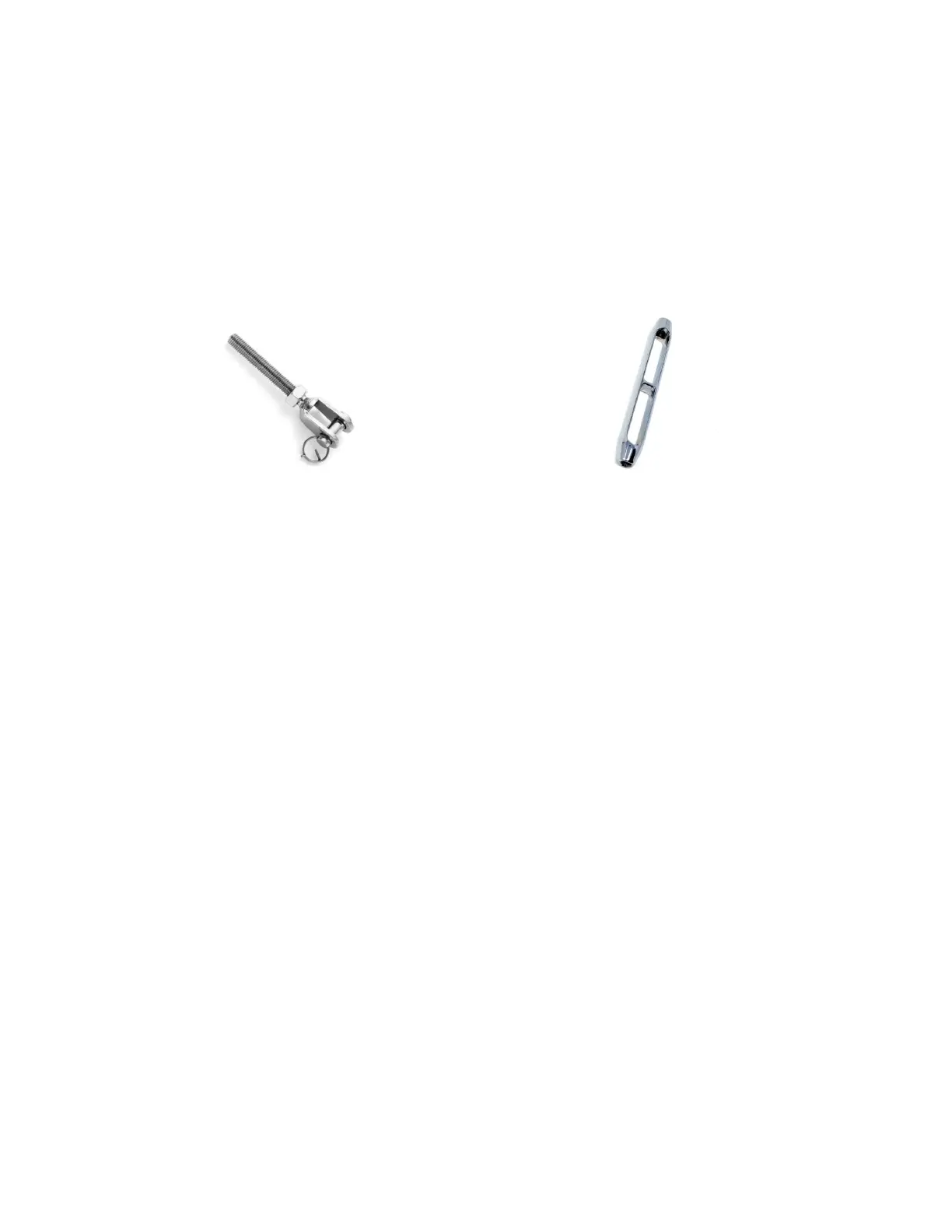
k) Assemble the turnbuckle of the upper side stays to the threaded fork toggle end. The upper
side stays are always attached to the most forward hole of the chain plate. The upper side
stays can either go inside or outside the lifeline. It is important to have it screwed in an
equal amount at the bottom and top of the turnbuckle. Otherwise, one end could be fully
threaded in before the other end. It is also important to not have it fully threaded in as it will
be too tight to raise the mast. Having them one third threaded in is a good reference.
Image 7: Threaded fork toggle end Image 8: Turnbuckle also known as rigging screw
l) The lower side stays do not need to be attached while raising the mast.
m) Insert the forestay T-fork toggle to the fitting at the top of the mast. Remove the cutter pin
and the split pin of the fork toggle at the bottom of the forestay. Make sure they are in a safe
place, and they won’t fall in the water. It is recommended to raise the mast onshore
specifically for this reason. If you have a furler, it is easier to attach the drum to the FE19R
and let the wire of the forestay lose. Otherwise, the drum can do a few scratches on the
deck while raising the mast.
n) Feed the gennaker halyard through the fairlead and cleat.
III. Raising the mast by hand
a) Clear the deck to have less obstacles while raising the mast. The boom, rudder and control
lines are not needed.
b) Make a bowline at the end of the tackline. Take the end of the shackle of the gennaker and tie a
bowline into the bowline of the tackline. It should look like a loop in a loop.
c) Make a knot after the cleat of the tack line. Cleat the tack line. This knot is used to prevent the
tack line to slip if it gets release by accident.
d) Pull all the slack of the gennaker’s halyard.


 To Next Page
 Loading...