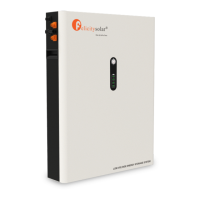
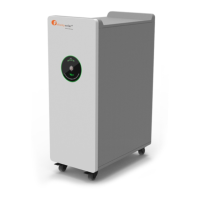
The Felicitysolar LiFePO4 Battery System for Households is a robust and expandable energy storage solution designed primarily for solar power systems in family homes. This user guide provides comprehensive information on its introduction, installation, operation, and emergency situations, ensuring safe and efficient use.
Function Description:
The core function of this system is to store electrical energy, particularly from solar panels, for household use. It features a built-in Battery Management System (BMS) that continuously monitors its operation, preventing the battery from exceeding its design limitations and ensuring its longevity. The system is designed to provide reliable power, contributing to energy independence and timely protection of household applications. Its expandability allows for increased storage capacity by adding more battery packs in parallel connection. The system supports both on-grid and off-grid configurations, with specific instructions for PV wake-up in off-grid scenarios.
Important Technical Specifications:
The manual details specifications for three models: LPBF24200-M, LPBF48200-M, and LPBF48200-P.
- Usable Capacity: LPBF24200-M offers 5KWH, while LPBF48200-M and LPBF48200-P both provide 10KWH.
- Nominal Voltage: LPBF24200-M operates at 25.6V, and the LPBF48200 models at 51.2V.
- Voltage Range: 24-28.8V for LPBF24200-M and 48-57.6V for LPBF48200 models.
- MAX. Charge & Discharge Current: All models support 120A@30S.
- Recommend Charge & Discharge Current: All models recommend ≤80A.
- MAX. Output Power: LPBF24200-M has a maximum output of 3000W, while LPBF48200 models support 6000W.
- Recommend Output Power: 2000W for LPBF24200-M and 4000W for LPBF48200 models.
- DOD (Depth of Discharge): ≥95% for all models, indicating high usable capacity.
- Modules Connection: Supports 1-6 units in parallel.
- Communication: CAN & RS485.
- Ingress Protection: IP21.
- Cycle Life: ≥6000 cycles at 25°C with 80% DOD.
- Working Temperature Range: Discharge: -20°C to +65°C; Charge: +0°C to +55°C.
- Dimensions and Weight:
- LPBF24200-M: Net Weight 38KG, Gross Weight 41.5KG, Product Dimension 450x415x213MM.
- LPBF48200-M: Net Weight 73KG, Gross Weight 78KG, Product Dimension 685x475x213MM.
- LPBF48200-P: Net Weight 70.5KG, Gross Weight 88KG, Product Dimension 755x600x160MM.
Usage Features:
- Parallel Connection: The batteries can be connected in parallel for expansion, allowing users to increase their total energy storage capacity. Series connection is explicitly not allowed. The manual provides detailed schematic diagrams for connecting two or six battery packs in parallel.
- Upright Installation: The units must be installed in an upright position.
- Compatibility: Designed for household photovoltaic systems. It is crucial to use appropriate cable sizes as per the required specifications for optimum operation.
- Controller Compatibility: The batteries are not allowed to be connected with PWM controllers for charging. It is recommended to implement pre-settings for inverters, MPPT charger controllers, or UPS devices that connect with the battery pack.
- Over-discharge Protection: The built-in protection board includes an over-discharge protection function. Users are strongly advised to stop using the load when the battery pack is over-discharged to prevent it from failing to be activated for discharge. Prompt charging is recommended when power is low.
- Easy Operation: The system features a simple On/Off button. A short press switches on the battery, initiating a self-inspection and displaying the State of Charge (SOC) via LED indicators. Pressing and holding the On/Off button for 3 seconds shuts down the battery.
- LED Indicators: A clear LED display provides visual feedback on the battery's status, including power on/off, standby, normal operation, discharge, charge, low power, and fault conditions. The SOC is indicated by a series of LEDs, representing 100%, 75%, 50%, 25%, and flashing for SOC < 10%.
- Communication Ports: Equipped with communication ports (CAN & RS485) for integration with other system components and monitoring. DIP switches (SW1-SW4) are used to set the communication address for parallel operation, and SW5 for termination resistance.
- Off-grid System Integration: For pure off-grid systems, a PV awake wire needs to be connected with the MPPT charge controller if the battery pack is charged solely by solar panels. This enables auto-restart when PV power becomes available.
- Stackability: One group of LPBF48V can be stacked up to 2 layers, and up to 6 units can be connected in parallel.
Maintenance Features:
- Safety Instructions: The manual emphasizes critical safety instructions, including avoiding disassembly, disconnecting all wirings before maintenance, and ensuring installation by qualified personnel. It warns against working with metal tools near batteries to prevent short circuits and explosions.
- Environmental Requirements: Batteries should be installed indoors, away from water, high temperatures, mechanical force, and flames. The recommended operating temperature range is 0°C to 45°C, and humidity should not exceed 80%.
- Regular Charging: To ensure accurate SOC calculation, the battery needs to be fully charged at least once a month.
- Emergency Protocols: Detailed procedures are provided for emergency situations such as fire (SCBA, protective gear, NOVEC 1230, FM-200, or dioxide extinguisher), leaking batteries (evacuate, seek medical attention for inhalation, eye/skin contact, ingestion), and wet batteries (do not access, contact supplier).
- Damaged Batteries: Damaged batteries are deemed dangerous and must be handled with extreme care, packed in their original container, and returned to the supplier.
- Warranty: The product warranty covers operation strictly in accordance with the user manual. Violations, such as product modification, unauthorized repairs, non-compliance with installation standards, improper storage, or transport damage, may void the warranty.

 Need help?
 General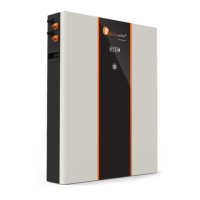

 To Next Page