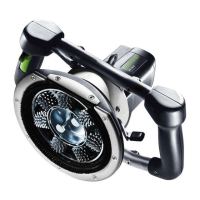
This document describes the Festool Dia grinding system DSG-AG 125, an angle grinder designed for dust-free grinding of mineral materials.
Function Description
The Festool Dia grinding system DSG-AG 125 is primarily used for grinding mineral materials, smoothing unevenness, removing paint, concrete, adhesive, and plaster, as well as preparing surfaces for new coatings. It consists of an angle grinder and an extraction hood, ensuring dust-free operation. The system features electronic controls for maintaining constant revolutions during operation and idle run, as well as for starting current limitation and protection against overloading.
Important Technical Specifications
Exhaust Cover (DCG-AG 125):
- Exhaust hose Ø: 27/36 mm
- Weight: 0.38 kg
Angular Grinder (AG 125-14 DE):
- Voltage: 220-240 V~
- Frequency: 50/60 Hz
- Input: 1400 W
- Idle revolutions: 3500 – 11000 min⁻¹
- Circumferential speed: 80 m/s
- Grinding wheel Ø: max. 125 mm
- Grinding spindle thread: M 14
- Limits to interaction current: Yes
- Revolutions pre-setting: Yes
- Constant electronics: Yes
- Heat protection: Yes
- Weight: 2.3 kg
- Protection level: II/回
Emission Levels (according to EN 60745):
- Sound pressure level: 90 dB (A)
- Sound power level: 101 dB (A)
- Inaccuracy of measurement: K = 3 dB (A)
- Vibration emission value (aₕ): 4.0 m/s²
- Inaccuracy of measurement: K = 1.5 m/s²
The device is designed for operation with a maximum grinding wheel diameter of 125 mm and a spindle thread of M 14. It offers variable speed control, allowing users to adjust revolutions from 3500 to 11000 min⁻¹ to suit different materials and applications.
Usage Features
Assembly and Setup:
- Exhaust Cover: The exhaust cover (1-1) is attached to the grinder. For dust extraction, a Festool vacuum cleaner hose (class M or H) is connected to the suction adapter (1-2).
- Additional Handle: An additional handle (1-8) is provided for safe and non-tiring working posture, especially with the "VIBRASTOP" construction to regulate vibrations.
- Grinding Wheel Fastening: Diamond grinding discs recommended by the manufacturer must be used with the prescribed flanges (4-2, 4-3). The flange (4-2) is mounted with the shoulder out towards the grinding wheel (4-1), and the grinding wheel is then fitted so the flange shoulder fits its aperture. Quick-change nuts are not to be used for clamping the disc. For diamond discs with an inner diameter of 22.2 mm, a spacer ring (4-4) must be inserted.
- Brush Ring: The brush ring (1-10) is assembled as shown in figure 3.
- Gearbox Rotation: For specific applications, the gearbox can be turned in 90° steps to achieve a better handling position of the switch. This requires removing four screws, carefully turning the gearbox, and then re-fastening the screws (5).
- Sliding Front Segment: The sliding front segment (1-11) is used for working close to edges (6).
Operation:
- Switching On/Off: The on/off switch (1-7) is slid forwards to turn on the machine. For continuous operation, pressing the front part of the switch locks it. To switch off, release the switch or press the rear part during continuous operation.
- Revolutions Pre-setting: The revolutions regulator (1-4) allows for smooth pre-setting of revolutions, with settings ranging from 3500 to 11000 min⁻¹.
- Safety Precautions:
- Always pull the plug out of the socket before performing any work on the machine.
- Use protective goggles and ear protection.
- Wear a dust mask and workshop apron to protect against small abrasive or workpiece fragments.
- Ensure the power tool is held by insulated gripping surfaces when there is a risk of contacting hidden wiring or the tool's own cord.
- Position the cord clear of the spinning accessory.
- Never lay the power tool down until the accessory has come to a complete stop.
- Do not run the power tool while carrying it at your side.
- Regularly clean the power tool's air vents.
- Do not operate near flammable materials or use accessories requiring liquid coolants.
- Maintain a firm grip and use the auxiliary handle to resist kickback forces.
- Do not position your body in the area where kickback may occur.
- Use special care when working corners or sharp edges to avoid snagging.
- Do not attach saw chain woodcarving blades or toothed saw blades.
- The machine must not be used in damp/wet spaces or explosive environments.
- Always inspect the flexible lead and plug before use.
- Apply the machine to the material only when switched on.
- Do not carry the machine by the lead or work on a ladder.
- Ensure the material being machined does not contain electric, water, or gas lines.
- Do not mill over metal objects, nails, or screws.
- The machine is not allowed to be operated by persons under 16 years of age.
- For AS/NZS, the tool must be supplied via a residual current device with a rated residual current of 30 mA or less.
- Ensure the direction of rotation marked on the label and diamond tool matches the machine's actual rotation.
- The flange and fastening nuts must be properly tightened.
- Avoid mechanical damage to the diamond tool.
Electronic Features:
- Starting Current Limitation: Ensures smooth acceleration without back thrust.
- Switching Off During Back Thrust: If revolutions suddenly drop (e.g., due to blocking), the motor current stops. The device must be switched off and then on again to restart.
- Protection Against Re-starting: Prevents uncontrolled starting after a power supply cut-off.
- Constant Electronics: Maintains constant revolutions during operation and idle run.
- Overload Protection: The safety electronics switch to a cooling regime if the critical temperature is reached, reducing motor revolutions to approximately 50%. After cooling, the device becomes fully operational.
Maintenance Features
- General Maintenance: All maintenance and repair work requiring the motor housing to be opened must only be carried out by an authorized service workshop.
- Storage: Electric tools should be stored in a dry place without heating, with temperatures not lower than -5°C. Unwrapped tools can be stored in dry places with temperatures not lower than +5°C, without sudden changes in temperature.
- Cooling Openings: Ensure the cooling openings of the motor are always clean and free to maintain sufficient airflow.
- Brushes: The machine is equipped with special self-disconnecting brushes. When worn, the power supply is automatically disconnected, and the machine stops.
- Suction Flange Height Adjustment System: If the suction flange height adjustment system does not operate smoothly, the flange must be removed and cleaned.
- Customer Service: For service and repair, contact Festool customer service or authorized workshops. Use only original Festool spare parts.
- Environment: Do not dispose of the power tool in household waste. Dispose of the machine, accessories, and packaging at an environmentally-responsible recycling center, observing national regulations. In the EU, used electric power tools must be collected separately for environmentally friendly recycling.

 Need help?

 To Next Page
 General