move the abrasive in a different pattern or
to have a different abrasive form factor to
reach different shapes of surfaces.
There are basically three different ways
the abrasive can be moved by a machine
sander: linearly in a fore-aft motion, in
a circle in a rotary motion, or back
and forth in an arc. Festool uses the
first two motions but not the arc motion.
If these motions are combined or the
pivot point is also moved at the same
time, the motion becomes much more
complex. If the pivot point rotates and
the pad is free to move independently but
not forced to move in a defined path, then
the motion is called “random orbit”.
We will discuss each of the different Fes-
tool sanders in terms of how they move
the abrasive from the pure rotary sander
to the various random orbit units.
RAS 115 uses a pure rotary motion
(third from the right in the picture).
LS 130 uses a pure linear back and
forth motion (center one pictured).
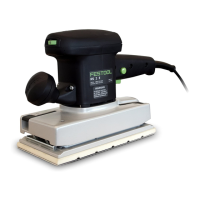
RS 400 (not pictured), DS 400
(second from the right) and RS 2
(third from the left) use an orbital
motion.
DX 93 Deltex (right most pictured)
uses a tight rotary motion.
ETS 150/3 (left most), 150/5 (not
shown), and ETS 125 (not shown)
use a random orbit motion.
RO 150 Rotex (second from the
left) and RO 125 (not pictured) can
be switched between a random or-
bit motion and a rotary motion with
a rotating pivot point.












 To Next Page