Conclusion
In this manual we have looked at nine dif-
ferent Festool sanders which run the
gamut from pure rotary, to pure linear, to
pure orbit, to combinations of all of these.
The different kinds of sanders allow you
to select the optimum abrasive motion for
the work you are doing and the result you
want to achieve.
The question I get all the time is, “Which
should I buy”? I think the best way to
parse that question is the following:
If you are only able to buy one Festool
sander, and you do general woodworking
and furniture making, my recommenda-
tion is to start with the RO 150 or RO
125 Rotex sander. These are the all-
around work horse sanders that, with the
right abrasive materials, can take you
from aggressive sanding and shaping in
the rotary mode through fine finish sand-
ing in the random orbit mode. Switch to
felt pads and rubbing compounds to im-
part a mirror-like shine to your finish or to
apply waxes easily. The one I use the
most is the RO 150 as I like the 150 mm
(6”) sanding surface. The smaller 125
mm RO 125 works just as well, only cov-
ers less ground. Some like the lighter
weight of the RO 125, but I do not find the
RO 150 either heavy or clumsy.
The RO 150 uses a 5mm stroke while the
RO 125 uses a 3.6 mm stroke which can
result in a slightly smoother finish with the
same grit abrasive.
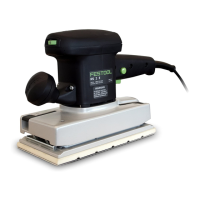
Need to sand large flat surfaces? The
choice is simple - use the RS 2. The
2.5mm stroke and pure rotary motion
coupled with the large (4.5” x 9”) rectan-
gular pad produces an exceptionally
smooth flat surface. It is ideal for panels,
edges or any flat component. It is so
smooth you can sand all day if you need
to without the dreaded tingle in the
hands, wrists or arms. Dust collection is
really good when coupled with any of the
Festool vacuums.
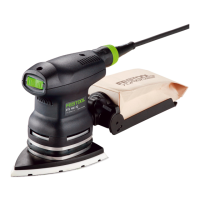
If one is doing model work or trying to
reach small recesses my choice would be
the DX 93 Deltex sander. The small
triangular pad reaches where most other
pad shapes will not. At high speeds such
as the maximum 9,500 RPM its 2.5mm
sanding stroke produces very rapid stock
removal but obviously only over small
surface areas as the pad is only 93mm x
93mm. Slow it down to the low speed of
5,000 RPMs and use a fine grit to pro-
duce very smooth, very controlled sand-
ing on small or fragile components.
Is rapid stock removal or rapid cleaning of
gunk or rust the objective? Go for the
RAS 115. Put on Saphir, Cristal or Ru-
bin abrasives and shape just about any-
thing. Switch to Vlies pads for cleaning,
gunk and rust removal.
Do you need to sand profiles or odd edge
surfaces? If so, there is no substitute for
the LS 130 pure linear sander with all of
the available profile shape pads. Add the
profiling kit and you can easily custom
shape a backer pad to fit nearly any pro-
file.
More and more I am asked to make solid
wood countertops like the ones shown on
the next page. To make them properly
(so they will never warp,) I like to place
sliding dovetails every 150 to 300mm
along the bottom side. This allows the
solid wood top to expand and contract
with normal seasonal changes in humidity
while holding the top from warping over


 To Next Page
 Loading...