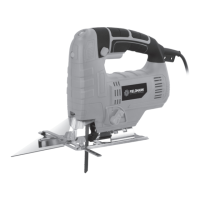
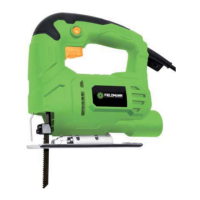
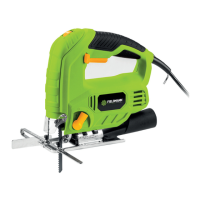
Operation
Saw blade replacement
WARNING! Turn off the jig saw and unplug the power supply cable from the socket.
Select a saw blade as applicable for the material to be cut.
Lift the plastic transparent cover, turn the keyless chuck to the right, insert the blade
all the way (teeth facing you) and release the keyless chuck.
Insert the blade into the blade holder, ensuring that the teeth are pointing forward and the flat
back edge of the blade locates in the guide roller.
Close the protective plastic transparent cover.
Check the blade is correctly positioned in the guide roller and that is sure is secure in the
blade holder.
Dust exhaust
Insert the extraction nozzle into the dust extraction opening at the rear of the saw and twist
anticlockwise to secure. (Clockwise to remove.) Attach a standard vacuum cleaner hose and let
the vacuum collect the dust as you saw. Always use a face mask, even when using the vacuum
extraction system.
Pendulum action control
The pendulum stroke action can be adjusted using the pendulum knob located on the left
hand side of the jig saw, near the blade.
There are four marked settings: 0, 1, 2 and 3
Indications of the best pendulum stroke setting for a particular job are given below:
Sheet metal 0
Steel 0
Plywood 2-3
Aluminium 0
Plastics 1-2
Wood 2-3
Angle sawing
The jig saw can be used to cut at various angles by adjusting the base plate.
Before adjusting the base plate, ensure that the jig saw is unplugged from the mains.
To adjust the base plate, loosen the hexagon bolt on the underside of the jig saw using the
hexagon key.
Slide the base plate forwards, incline it at the desired angle (range: 15°, 30°, 45°)
Tighten the hexagon bolt using the hexagon key.
Operate the same way as for straight cutting, ensuring that the base plate is firmly held flat
against the work piece.
15
OPERATING INSTRUCTIONSELECTRICAL JIG SAW
ENOperation
Straight cutting
Ensure the work piece is firmly secured in a vice or workbench.
Mark a line on the work piece through which the cut is required.
Start up the jig saw and place the front of the base plate onto the work piece.
Align the blade with the cutting mark on the work piece.
Slowly move the jig saw forward along the cutting mark. Press the jig saw down firmly onto
the work piece to prevent the blade from snagging or breaking.
Allow the tool to work at its own pace, letting the blade cut freely - do not force the tool.
Increasing pressure will not result in a faster cut.
Choose an appropriate blade according to the required job and finish, depending on the
type and thickness of the material. Large teeth will give a quick, coarse cut and small teeth
will produce a quality finish.
When cutting thin board, place it on a wood board to help absorb vibrations
ON/OFF switch
The on/off switch (1) is located in the saw handle.
Depress the trigger switch to turn on the jig saw.
The on/off switch can be locked with the locking button on the side of the saw handle.
To unlock the switch, depress the switch button again. Always ensure that the switch is in the
off position before connecting the tool to the mains. Always disconnect the tool from the
mains when not in use.
Speed control
The speed of the machine can be adjusted by operating the speed control wheel on the front
of handle.
To increase the speed, turn the wheel forward, and to decrease the speed, turn the wheel
backwards.
Cleaning and Storing Instructions
WARNING! Prior to maintenance and cleaning, ensure the power is disconnected from
the saw. Unplug the power cable from the power supply network. Use only mild soap and a
slightly damp cloth to clean your saw. Many household cleaners contain chemicals which
could seriously damage the plastic. Do not use petrol, turpentine, lacquer or paint thinners
or similar products to clean the machine. Never let any liquid get inside the tool and never
immerse any part of your saw into liquid.
Never use water or other liquids to clean the electrical parts of the tool.
Always clean the tool after use.
Ensure the ventilation slots do not become blocked to prevent overheating.


 To Next Page
 Loading...