1716
4 . Turn
on power to the circuit
and
read the display.
5 . After measuring current, turn off power to the
circui
t
and
discharge all high-
voltage
capacitors
.
Dis connec
t
the meter and restore the circuit to normal
o p e r a t i o n .
Tips for measuring current
When
measuring a 3-phase
system, special at
t
ention
should be taken to the
phase to phase voltage which is
significan
t
ly higher than the phase
t
o earth
voltage. To avoid exceeding the vol
t
age rating of the protecti on fus e(s)
accidentally, always consider the phase to phase voltage as the working
vol
t
age
for the protec
t
ion fuse(s).
When measuring current, the meter’s internal shunt resis
t
ors develop a vol
t
age
across the me
t
er’s terminals called “burden voltage”.
This voltage
drop may affect precision circuits or measurements.
Current (
,
,
)
Measurements
Current is
the flow of
electrons through a conductor. To measure current, you must
open
t
he circuit under test,
then
place the me
t
er
in
series with the circuit.
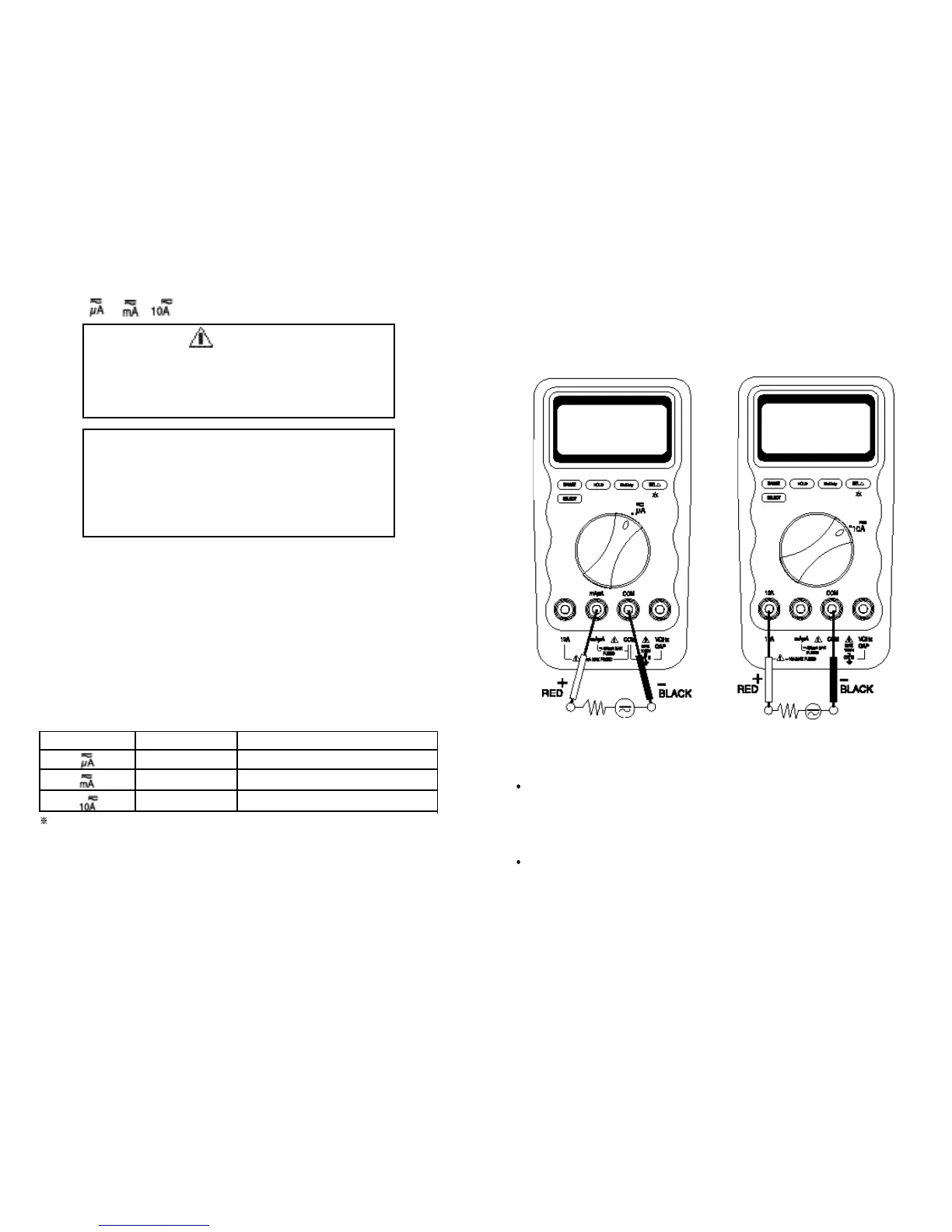
The available current ranges are :
400.0
µA, 4000 µA, 40.00
mA, 400.0
mA, 4.000
A, and 10.00 A
The
meter defaults a
t
d c. Press S E L E C T button momentarily to select a c .
To measure dc o
r
ac current,
1 . Turn of
f
power to the circuit and discharge all high-voltage capacitors.
2 .
I
nser
t
the black lead into
the C O M terminal and the red lead in
t
o an
input
terminal appropriate for
t
he measurement range as the following table.
To avoid blowing the meter’s 440 mA fuse, use the mAµA terminal only if
you are sure the
current is less
t
han 400 mA.
3 . Open the current path to
be tes
t
ed. Touch the red probe
t
o the more positive
side of the break and touch the black probe to the more negative side of the
break. (Reversing the leads will produce a negative reading, but will
not damage
the meter.)
Warning
Never a
t
tempt an in-circuit current measurement where the
open-circuit potential to earth is greater than 1000V. You may
damage the meter or be injured if the fuse blows during such
a measurement.
Caution
Check the meter
f
uses before measuring
current.
Use the
proper terminals ,
functi on,
and
range for c urrent
measurements. Never
place the probes in parallel wi
t
h any
circuit or component when the test leads are plugged into the
current terminals.
Range RangesInput
mAµA
mAµA
10A
400.0 µA, 4000 µA
40.00 mA, 400.0 mA
4.000 A, 10.00 A
SERIES CONNECTION SER
I
ES CONN
E
CTION


 To Next Page
 Loading...