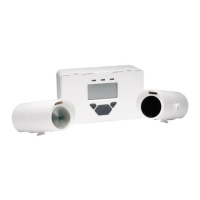
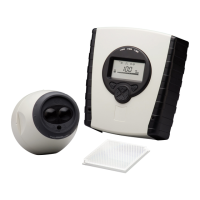
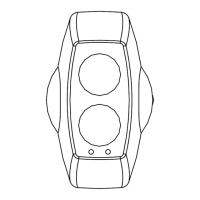
The Fireray FD2705R/FD2710R is a loop-powered, analogue addressable reflective beam smoke detector designed for the detection of smoke in large, open areas. It comprises a transmitter and receiver housed within a single enclosure, making installation and alignment simpler compared to traditional separate transmitter/receiver units. The detector operates by emitting an invisible infrared light beam that is reflected by one or more prisms mounted directly opposite the detector. The reflected light is then detected and analyzed by the receiver.
Function Description
The core function of the Fireray FD2705R/FD2710R is to detect smoke by monitoring the attenuation of its infrared light beam. When smoke enters the beam path, it reduces the amount of infrared light reaching the receiver. The detector continuously analyzes this obscuration. If the received infrared signal drops below a pre-selected alarm threshold for approximately 10 seconds, a fire condition is activated.
The detector offers selectable alarm thresholds of 25%, 35%, and 50% obscuration, allowing installers to tailor its sensitivity to the specific environment. A 25% threshold is the most sensitive, while a 50% threshold is recommended for exceptionally dirty or hostile environments where nuisance alarms might be a concern. For compliance with BS5839 part 5, 25% and 35% thresholds are typically used.
In addition to fire detection, the device also monitors for fault conditions. If the infrared beam is rapidly obscured to 90% or greater for approximately 10 seconds, a fault condition is activated. This can occur due to various reasons, such as an object blocking the beam path, transmitter failure, loss of the prism(s), or sudden misalignment of the detector. A fault condition will automatically reset within 5 seconds once the obstruction is removed or the issue is rectified.
The detector incorporates automatic contamination compensation, a crucial maintenance feature. It continuously monitors for long-term degradation of the signal strength, which can be caused by component aging or the gradual build-up of dirt on the optical surfaces. This is achieved by comparing the received infrared signal against a standard every 15 minutes. Differences of less than 0.7dB per hour are automatically corrected. Even if the detector indicates an AGC (Automatic Gain Control) fault, it will continue to operate correctly, indicating alarm and fault conditions as normal. This ensures consistent performance over time without requiring frequent manual adjustments for minor environmental changes.
Usage Features
The Fireray FD2705R/FD2710R is designed for ease of installation and alignment, particularly in large spaces.
- Range: The FD2705R model is suitable for ranges from 5 to 50 meters, utilizing one prism for reflection. The FD2710R model extends this capability to ranges from 50 to 100 meters, requiring four prisms. This flexibility allows the system to be deployed in a wide variety of building sizes and layouts.
- Microprocessor Controlled: The detector is microprocessor-controlled, enabling advanced signal processing, automatic compensation, and reliable operation.
- Unique Simple Alignment: Alignment is a critical step in beam detector installation, and this device features a unique, simple alignment process. Mechanical alignment is achieved using two adjustment thumbwheels for horizontal and vertical adjustments. The alignment process involves two modes: "Prism Targeting Mode" and "Alignment Mode."
- In Prism Targeting Mode, the installer adjusts the thumbwheels to locate the prism(s). The Red and Amber LEDs on the detector provide feedback: a flashing Red LED indicates a weak signal, while a flashing Amber LED indicates a strong enough signal. A crucial step here is to confirm that the prism(s), and not another reflective surface, are reflecting the beam by temporarily covering the prism(s).
- In Alignment Mode, the detector automatically adjusts its infrared beam power and receiver sensitivity to achieve an optimum signal strength. The indicator lamp's color and state (flashing Red, flashing Amber, OFF, or flickering Red/Amber) guide the installer through the fine-tuning process. Flashing Red indicates too much signal, prompting the detector to reduce power, while flashing Amber indicates a weak signal, leading to increased power. The goal is to reach an "OFF" state, signifying optimized power and receiver gain. The alignment process is iterative, involving adjusting one thumbwheel until the LEDs stop flashing, then repeating for the other.
- Loop Powered: Being loop-powered simplifies wiring and reduces installation costs, as it draws power directly from the fire alarm control panel loop.
- Mounting: The detector head assembly must be mounted on a solid structure between 0.3 and 0.6 meters below the ceiling and no closer than 0.5 meters to an adjacent wall or structure. The prism(s) must also be mounted on a solid structure, 90 degrees to the beam path, and importantly, not on glass or a polished reflective surface, which could cause false reflections.
- Sloping Ceilings: For sloping ceilings, specific guidelines are provided for detector positioning in the apex. If the distance from the apex to the intersection of the ceiling and adjacent wall is greater than 0.6 meters, the ceiling is considered sloping. Positioning the detector in the apex can increase the lateral beam coverage (Y) based on the angle of pitch (Φ), extending beyond the typical 7.5 meters either side of the beam. A graph is provided to determine when the Fireray must be positioned in the roof apex based on the width of the room.
- Smoke Layering Mitigation: To overcome smoke layering effects, where smoke may not reach ceiling level due to static hot air, the detector is mounted at the recommended height below the ceiling (0.3 to 0.6 meters). This positions the infrared beam within the smoke layer, ensuring earlier detection.
Maintenance Features
While the detector is designed for minimal maintenance, certain aspects contribute to its long-term reliability and ease of servicing:
- Automatic Contamination Compensation: As mentioned, this feature actively compensates for gradual signal degradation due to dirt build-up or component aging, reducing the need for frequent manual cleaning or recalibration.
- Status Indication LEDs: The detector includes Red and Amber LEDs that provide clear status indications:
- Red LED indicates a FIRE condition (set and cleared by the panel).
- Amber LED flashing once every 2 seconds indicates a FAULT condition.
- Amber LED flashing once every 10 seconds indicates normal operating mode.
These visual indicators aid in quick troubleshooting and verification of the detector's operational status.
- System Testing: After installation and alignment, the system requires testing for both alarm and fault conditions.
- Alarm (Smoke) Test: This is performed using a dual test filter. The installer selects the obscuration mark on the filter corresponding to the chosen alarm threshold (e.g., 35%). Placing this filter over the receiver optics should trigger a fire indication within 10 seconds.
- Fault Test: This is performed by completely covering the prism(s) with a non-reflective material. The detector should indicate a fault condition (Amber LED flashing) within approximately 10 seconds. The fault should automatically reset within 2 seconds of removing the obstruction.
- DIP Switch Settings: Configuration settings, including alarm thresholds and address settings, are accessed via DIP switches located behind the detector's back plate. This allows for easy adjustment of operational parameters without complex programming tools.
- Removable Cover: The outer cover can be removed during installation to prevent damage, and it can be easily replaced, facilitating access to internal components for wiring and settings adjustments.
The Fireray FD2705R/FD2710R is a robust and intelligent beam smoke detector, offering reliable fire detection in challenging environments through its advanced features, simplified alignment, and self-compensating capabilities.

 Need help?
 General

 To Next Page