BASIC SAFETY INFORMATION
• Dangers, Warnings, and Cautions alert you to important
operating instructions or to potentially hazardous situations.
Pay special attention to these items.
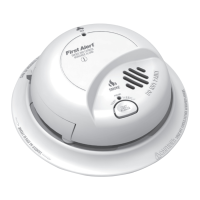
• This Smoke/CO Alarm is approved for use in single-family
residences. It is NOT designed for marine or RV use.
•
This combination Smoke/Carbon Monoxide Alarm has two
separate alarms. The CO Alarm is not designed to detect fire
or any other gas. It will only indicate the presence of carbon
monoxide gas at the sensor. Carbon monoxide gas may be
present in other areas. The Smoke Alarm will only indicate
the presence of smoke that reaches the sensor. The Smoke
Alarm is not designed to sense gas, heat or flames.
• This unit will not operate without battery power. The Smoke/
CO Alarm cannot work until you activate the battery power
pack.
• NEVER ignore any alarm. See “If Your Smoke/CO Alarm
Sounds” for more information on how to respond to an
alarm. Failure to respond can result in injury or death.
• The Silence Features are for your convenience only and will
not correct a problem. See “Using the Silence Features” for
details. Always check your home for a potential problem
after any alarm. Failure to do so can result in injury or death.
• Test this Smoke/CO Alarm once a week. If the Alarm ever
fails to test correctly, have it replaced immediately! If the
Alarm is not working properly, it cannot alert you to a prob-
lem.
• This product is intended for use in ordinary indoor loca-
tions of family living units. It is not designed to measure CO
levels in compliance with Occupational Safety and Health
Administration (OSHA) commercial or industrial standards.
Individuals with medical conditions that may make them
more sensitive to carbon monoxide may consider using
warning devices which provide audible and visual signals
for carbon monoxide concentrations under 30 ppm. For
additional information on carbon monoxide and your medical
condition contact your physician.
SYMPTOMS OF CO POISONING
These symptoms are related to CO POISONING and should be
discussed with ALL household members.
Mild Exposure: Slight headache, nausea, vomiting, fatigue (“flu-like”
symptoms).
Medium Exposure: Throbbing headache, drowsiness, confusion, fast
heart rate.
Extreme Exposure: Convulsions, unconsciousness, heart and lung
failure. Exposure to Carbon Monoxide can cause brain damage, death.
This CO Alarm measures exposure to CO over time. It alarms if CO
levels are extremely high in a short period of time, or if CO levels reach
a certain minimum over a long period of time. The CO Alarm generally
sounds an alarm before the onset of symptoms in average, healthy
adults. Why is this important? Because you need to be warned of a
potential CO problem while you can still react in time. In many reported
cases of CO exposure, victims may be aware that they are not feeling
well, but become disoriented and can no longer react well enough to
exit the building or get help. Also, young children and pets may be the
first affected. The average healthy adult might not feel any symptoms
when the CO Alarm sounds. However, people with cardiac or respiratory
problems, infants, unborn babies, pregnant mothers, or elderly people
can be more quickly and severely affected by CO. If you experience
even mild symptoms of CO poisoning, consult your doctor immediately!
REGULATORY INFORMATION FOR SMOKE/CO ALARMS
REGULATORY INFORMATION FOR CO ALARMS
WHAT LEVELS OF CO CAUSE AN ALARM?
Underwriters Laboratories Inc. Standard UL2034 requires residential CO Alarms to sound when exposed to levels of CO and exposure times as
described below. They are measured in parts per million (ppm) of CO over time (in minutes).
UL2034 Required Alarm Points*:
• If the alarm is exposed to 400 ppm of CO, IT MUST ALARM BETWEEN 4 and 15 MINUTES.
• If the alarm is exposed to 150 ppm of CO, IT MUST ALARM BETWEEN 10 and 50 MINUTES.
• If the alarm is exposed to 70 ppm if CO, IT MUST ALARM BETWEEN
60 and 240 MINUTES.
* Approximately 10% COHb exposure at levels of 10% to 95% Relative Humidity (RH).
The unit is designed not to alarm when exposed to a constant level
of 30 ppm for 30 days.
CO Alarms are designed to alarm before there is an immediate life threat. Since you cannot see or smell CO, never assume it’s not present.
• An exposure to 100 ppm of CO for 20 minutes may not affect
average, healthy adults, but after 4 hours the same level may cause headaches.
• An exposure to 400 ppm of CO may cause headaches in average, healthy adults after 35 minutes, but can cause death after 2 hours.
Standards: Underwriters Laboratories Inc. Single and Multiple Station carbon monoxide alarms UL2034.
According to Underwriters Laboratories Inc. UL2034, Section 1-1.2: “Carbon monoxide alarms covered by these requirements are intended to respond
to the presence of carbon monoxide from sources such as, but not limited to, exhaust from internal-combustion engines, abnormal operation of fuel-fired
appliances, and fireplaces. CO Alarms are intended to alarm at carbon monoxide levels below those that could cause a loss of ability to react to the dan-
gers of Carbon Monoxide exposure.” This CO Alarm monitors the air at the Alarm, and is designed to alarm before CO levels become life threatening. This
allows you precious time to leave the house and correct the problem. This is only possible if Alarms are located, installed, and maintained as described in
this manual.
Gas Detection at Typical Temperature and Humidity Ranges: The CO Alarm is not formulated to detect CO levels below 30 ppm typically. UL test-
ed for false alarm resistance to Methane (500 ppm), Butane (300 ppm), Heptane (500 ppm), Ethyl Acetate (200 ppm), Isopropyl Alcohol (200 ppm) and
Carbon Dioxide (5000 ppm). Values measure gas and vapor concentrations in parts per million.
Audible Alarm: 85 dB minimum at 10 feet (3 meters).
How to Obtain Warranty Service
Service: If service is required, do not return the product to your retailer. In order to obtain warranty service, contact the Consumer Affairs Division at
1-800-323-9005, 7:30 AM - 5:00 PM Central Standard Time, Monday through Friday. To assist us in serving you, please have the model number and
date of purchase available when calling.
For Warranty Service return to: BRK Brands, Inc., 1301 Joe Battle El Paso, TX 79936
Disposal: Waste electrical products should not be disposed of with regular household waste. Please recycle where facilities exist.
Check local requirements for disposal of Li-Ion electronic devices.
The Alarm should be deactivated before disposal. See page 3, step 11.
You can also return your Alarm to us for disposal. For return address see above.
Please include a note confirming the product is being returned for disposal.
This Smoke/CO Alarm is intended for residential use. It is not intended
for use in industrial applications where Occupational Safety and Health
Administration (OSHA) requirements for Carbon Monoxide Alarms must
be met. The Smoke Alarm portion of this device is not intended to alert
hearing impaired residents. Special purpose Smoke Alarms should be
installed for hearing impaired residents (CO Alarms are not yet available
for the hearing impaired).
Smoke/CO Alarms may not waken all individuals. Practice the
escape plan at least twice a year, making sure that everyone is involved
– from kids to grand-parents. Allow children to master fire escape
planning and practice before holding a fire drill at night when they are
sleeping. If children or others do not readily waken to the sound of the
Smoke/CO Alarm, or if there are infants or family members with mobility
limitations, make sure that someone is assigned to assist them in fire
drill and in the event of an emergency. It is recommended that you hold
a fire drill while family members are sleeping in order to determine their
response to the sound of the Smoke/CO Alarm while sleeping and
to determine whether they may need assistance in the event of an
emergency.
Smoke
/CO
Alarms cannot work without power. Battery operated
units cannot work if the batteries are missing, disconnected or dead, if
the wrong type of batteries are used, or if the batteries are not installed
correctly. AC units cannot work if the AC power is cut off for any reason
(open fuse or circuit breaker, failure along a power line or at a power
station, electrical fire that burns the electrical wires, etc.). If you are
concerned about the limitations of battery or AC power, install both
types of units.
This Smoke/CO Alarm will not sense smoke or CO that does not
reach the sensors. It will only sense smoke or CO at the sensor.
Smoke or CO may be present in other areas. Doors or other obstruc-
tions may affect the rate at which CO or smoke reaches the sensors.
If bedroom doors are usually closed at night, we recommend you
install an alarm device (Combination CO and Smoke Alarm, or separate
CO Alarms and Smoke Alarms) in each bedroom and in the hallway
between them.
This Smoke/CO Alarm may not sense smoke or CO on another
level of the home. Example: This alarm device, installed on the second
floor, may not sense smoke or CO in the basement. For this reason,
one alarm device may not give adequate early warning. Recommended
minimum protection is one alarm device in every sleeping area, every
bedroom, and on every level of your home. Some experts recommend
battery powered Smoke and CO Alarms be used in conjunction with
interconnected AC powered Smoke Alarms. For details, see “About
Smoke Alarms” for details.
Smoke/CO Alarms may not be heard. The alarm horn loudness
meets or exceeds current UL standards of 85 dB at 10 feet (3 meters).
However, if the Smoke/CO Alarm is installed outside the bedroom, it
may not wake up a sound sleeper or one who has recently used drugs
or has been drinking alcoholic beverages. This is especially true if the
door is closed or only partly open. Even persons who are awake may
not hear the alarm horn if the sound is blocked by distance or closed
doors. Noise from traffic, stereo, radio, television, air conditioner, or
other appliances may also prevent alert persons from hearing the alarm
horn. This Smoke/CO Alarm is not intended for people who are hearing
impaired.
The Alarm may not have time to alarm before the fire itself caus-
es damage, injury, or death, since smoke from some fires may
not reach the unit immediately. Examples of this include persons
smoking in bed, children playing with matches, or fires caused by
violent explosions resulting from escaping gas.
This Smoke/CO Alarm is not a substitute for life insurance.
Though this Smoke/CO Alarm warns against increasing CO levels or
the presence of smoke, BRK Brands, Inc. does not warrant or imply in
any way that they will protect lives. Homeowners and renters must still
insure their lives.
This Smoke/CO Alarm has a limited life. Although this Smoke/CO
Alarm and all of its parts have passed many stringent tests and are
designed to be as reliable as possible, any of these parts could fail at
any time. Therefore, you must test this device weekly. The unit should
be replaced immediately if it is not operating properly.
This Smoke/CO Alarm is not foolproof. Like all other electronic
devices, this Smoke/CO Alarm has limitations. It can only detect smoke
or CO that reaches the sensors. It may not give early warning of the
source of smoke or CO is in a remote part of the home, away from the
alarm device.
GENERAL LIMITATIONS OF SMOKE/CO ALARMS
ABOUT SMOKE ALARMS
Battery (DC) operated Smoke Alarms: Provide protection even when
electricity fails, provided the batteries are fresh and correctly installed.
Units are easy to install, and do not require professional installation.
AC powered Smoke Alarms: Can be interconnected so if one unit
senses smoke, all units alarm. They do not operate if electricity fails.
AC with battery (DC) back-up: will operate if electricity fails, provided
the batteries are fresh and correctly installed. AC and AC/DC units
must be installed by a qualified electrician.
Smoke/CO Alarms for Solar or Wind Energy users and battery
backup power systems: AC powered Smoke/CO Alarms should only
be operated with true or pure sine wave inverters. Operating this Alarm
with most battery-powered UPS (uninterruptible power supply) products
or square wave or “quasi sine wave” inverters will damage the Alarm.
If you are not sure about your inverter or UPS type, please consult with
the manufacturer to verify.
Smoke Alarms for the hearing impaired: Special purpose Smoke
Alarms should be installed for the hearing impaired. They include a
visual alarm and an audible alarm horn, and meet the requirements of
the Americans With Disabilities Act. Can be interconnected so if one unit
senses smoke, all units alarm.
Smoke alarms are not to be used with detector guards unless the
combination has been evaluated and found suitable for that purpose.
All these Smoke Alarms are designed to provide early warning of fires
if located, installed and cared for as described in the user’s manu-
al, and if smoke reaches the Alarm. If you are unsure which type of
Smoke Alarm to install, refer the National Fire Protection Association
(NFPA) Standard 72 (National Fire Alarm and Signaling Code) and
NFPA 101 (Life Safety Code). National Fire Protection Association,
One Batterymarch Park, Quincy, MA 02269-9101. Local building codes
may also require specific units in new construction or in different areas
of the home.
SPECIAL COMPLIANCE CONSIDERATIONS
This Smoke Alarm is suitable for use in apartments, condominiums,
townhouses, hospitals, day care facilities, health care facilities, boarding
houses, group homes and dormitories provided a primary fire detection
system already exists to meet fire detection requirements in common
areas like lobbies, hallways, or porches. Using this Smoke Alarm in
common areas may not provide sufficient warning to all residents or
meet local fire protection ordinances/regulations.
This Smoke Alarm alone is not a suitable substitute for complete fire
detection systems in places housing many people—like apartment
buildings, condominiums, hotels, motels, dormitories, hospitals, health
care facilities, nursing homes, day care facilities, or group homes of
any kind. It is not a suitable substitute for complete fire detection
systems in warehouses, industrial facilities, commercial buildings, and
special-purpose non-residential buildings which require special fire
detection and alarm systems. Depending on the building codes in your
area, this Smoke Alarm may be used to provide additional protection in
these facilities.
In new construction, most building codes require the use of AC or AC/
DC powered Smoke Alarms only. In existing construction, AC, AC/DC,
or DC powered Smoke Alarms can be used as specified by local build-
ing codes. Refer to NFPA 72 (National Fire Alarm and Signaling Code)
and NFPA 101 (Life Safety Code), local building codes, or consult your
Fire Department for detailed fire protection requirements in buildings not
defined as “households”.
HUD MAP Program
Certain HUD battery powered Smoke Alarm applications, especial-
ly those that fall under HUD 223(f) MAP (Multi-family Accelerated
Processing), may require a 10 Year sealed tamper resistant battery.
This alarm does not meet that requirement. Substitute First Alert
SA340B.
FCC Compliance
This equipment has been tested and found to comply with the limits for
a Class B digital device, pursuant to Part 15 of the FCC rules. These
limits are designed to provide reasonable protection against harmful
interference in a residential installation. This equipment generates, uses
and can radiate radio frequency energy and, if not installed and used
in accordance with the instructions, may cause harmful interference to
radio communications.
However, there is no guarantee that the interference will not occur in a
particular installation. If this equipment does cause harmful interference
to radio or television reception, which can be determined by turning
the equipment off and on, the user is encouraged to try to correct the
interference by one or more of the following measures:
• Reorient or relocate the receiving antenna.
• Increase the separation between the equipment and receiver.
• Connect the equipment into an outlet on a circuit different from that
of the receiver.
• Consult the dealer or an experienced radio or TV technician for
help.
Warning: Changes or modifications to the product, not expressly
approved by First Alert / BRK Brands, Inc., could void the user’s
authority to operate the equipment.
This device complies with Part 15 of the FCC Rules. Operation is
subject to the following two conditions: (1) this device may not cause
harmful interference, and (2) this device must accept any interference
received, including interference that may cause undesired operation.


 To Next Page
 Loading...