Need help?
Do you have a question about the First Co HBC and is the answer not in the manual?
General warnings for installers, service personnel, and owners regarding product alteration and installation.
Important notes for installers before starting the installation process.
Safety precautions and guidance for installation, adjustment, alteration, service, and maintenance.
Explains the general safety-alert symbol and electrical shock hazard symbol.
Defines WARNING for injury/death, CAUTION for damage, and NOTE for suggestions.
Manufacturer disclaimers, installation rules, and safety practices during construction.
Inspect shipments for damage and adhere to all applicable installation codes.
Warning about unit weight and need for multiple people to prevent injury or death.
Emphasizes licensed contractor installation and general precautions.
Covers tool use, electrical safety, nameplate review, soldering, rotating parts, leveling, drain checks, filter, and air distribution.
Installer must follow all local and national code requirements for installation.
Guidelines for free return installation, ensuring sealed spaces and proper access.
Notes on secondary drain pans and condensate overflow shut-off switches.
Instructions for securely mounting the fan coils using provided slots and hardware.
Ductwork installation must comply with NFPA codes and be adequately insulated.
Duct systems must be sized correctly and insulated according to standards.
Critical warnings about electrical shock hazards during servicing and installation.
Field wiring must comply with codes; review wiring diagrams and nameplate data.
Units use a Class 2 transformer; avoid interconnecting multiple transformers.
Precautions for flushing, soldering, supporting pipes, expansion, and valve insulation.
Caution that hydronic systems are tested with water, not air, to prevent damage.
Instructions for piping installation, sizing, and compliance with codes.
Caution against bending coil header tubing to prevent fractures and leaks.
Purge external piping of debris before connecting to the fan coil.
Chilled water piping requires insulation to prevent condensation damage.
Condensate drain lines need proper slope, traps, and periodic checks for drainage.
Contractor must insulate lines and valve packages to prevent condensate drippage.
Consider noise transfer to the conditioned space from fan coil units.
Procedure for attaching and installing two-way motorized valve assemblies.
Procedure for mounting and installing three-way motorized valve assemblies.
Warnings regarding proper electrical grounding and avoiding rotating components.
Wire thermostats and switches per diagrams to avoid damage and voiding warranties.
A checklist of essential checks before starting the fan coil unit operation.
Annual inspection and cleaning of the fan for balance and vibration.
Check motor connections for security and adherence to wiring diagrams.
Warning for ECM motors: power is always applied, requiring disconnection before servicing.
Air filters require cleaning or replacement every 30 days or more often if conditions require.
Coil heat transfer surfaces must be kept clean using compressed air or water flushing.
Maintenance of drain piping, including slope, disposal point, and periodic checks.
Establish and maintain a formal schedule for regular preventative maintenance.
Information on obtaining the latest Maintenance Program log.
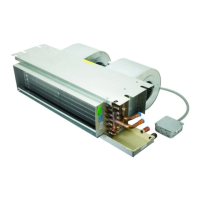
This document provides installation, operation, and maintenance instructions for HBC(X), PHBC(X), RHBC(X), and CHBC(X) Horizontal Hydronic Fan Coil Units.
These units are horizontal hydronic fan coil units designed for indoor installation, typically above a dropped ceiling. They are designed to provide heating and cooling by circulating either hot or chilled water through a hydronic coil. The fan circulates air over the coil, transferring heat to or from the conditioned space. The units are listed for installation with zero clearance to combustible materials, including the fan coil cabinet, discharge plenum, and connecting ducts.

 To Next Page
 General