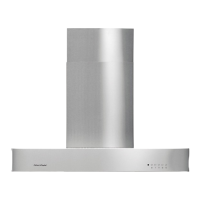
This document describes the installation and features of the Fisher & Paykel Integrated Insert Rangehood, specifically models HP60IDCHX4 and HP90IDCHX4, which are contemporary-style rangehoods designed for integration into cabinetry.
Function Description:
The Fisher & Paykel Integrated Insert Rangehood is designed to extract cooking fumes, grease, and odors from the kitchen environment. It can be configured for either ducted (vented to the outside) or recirculated (filtered and returned to the kitchen) operation. The rangehood is intended to be installed above a cooktop, with specific height requirements to ensure optimal performance and safety.
Important Technical Specifications:
Product Dimensions (HP60IDCHX4):
- Overall height of rangehood without ducting adapter: 316 mm
- Overall height of rangehood with ducting adapter: 361 mm
- Overall width of rangehood: 530 mm
- Overall depth of rangehood (excl. cabinetry front pane): 280 mm
- Diameter of ducting adapter: 150 mm
- Width of rangehood chassis: 498 mm
- Depth of rangehood chassis: 258 mm
- Thickness of fascia: 2 mm
- Distance from ducting outlet centre to rear of chassis: 152 mm
- Height adjustability of clip that secures cooker hood (cabinet base panel thickness): min 15 mm, max 40 mm
- Distance from rear to centre of light: 253 mm
Product Dimensions (HP90IDCHX4):
- Overall height of rangehood without ducting adapter: 316 mm
- Overall height of rangehood with ducting adapter: 361 mm
- Overall width of rangehood: 830 mm
- Overall depth of rangehood (excl. cabinetry front pane): 280 mm
- Diameter of ducting adapter: 150 mm
- Width of rangehood chassis: 792 mm
- Depth of rangehood chassis: 258 mm
- Thickness of fascia: 2 mm
- Distance from ducting outlet centre to rear of chassis: 152 mm
- Height adjustability of clip that secures cooker hood (cabinet base panel thickness): min 15 mm, max 40 mm
- Distance from rear to centre of light: 253 mm
Cavity Dimensions Standard Installation:
- Width of cutout: 500 mm (for HP60IDCHX4), 800 mm (for HP90IDCHX4)
- Depth of cutout: 260 mm (for both models)
Minimum Distance Above Cooktops:
- Minimum height from top of cooktop to base of product: 600 mm. This height may be greater depending on the cooktop. Refer to cooktop installation guide for details.
Electrical Requirements:
- Frequency: 50 Hz
- Voltage: 220 - 240 V
Weight Hazard:
- Product weight: 9kg (HP60) and 11kg (HP90).
Usage Features:
Installation Flexibility:
The rangehood supports both ducted and recirculated installations.
- Ducted Installation: Requires 150mm rigid or semi-rigid ducting, a 150mm outlet, and a duct outlet (soffit, wall, or roof). This method vents air outside the home.
- Recirculation Installation: Requires two 793599 Carbon filters and a recirculation outlet. This method filters the air and returns it to the kitchen.
Cooktop Compatibility:
The rangehood is designed to work with various cooktop types. For induction cooktops, it's noted that they use energy-efficient technology that only heats the contents of a cooking pot, meaning the surrounding air does not get heated when using an induction cooktop. This reduces the likelihood of condensation on cooler surfaces. For other cooktop types (e.g., gas or radiant electric), the rangehood filters, splashbacks, and surrounding cabinetry do not get warmed up, increasing the likelihood of condensation on these cooler surfaces.
Condensation Management:
Condensation can be minimized by:
- Using the rangehood on a lower speed setting when boiling.
- Using the induction cooktop on a lower heat setting when boiling.
- Switching the rangehood on 5 minutes before cooking and letting it run for at least 5 minutes after cooking.
- Note: Recirculation does not remove moisture.
Safety Features:
- Electric Shock Hazard: Failure to follow instructions can result in electric shock or death. Installation must be completed by qualified personnel, and the appliance must be earthed. Always disconnect the appliance from the mains power supply before carrying out any maintenance or repairs.
- Weight Hazard: The appliance is heavy. Ensure adequate care is taken when installing the appliance.
- Cut Hazard: Take care as some edges are sharp. Wear gloves to protect against sharp edges.
- Fire Hazard: Ducts must not be discharged into an existing flue that is used for exhausting fumes from appliances burning gas or other fuels. Rangehoods may affect the safe operation of appliances burning gas or other fuels (including those in other rooms) due to backflow of combustion gases. These gases can potentially result in carbon monoxide poisoning. Ensure there is adequate ventilation of the room when the rangehood is used at the same time as appliances burning gas or other fuels. After installation of a rangehood, the operation of the gas appliances should be tested by a competent person to ensure that backflow does not occur.
Installation Process:
The installation guide provides detailed steps for:
- Unpacking the product and checking materials.
- Preparing the cabinetry (non-precut and precut options).
- Installing ducting (rigid and semi-rigid options).
- Preparing the hood by fitting the duct adapter and non-return valves.
- Installing the hood into the cabinetry and securing it.
- Securing ducting and installing carbon filters for recirculation models.
- Connecting power.
- Final checks and removal of protective film.
Maintenance Features:
Filter Maintenance:
- For recirculation models, carbon filters (793599) need to be installed and secured onto the blower. These filters are crucial for removing odors in recirculation mode and will need periodic replacement.
- The rangehood includes filters (likely grease filters, though not explicitly detailed in the provided text) that are designed to be easily removed and clipped back into place. Users are instructed to ensure filters are correctly oriented before clipping them back.
Cleaning:
- The final step of installation involves removing the protective film from all surfaces of the rangehood, implying that the surfaces are designed for easy cleaning.
Troubleshooting/Checks:
An installer checklist is provided to ensure proper installation and operation, including:
- Confirmation that all packaging has been removed.
- Correct installation of the rangehood.
- Secure connections.
- Ducting is not bent or crushed.
- Rangehood suction is checked.
- External vent is sealed appropriately (for ducted models).
- All local regulations have been met.
- Operation has been tested (refer to user guide for details).
- Check for unusual noises.
This comprehensive guide ensures that the Fisher & Paykel Integrated Insert Rangehood is installed safely and functions optimally, providing an effective solution for kitchen ventilation.

 Need help?
 General

 To Next Page