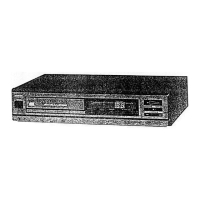
The provided document is a service manual for the FISHER DAC-204 Digital Compact Disc Player (EUROPE).
Device Description
The FISHER DAC-204 is a digital compact disc player designed for audio playback. It utilizes a compact disc digital audio system to deliver high-fidelity sound.
Function Description
The primary function of the DAC-204 is to play audio compact discs. It offers a range of playback and programming features:
- Disc Selection: The player supports multi-disc playback, allowing users to select discs using dedicated DISC NUMBER buttons (1-5).
- Track Selection: Individual tracks can be selected using TRACK/INDEX NUMBER buttons (0-9).
- Index Selection: For discs with index points, specific sections within a track can be accessed using INDEX and TRACK/INDEX NUMBER buttons (0-9). This feature is available during normal disc play.
- Program Selection: Users can program a sequence of up to 32 selections from multiple discs using DISC NUMBER (1-5) and TRACK/INDEX NUMBER (0-9) buttons.
- Program Functions:
- Program Reset: Clears the current program using the CLEAR button.
- Checking Program: Allows review of the programmed sequence by pressing the CHECK button (in STOP mode).
- Intro Scan: Plays the first 1-99 seconds of each track in the program.
- Scanning: Provides two-speed fast-forward/back with audible sound and two-speed search in PAUSE mode.
- Random Disc Play: Shuffles playback of tracks across all loaded discs using the RANDOM PLAY button.
- Total Disc Time Display: Shows the total playback time of the disc by pressing the DISPLAY button twice.
- Repeat: Allows repetition of all tracks or all programmed tracks.
Important Technical Specifications
The DAC-204 boasts impressive audio characteristics:
- Frequency Response: 20 Hz – 20 kHz, covering the full range of human hearing.
- Harmonic Distortion: Less than 0.006% at 1 kHz, indicating very low signal distortion.
- S/N Ratio (Signal-to-Noise Ratio): More than 90 dB, ensuring a clean audio signal with minimal background noise.
- Wow and Flutter: Below measurable limits, guaranteeing stable playback speed.
- Channel Separation: More than 80 dB at 1 kHz, providing excellent stereo imaging.
- Power Requirements: AC 110/220V, 50 Hz, consuming 20 Watts.
- Dimensions (W x H x D): 440 x 113 x 290 mm.
- Weight (approx.): 5.0 kg.
Usage Features
The player's design incorporates several user-friendly features:
- Multi-Disc Capability: The presence of "DISC NUMBER (1-5) buttons" suggests that this model is a multi-disc changer, allowing several CDs to be loaded and played sequentially or in a programmed order without manual disc changes.
- Intuitive Controls: The use of dedicated number buttons for track and index selection, along with clear function buttons like CLEAR, CHECK, RANDOM PLAY, DISPLAY, and a general "PLAY button," indicates a straightforward control scheme.
- Display: The "Total Disc Time Display" is a useful feature for users to monitor playback duration.
- Sound during Scan: The "2 speed fast-forward/back with sound" feature allows users to quickly locate specific parts of a track while still hearing the audio, which is more convenient than silent fast-forward.
Maintenance Features
The service manual provides detailed information crucial for maintenance and repair:
- Safety Interlock: The device incorporates a safety interlock system to prevent unnecessary laser output, protecting users from hazardous radiation. The laser emits a beam only when specific conditions are met, such as the loading limit switch being "ON" (disc on turntable) and the pickup being at the minimum internal circumference. The laser output is controlled by Pin 16 of IC 901 (µPD75206G); an "L" (Low) level enables the laser, while an "H" (High) level disables it.
- Laser Diode Properties: The manual specifies the laser diode's material (Ga-Al-As), wavelength (755-815 nm at 25°C), and continuous wave maximum output (0.5 mW), which are vital for technicians when replacing or servicing the laser assembly.
- Safety Certification: The player is designed to meet UL and FCC requirements and complies with safety performance standards, emphasizing the importance of using designated replacement parts with the same ratings for components identified with the IEC symbol (A) during servicing to maintain safety.
- Adjustment Procedures: The manual outlines precise adjustment procedures for various components, including:
- Initial Position of Volume: Setting mechanical centers for focus, tracking, and kick gain potentiometers (P101-P107).
- Free Run Frequency Adjustment: Adjusting the PLL OSC coil (T102) to 4.3218MHz.
- Focus Offset Adjustment: Adjusting P105 to achieve 0V±10mV at the FC test point.
- Tracking Offset Adjustment: Adjusting P106 to achieve 0V±50mV at the TC test point.
- Diffraction Grid Adjustment: A precise procedure involving an adjustment jig to align the E and F beams with the main beam, ensuring a 180° phase difference for optimal laser pick-up.
- Pick-up Angle Adjustment: Rotating the angle adjustment screw to maximize the waveform at the HF test point.
- E-F Balance Adjustment: Adjusting P101 to achieve 0V±15mV at the TE test point.
- Turntable Height Adjustment: Ensuring the turntable's top surface is 11.9mm from the chassis and adjusting if the DC Voltmeter reading at FC is not within 0V±0.25V.
- Focus/Tracking Gain Adjustment: Using a measurement circuit to adjust P102 and P103 for a 90° phase difference in output waveforms.
- Kick Gain Adjustment: Adjusting P104 to achieve a track jump between 1 and 1.5 tracks.
- DAC Adjustment: Adjusting P107 to achieve a sine waveform on the oscilloscope when playing a 1kHz, -60dB test tone.
- Exploded Views and Parts Lists: Comprehensive diagrams and lists for the cabinet, CD index mechanism, and CD mechanism, including part numbers and quantities, facilitate identification and ordering of replacement parts.
- P.C. Board Parts Lists and Diagrams: Detailed lists and views of the Main, Power, LED, Photo Transistor, Photo Sensor, and Lamp P.C. Boards, along with schematic diagrams, aid in troubleshooting and component replacement.
- Integrated Circuit Block Diagrams: Block diagrams for key ICs like YM3815, µPC4570HA/LA6393S, LC3517AM-15, CX20109, and LA6510 provide insight into their internal functions, assisting in circuit analysis.
- Semiconductor Lead Identification: Diagrams showing lead configurations for various transistors and ICs (µPC4570C, µPC4570HA, CX20109, LC3517AM-15, LA6393S, YM3815, LA6510) are essential for correct component handling and installation.
The manual explicitly states that "THE COMPACT DISC PLAYER SHOULD NOT BE ADJUSTED OR REPAIRED BY ANYONE EXCEPT QUALIFIED SERVICE PERSONNEL," underscoring the complexity and safety requirements for servicing this device.

 Need help?

 To Next Page
 General