Need help?
Do you have a question about the FLIGHTORY STALLION VTOL and is the answer not in the manual?
Join the Flightory Tech group on Facebook to share builds and interact with the community.
Follow Flightory on Instagram for more footage and updates on the aircraft.
Details requirements for VTOL conversion, referencing the base manual for scratch builds.
Describes the aircraft's trimotor layout, front tilt motors, rear motor, and yaw control.
Lists required parts for the VTOL version, including wings and motor mounts, with their materials.
Suggests using carbon fiber additives for high-temperature printing to enhance component strength.
Lists recommended motors, propellers, servos, ESCs, battery, bearings, and hardware for the aircraft.
Shows 3D print orientation and infill settings for Wing 1 and Wing 2.
Details 3D print orientation and infill for the BOOM L/R and MOTOR MOUNT TAIL.
Covers MOTOR MOUNT FRONT printing with full infill and reinforcement techniques for durability.
Confirms VTOL PACK files are available in STL/STEP format and can be found in STEP labeled folders.
Instructions for positioning the tail motor shaft 195mm from the tube's front end.
Details mounting the motor, securing it, and routing cables through the tail boom.
Explains how to slide and secure the tail boom into the fuselage.
Mount the motor onto the FRONT MOUNT and secure the BOOM with a screw, nut, and washer.
Install the servo into its slot and route cables through the designated channel.
Place the motor, secure assembly with servo horn, and route motor cables.
Insert bearing and secure with M3 nut for smooth movement and stabilization.
Assembling the wing, noting similarities to the base version and optional LED mounting.
Firmly glue the boom using CA glue; the main spar reinforces the structure.
Insert wings and route motor/servo cables to the fuselage channel.
The aircraft structure is ready for connecting cables and initial configuration.
Recommends Ardupilot and provides links for comprehensive Tiltrotor Planes configuration.
Explains tricopter setup, yaw control via front motors, and motor numbering for Mission Planner.
Details the assignment of channels for servos, including Aileron, VTail, and motor controls.
Covers parameters like Q_ENABLE, Q_FRAME_CLASS, Q_TILT_MASK, Q_TILT_TYPE, Q_TILT_YAW_ANGLE, Q_TILT_MAX.
Details parameters Q_TILT_RATE_UP, Q_ASSIST_SPEED, Q_M_PWM_TYPE, Q_OPTIONS for tilt rotor control.
Covers speed parameters (ARSPD_FBW_MIN/MAX, Q_TRANSITION_MS, Q_LAND_SPEED) and battery voltage.
Provides links to Ardupilot documentation for quadplane setup, flight modes, flying, tuning, and tips.
The Flightory Stallion VTOL is a 3D-printable unmanned aerial vehicle (UAV) designed for vertical take-off and landing (VTOL) operations. This user manual provides instructions for converting the basic Stallion aircraft into its VTOL configuration and offers guidance on its assembly, recommended components, and software configuration using Ardupilot.
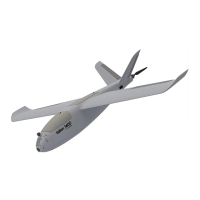
The Stallion VTOL is a trimotor aircraft, featuring two front tilt motors and one fixed rear motor. This configuration allows for both vertical take-off and landing (hover mode) and efficient horizontal flight (plane mode). Yaw control in hover mode is achieved by tilting the front motors, providing precise maneuverability during vertical operations. The aircraft is designed to be built from 3D-printed parts, with specific material recommendations for optimal strength and performance. The manual focuses on the VTOL modification, assuming the user already possesses the basic Stallion aircraft or refers to its dedicated manual for initial construction.
While specific dimensions and performance metrics are not explicitly detailed in the provided pages, the manual highlights key components and materials:
The Stallion VTOL is designed for flight operations that leverage its vertical take-off and landing capabilities, making it suitable for environments where traditional runway take-off and landing are not feasible.
Q_TRANSITION_MS parameter, set to 7000 milliseconds (7 seconds), ensures a smooth transition without loss of lift or altitude.EnableLandReposition option allows for manual position adjustment during automatic landing, enhancing precision. ThrLandControl also enables manual throttle control during landing.Q_ASSIST_SPEED parameter, when set to -1, disables the automatic tilt-up of motors to assist in generating lift below a certain speed, as this function is not desired for the Stallion VTOL.The manual emphasizes several aspects related to the maintenance and durability of the 3D-printed components:
Q_ENABLE, Q_TILT_ENABLE, Q_FRAME_CLASS, Q_TILT_MASK, Q_TILT_TYPE, Q_TILT_YAW_ANGLE, Q_TILT_MAX, Q_TILT_RATE_UP, Q_ASSIST_SPEED, Q_M_PWM_TYPE, Q_OPTIONS, ARSPD_FBW_MIN, ARSPD_FBW_MAX, Q_TRANSITION_MS, Q_LAND_SPEED, Q_M_BAT_VOLT_MAX, and Q_M_BAT_VOLT_MIN. These parameters need to be correctly set for the aircraft to function as intended.Q_M_PWM_TYPE = 7) allows bypassing manual ESC calibration, simplifying setup.Q_M_BAT_VOLT_MAX and Q_M_BAT_VOLT_MIN (e.g., 16.8V and 13.2V for 4S packs) enables throttle compensation in hover mode, ensuring consistent thrust regardless of battery voltage.

 To Next Page
 General