Need help?
Do you have a question about the FLIR MPX C237EC and is the answer not in the manual?
Learn to open, navigate, select, and change settings using the joystick control.
Understand how to return to previous menus or exit the main menu.
Follow advice on power, installation, and lens cleaning to prevent hazards.
Loosen screw, separate base, mark drill holes, and feed camera cable through base.
Attach the camera base to the mounting surface using the provided screws.
Position dome cover, adjust ball camera, and tighten security screw for final mounting.
Connect BNC video and power cables to the camera and DVR for operation.
Utilize the joystick to remotely adjust zoom and focus for optimal viewing.
Illustrates MPX and Analog connections for DVR and power.
Details maximum lengths for RG59, RG6, and Balun extension cables.
Covers image sensor, resolution, and supported video formats.
Specifies lens focal length, field of view, and connector type.
Details power, operating temperature, environmental rating, and physical size.
This document describes the installation, setup, and operation of a 1.3MP Motorized Varifocal Lens WDR Dome Camera. It provides comprehensive instructions for both physical installation and configuration via an On-Screen Display (OSD) menu, along with essential safety precautions and package contents.
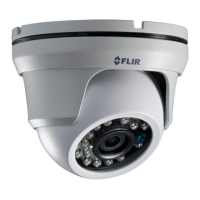
The 1.3MP Motorized Varifocal Lens WDR Dome Camera is a surveillance device designed to capture high-resolution video. Its motorized varifocal lens allows for flexible adjustment of the field of view and focus, which can be controlled either directly from the camera cable's joystick or remotely when connected to a compatible FLIR MPX DVR. The Wide Dynamic Range (WDR) feature enhances image quality in challenging lighting conditions by balancing bright and dark areas within the same scene. The camera supports both digital (720p MPX HD-CVI) and analog (Composite 1.0Vpp @ 75ohm) video outputs, making it versatile for integration into various surveillance systems. Infrared (IR) LEDs provide night vision capabilities, ensuring continuous monitoring even in complete darkness. The camera is housed in a durable, IP66-rated dome enclosure, making it suitable for both indoor and outdoor environments.
The camera's settings are configured through an integrated control stick located on the camera cable. To access the OSD menu, the joystick's middle button is pushed. Navigation is done by moving the joystick up/down to select a setting and left/right to change its value. Pushing the middle button confirms the selection. Submenus are indicated by arrows, and selecting a setting with an arrow and pushing the joystick enters that submenu. Users can return to the previous menu by selecting "RETURN" or exit the main menu by selecting "EXIT." A test monitor can be optionally connected to the camera's analog (yellow) BNC connector for easier OSD menu configuration. The OSD menu provides extensive control over various camera parameters, including:
The camera features a motorized varifocal lens, allowing for flexible adjustment of the field of view. Zooming in or out can be performed by holding the joystick on the camera cable up or down. The camera automatically adjusts its focus after zoom changes. For systems connected to a FLIR MPX DVR, zoom and focus can also be adjusted remotely through the DVR's interface.
The installation process begins with testing the camera by temporarily connecting it to a DVR before permanent mounting. The dome cover is loosened with an Allen key, and the camera base is separated from the ball camera and dome cover by rotating it counter-clockwise. A mounting template is used to mark and drill holes for the mounting screws, with drywall anchors provided for drywall installations. The camera cable is fed through the base, and video and power cables are connected. The camera base is then attached to the mounting surface. The dome cover is positioned over the ball camera and twisted clockwise onto the base, but not fully tightened. The ball camera is then moved to the desired position, and while holding it in place, the dome cover is twisted the rest of the way to secure it, preventing movement. Finally, the security screw on the dome cover is tightened with the Allen key.
The camera requires connection to a video cable via one of its two BNC connectors and to a 12V DC or 24V AC power source. It can connect to either an MPX DVR for 720p viewing/recording or an analog DVR for 960H viewing/recording. Proper polarity must be observed for the power connection. For AC power, consistent wiring polarity is crucial to prevent video rolling when multiple cameras are connected. A regulated power supply is required to prevent damage and void the warranty. The power connection should not exceed 200ft (61m) to avoid affecting camera focus.
The document provides guidelines for extension cable lengths:
The camera is designed for durability with an IP66 environmental rating, indicating protection against dust and powerful water jets. Regular cleaning of the lens cover with a soft cloth will help maintain optimal image clarity. Given its robust construction and sealed enclosure, internal maintenance is not required or recommended. For detailed explanations of camera settings and advanced troubleshooting, users are directed to the OSD instruction manual available on the manufacturer's website.
 General
| Resolution | 700 TVL |
|---|---|
| Focus | Fixed |
| Power Supply | 12V DC |
| Ingress Protection | IP66 |
| IR Range | 30m |
| Frame Rate | 30fps |
| Lens Options | 3.6mm |
| Operating Temperature | -30°C to 50°C |

 To Next Page