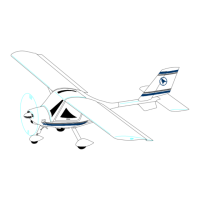
This document is the Pilot Operating Handbook for the FLY SYNTHESIS TEXAN TOP CLASS 570 ISR, equipped with a Rotax 912 ULS engine. It provides essential information for the safe and efficient operation of the aircraft.
Function Description:
The FLY SYNTHESIS TEXAN Top Class ISR is a light sport aircraft designed for flight operations. It features a laminar flow airfoil section, rectangular shape low wing, and composite materials for the fuselage and wings. The aircraft is equipped with a Rotax 912 ULS engine and can be fitted with various propeller types, including DUC Hélices Carbon 3-blades, GT Propellers Wood 2-blades, and Allsport Idrovario composite 2-blade auto variable pitch. The aircraft is designed to comply with BCAR Section S, CS-VLA, F2279, F2295, and F2483 standards, and does not conform to standard category airworthiness requirements.
Important Technical Specifications:
Dimensions:
- Wing span: 8.600 m
- Length: 6.990 m
- Height: 2.400 m
Wing:
- Surface: 11.80 m²
- Wing chord: 1.399 m
- Wing load: 48.3 kg/m²
Flap:
- Surface: 0.570 m²
- Span: 1.700 m
- Chord: 0.340 m
- Travel: 0° - 45°
Aileron:
- Surface: 0.570 m²
- Span: 1.700 m
- Chord: 0.340 m
- Travel: down 17° / up 22°
Stabilator:
- Surface: 1.950 m²
- Span: 3.000 m
- Chord: 0.650 m
- Travel: down 11° / up 16°
Vertical fin (with rudder):
- Surface: 1.150 m²
- Height: 1.350 m
- Mean chord: 0.850 m
Rudder:
- Surface: 0.600 m²
- Height: 1.350 m
- Mean chord: 0.440 m
- Travel: +/-18°
Weights (Rotax 912 ULS):
- Empty weight: 325 kg
- Maximum allowed weight in baggage compartment: 16 kg
- Maximum Take Off Weight: 570 kg
- Minimum single pilot weight: 70 kg
- Maximum pilot and passenger weight: 180 kg
Landing Gear:
- Type: Tricycle type landing gear with dampened nose wheel
- Main gear track: 2.130 m
- Wheelbase: 1.585 m
- Tire (Main): 4.00x6"
- Tire (Nose wheel): 4.00x4"
- Tire pressure (Main): 2.2 - 2.4 bar
- Tire pressure (Nose wheel): 1.8 bar
- Brakes: Main wheels hydraulic disc.
Fuel System:
- Type: Two lines with mechanical and auxiliary electric fuel pump
- Tanks: Fuel plan draining system and fuel back system in the right tank. Two integrated tanks with 50 liters of capacity for each tank. T-level and fuel reservoir sensor for each tank. Two push tank caps and a vent line coming to below the lower surface of the wing.
- Non-usable fuel: 2 liter for each tank
- Fuel filter: Gascolator on firewall, filtered electric fuel pump
- Fuel specification: Premium Automotive Unleaded fuel min 95Ron.
Electrical System:
- Type: 12 V CC electric wiring with starting battery. Circuit breakers protected wiring. Provision for gyroscopic instruments, autopilot, radio and GPS AvMap EKP IV.
Powerplant (Rotax 912 ULS):
- Engine: 4 stroke, 4 cylinder horizontally opposed, spark ignition engine, liquid cooled cylinder heads, ram air cooled cylinders, two constant depression carburetors, mechanical fuel pump, air box, friction clutch geared reduction drive, radiator cooled oil, warm air at carburetor system.
- Ignition: Increased electric ignition system HD
- Battery: Sealed Lead Acid Battery 12 Volts. (Applicable to both engines)
Standard propellers:
- DUC composite three blades propeller, diameter 1750 mm, ground variable pitch. GT-2 wood two blades propeller, diameter 1730 mm, fixed pitch 1550 mm. Allsport Idrovario carbon two blades propeller, diameter 1760, automatic in- flight variable pitch with Custom Intelligent Propeller control box, manual operations have been removed.
Instruments:
- Standard instruments: Airspeed indicator, altimeter, vertical speed indicator, magnetic compass, slip indicator, flap angle indicator, two fuel level tank indicators with two low fuel level amber warning lamps, CHT, EGT, RPM, oil temperature indicator, oil pressure indicator, fuel pressure indicator, engine run time indicator, 12 Volt aux socket.
Other Standard Equipment:
Main wheels and nose wheel fairings, main legs and nose leg aerodynamic fairing, depth adjustable seats, four points safety belts, electric flap system (travel: 0° - 45°), manual trim regulation system, fully upholstered cabin interior, canopy lock system with key, hooks for ground anchorage, landing lights.
Airspeed Limitations (Rotax 912 ULS IAS):
- Vne (Never Exceed speed): 230 km/h (142 mph) - Never exceed this speed in every condition or configuration.
- Vmo (Maximum Structural Cruising Speed): 195 km/h (121 mph) - Never exceed this speed in turbulent air condition.
- Va (Maneuvering speed): 145 km/h (90 mph) - Do not make full stick and full rudder deflections above this speed.
- Vfe (Maximum speed with full flaps): 120 km/h (75 mph) - Do not exceed this speed with flap extended.
- Vs (Stall speed without flap): 74 km/h (46 mph) - Do not descend this speed without flap to avoid undesired stall conditions.
- Vs1 (Stall speed in take off position (15°)): 70 km/h (44 mph) - Do not descend this speed with flap in take off position to avoid undesired stall conditions.
- Vs0 (Stall speed in landing position - full flap (45°)): 65 km/h (40 mph) - Do not descend this speed with flap in landing position to avoid undesired stall conditions.
Powerplant and Propeller Limitations (Rotax 912 ULS):
- Engine model: 912 ULS
- Maximum take off power: 73.5 kW
- Maximum continuous power: 69 kW
- Maximum take-off RPM: 5800 rpm
- Maximum continuous RPM: 5500 rpm
- Minimum cylinder head temperature: 135°C
- Maximum oil temperature: 130°C
- Minimum oil pressure: 0.8 bar
- Maximum oil pressure: 7 bar
- Minimum fuel pressure: 0.15 bar
- Maximum fuel pressure: 0.4 bar
- Usable type of fuel: minimum 95 RON
- Usable type of oil: See engine manual specifications
Load Factor Limitations:
- Flap retracted:
- Maximum positive load factor: 3.8 (+)
- Maximum negative load factor: 1.9 (-)
- Flap extended:
- Maximum positive load factor: 2.0 (+)
- Maximum negative load factor: 0.0 (+)
Usage Features:
The handbook emphasizes the importance of adhering to all procedures and instructions for safe operation. It includes sections on general information, limitations, emergency procedures, normal procedures, performances, weight and balance, aircraft ground handling and servicing, and aircraft check lists.
- Pre-flight checks: Detailed checklists are provided for pre-flight inspection, including checks of the main landing gear, wing surfaces, empennage, propeller, engine, and inside the cabin.
- Take-off: Procedures for take-off, including short runway take-off with an obstacle, are outlined.
- Climb: Recommended engine RPM and instrument readings for climb are specified.
- Cruise: Engine RPM and instrument readings for cruise are provided.
- Landing: Procedures for landing, including final approach speed and touch down speed, are detailed.
- Emergency Procedures: Comprehensive instructions are given for various emergencies, such as engine fire, engine failure during take-off or climb, electrical wiring failure, stall recovery, non-intentional spin recovery, low voltage in flight, low voltage on ground, smoke elimination from cabin, landing without flaps, landing with a deflated tire, forced landing, opening parachute procedure, oil temperature & pressure in yellow arc or red line, low fuel pressure, unintentional flight within icing conditions, abnormal engine vibrations, landing with brake system failure, and propeller pitch control system emergency.
- Normal Procedures: This section covers general information, speed for normal employment, fuel circuit draining procedure and refueling operations, pre-flight inspection, and flight inside heavy rain.
- Performance Data: Includes take-off and landing phases, density altitude conversion, and unit conversion tables for speed and distance.
- Weight & Balance: Instructions for determining the aircraft's center of gravity and ensuring it remains within limits are provided.
Maintenance Features:
The manual outlines procedures for aircraft ground handling and servicing to ensure the aircraft remains in airworthy condition.
- Aircraft Ground Movement: Instructions for moving the aircraft with engine running and off, including parking brake usage and steering.
- Aircraft Ground Anchorage: Details on how to properly anchor the aircraft to prevent movement due to wind or other forces.
- Aircraft Cleaning: Recommendations for cleaning the aircraft, including the use of specific cleaning agents and methods for different parts of the aircraft.
- Aircraft Servicing:
- Servicing fuel: Procedures for checking fuel level, pouring fuel, and ensuring the fuel cap is directed to the front.
- Servicing oil: Instructions for removing top cowling, checking oil level, and adding oil if necessary.
- Servicing coolant (Rotax engine): Procedures for removing top cowling, opening coolant tank, checking coolant level, and adding coolant if necessary.
The document emphasizes that any revisions or sections should be printed and replaced in the manual at the earliest possible time for flight safety. All amendments to the manual should be logged and recorded in the table under log of amendments.

 Need help?
 General

 To Next Page