
 Need help?
Do you have a question about the Flybar AERO-3 and is the answer not in the manual?
Key safety rules for scooter operation, including avoiding steep hills, traffic, and adverse conditions.
Mandates wearing a helmet, elbow and knee pads, and shoes with rubber soles for rider protection.
Specifies approved cleaning methods and warns against harsh chemicals or unauthorized modifications.
Provides step-by-step instructions for safely folding and unfolding the scooter.
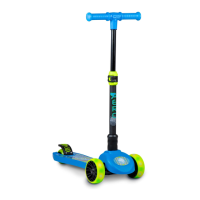
The Flybar Aero-3 Scooter is a kick scooter designed for children aged 3 and above, with a maximum weight capacity of 120 lbs (55 kgs). It is available in multiple color variations, indicated by model numbers FBAS3-P, FBAS3-O, FBAS3-B, and FBAS3-G. The scooter features a three-wheel design, providing enhanced stability for young riders.
Before allowing a child to use the Aero-3 scooter, it is crucial to ensure that the steering rod is fully engaged and all screws are tight. The wheels must be correctly secured and show no signs of wear. Protective equipment, including a helmet, elbow pads, knee pads, and shoes with rubber soles, must always be worn.
Children should not ride the scooter down steep hills, as the brake is not designed for high downhill speeds. The brake pad can become hot with prolonged use, so direct skin contact should be avoided. The scooter is not intended for use at speeds beyond a child's control or as a stunt scooter. It should not be ridden on roads, paths, or areas with motor vehicle traffic. Only one child may ride the scooter at a time. Riding at dusk or night is not permitted. The scooter should not be used on wet, oily, sandy, dirty, icy, rough, or uneven surfaces.
Before attempting risky maneuvers, a child should practice control and balance. The riding style should always be adjusted to the rider's personal skill level. The product complies with CPSC/ASTM/EN14619 safety standards.
Regular maintenance is essential for the scooter's longevity and safe operation. Before each ride, check that all parts are sufficiently tightened and the handlebar is securely fixed. Ensure that all wheels spin smoothly and that the deck grip tape provides adequate traction. All nuts and bolts should be checked for tightness before every ride, as they may loosen over time.
Wheels are subject to natural wear and tear and should be checked regularly. Worn-out wheels must be replaced when necessary. Replacements can be obtained by contacting Flybar at flybar.com or 845-647-8400.
Cleaning the scooter requires specific care. Do not use a wet cloth, alcohol, industrial cleaners, or solvents, as these can cause loss of gloss, remove decals, or dissolve the scooter's materials. The scooter should be stored in a cool, dry place. Metal parts may corrode over time, especially if the scooter is frequently used near the sea or left outdoors.
No attachments not included with the scooter should be used, and no modifications should be attempted.
The Aero-3 Scooter features a convenient folding mechanism for storage and transport, which requires adult assistance.
Flybar provides a one-year warranty to the original purchaser, covering defects in material and workmanship from the original date of purchase. This warranty does not cover physical damage resulting from abuse, neglect, improper repair, improper fit, alterations, or unintended use. If the Flybar Aero Scooter is found to be defective within the warranty period, Flybar will, at its discretion, repair or replace the scooter free of charge. Proof of purchase is required for warranty claims. For complete warranty information, visit www.flybar.com.
Flybar's history dates back to 1918 when George Hansburg invented the pogo stick. Hansburg's invention quickly gained popularity, notably through Florenz Ziegfeld's Follies show, which incorporated a pogo routine. This led to high demand, and Hansburg established a factory in NY. For over 99 years, Flybar has been a leading innovator in pogo sticks, maintaining its reputation as "The Original Pogo Stick Company" and setting the standard for pogo stick measurement.
Today, Flybar's product range extends beyond pogo sticks to include new products for toddlers, stilts, scooters, swings, and skateboards. All products are designed and developed with the same passion and innovation that George Hansburg demonstrated nearly a century ago. Flybar has been in business since 1918. The company, Flybar Inc., is located in Freehold, NJ 07728. All rights are reserved, 2019. The product is Made in China.

 To Next Page
 General