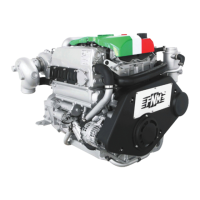
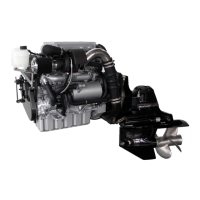
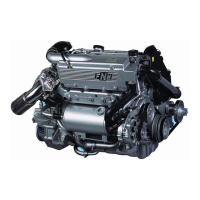
The FNM HPE Series Marine Diesel Engines are designed for pleasure and work boats, emphasizing performance, compact structure, outstanding power-to-weight ratio, long life, and low fuel consumption while meeting anti-pollution standards.
Function Description:
The FNM HPE engines are marine diesel engines equipped with an electronic or mechanical throttle for gear engagement and acceleration control. They feature a cooling system that includes an intercooler, expansion tank, and water-to-water exchanger to manage engine and intake air temperatures. Lubrication is handled by an oil sump and oil exchanger, while fuel is supplied through a diesel fuel exchanger and filter. Electrical power is generated by an alternator, and the engine is started by a starter motor. The exhaust system includes a turbocharger and raiser to manage exhaust gases. The engine's operation is monitored and controlled via a digital instrument panel, which displays various parameters and alerts the user to potential issues.
Important Technical Specifications:
The manual provides detailed specifications for three engine series: 13HPE, 20HPE/P, and 30HPE/P.
- Cylinders: All series have 4 cylinders.
- Displacement: 13HPE: 1248 cm³, 20HPE/P: 1910 cm³, 30HPE/P: 2988 cm³.
- Bore: 13HPE: 69.6 mm, 20HPE/P: 82.0 mm, 30HPE/P: 95.8 mm.
- Stroke: 13HPE: 82.0 mm, 20HPE/P: 90.4 mm, 30HPE/P: 104.0 mm.
- Engine Type: All are four-stroke diesel engines.
- Compression Ratio: 13HPE: 17.6:1, 20HPE/P: 18:1, 30HPE/P: 17.6:1.
- Injection Type: Direct Common Rail Injection.
- Boosting: 13HPE and 20HPE/P use a turbine with variable geometry; 30HPE/P uses a turbine with cooled body.
- Timing System: 16-Valve DOHC.
- Firing Order: 1-3-4-2.
- Idle Speed: 13HPE: 900 rpm, 20HPE/P and 30HPE/P: 800 rpm.
- Max Revolution Speed (with load): 13HPE: 4000-4400 rpm, 20HPE/P: 3200-4100 rpm, 30HPE/P: 3800-4100 rpm.
- Maximum Power (kW @ rpm):
- 13HPE: 80.8 @ 4400 (110/110JD), 58.8 @ 4000 (80), 57 @ 3800 (80SD).
- 20HPE/P: 29.4 @ 3200 (40), 73 @ 3800 (100), 88 @ 3800 (120), 108 @ 4100 (150), 129 @ 4100 (180).
- 30HPE/P: 107 @ 3800 (145), 132 @ 3800 (180), 165 @ 4100 (225), 184 @ 4100 (250).
- Maximum Torque (Nm @ rpm):
- 13HPE: 230 @ 2600 (110), 157 @ 2200 (80/80SD), 66 @ 4000 (40).
- 20HPE/P: 91.4 @ 2600 (40), 320 @ 2600 (120/150), 350 @ 2400 (180).
- 30HPE/P: 520 @ 2600 (250), 416 @ 2500 (225).
- Alternator: 13HPE and 30HPE/P: 75A 12V; 20HPE/P: 105A 12V.
- Engine Oil Capacity (without filter): 13HPE and 30HPE/P: 3.2 l; 20HPE/P: 4.0 l.
- Thermostatic Valve: 65°C ± 1.5°C.
- Cooling Capacity: All series: 7.5 l.
- Sea Water Pump Flow: 13HPE: 90 l/min (24.0 gal/min); 20HPE/P and 30HPE/P: 100 l/min (26.6 gal/min).
- Engine Starter: 13HPE: 1.3 kW 12V; 20HPE/P and 30HPE/P: 1.8 kW 12V.
- Wet Weight (excluding transmission): 13HPE: 188 kg; 20HPE/P: 240 kg; 30HPE/P: 150 kg.
Usage Features:
- Digital Instrument Panel: Features a key lock, crankshaft revolutions counter, and a CANBUS universal instrument for displaying operating parameters and alarms. It has Normal, Selection, and Setting modes.
- Engine Start-up: Involves checking indicator lights, engine preheating, and turning the key to start. The instrument performs a self-test for 10 seconds during which the engine should not be started.
- Engine Stop: Turn the key counterclockwise to position (0).
- Throttle Control: Available in mechanical or electronic (Flexball®) versions. Mechanical throttles can include a neutral lock button, throttle-only button, lanyard stop switch, control handle, and trim/tilt/trailer functions. Electronic throttles allow for command acquisition, warm-up mode (clutch disengaged acceleration), and synchro mode (for twin-engine systems to control both engines with one lever).
- Safety Features: Includes warnings for dangerous situations (e.g., hot surfaces, moving parts, electrical shock, poisoning), instructions for proper disposal of pollutants, and guidelines for safe operation and maintenance.
- Engine Delivery Check: Upon receipt, verify the integrity of packaging, ECU box, wiring, instrument panel, and check for fluid leaks.
Maintenance Features:
Maintenance is categorized into Ordinary, Periodic, and Extraordinary, with specific responsibilities:
- Ordinary Maintenance (User/Workshop Staff):
- Oil Levels Check: Regularly check engine and transmission oil levels using the dipstick. Ensure levels are between min and max marks.
- Coolant Level Check: Verify coolant level is above the engine head.
- Sea Water Filters Cleaning: Daily inspection and cleaning of sea water filters to ensure smooth water passage.
- Fluids Leakage Check: Periodically inspect for any fluid drips from the engine, tanks, or hoses.
- Fuel Filter Draining and Inspection: Drain water from the fuel filter and check for impurities.
- Battery Status Check: For maintenance-free batteries, check the indicator color (green: good, dark: recharge, yellow: replace). For lead-acid batteries, check electrolyte level and refill with distilled water if needed.
- Anodes Consumption Check and Replacement: Replace zinc anodes if consumed over 50%.
- Fuel Filter Replacement: Replace the fuel filter according to instructions, bleeding the fuel supply circuit afterward.
- Air Filter Cleaning or Replacement: Clean the filtering sponge or metal filter with compressed air (max 2 bar) or replace it.
- Engine and Transmission Oil Change: Drain old oil, refill with new oil of the recommended type, and check for leaks.
- Service Belts Inspection and Tensioning: Verify belt status and replace if worn.
- Periodic Maintenance (Qualified Personnel): Includes sea water pump impeller inspection and replacement, sea water circuit cleaning, oil filter change, cleaning of tube bundles (water-to-water exchanger, intercooler, fuel exchanger), and greasing the engine starter pinion.
- Extraordinary Maintenance (Authorized FNM® Service Centers): Covers more complex operations such as crankshaft and propeller lubrication, engine alignment, bolts tightening, wiring inspection, mechanical couplings inspection and lubrication, Mercathode® system verification, steering system greasing, auxiliary belts replacement, timing belts and tensioners replacement, engine coolant replacement, flexible coupler inspection, thermostatic valves replacement, antifreeze fuel additive, electrical wiring disconnection, turbine inspection and actuator greasing, fuel tank cleaning, engine cleaning for salt removal and anti-rust treatment, and electrical wiring reconnection.
- Engine Inactivity Preparation: Involves cleaning and remounting heat exchangers, spraying the sea water pump impeller with silicon grease, cleaning the sea water circuit with fresh water and antifreeze, draining and refilling engine oil with additives, checking and cleaning the fuel tank and filter, and spraying cylinders with protective oil.
- Restoring Engine After Inactivity: Includes verifying battery charge, checking electrical contacts, performing engine electronic diagnosis, checking and topping up oil and coolant levels, verifying and replacing oil and fuel filters, cleaning the air filter, checking belts, verifying sea water pump impeller and anodes, and greasing the starter pinion and turbocharger actuator.
- Maintenance Products: Specific recommendations for engine oil (FNM® XTC SAE 5w40 Synthetic, Bardahl® XTC SAE 5w40 Synthetic), transmission oil (refer to manufacturer's manual), engine oil additive (Bardahl® 2 Oil Treatment), fuel additives (BARDAHL® DAB or IOSSO Fuel Anti Bacterial, Bardahl® Diesel Antifreeze, Bardahl® Diesel Injector Cleaner), metal protector/unlocker (Bardahl® Spray K9), grease for gears (Bardahl® Viscogrease), turbine lubrication (ZEP® 2000 Grease Spray, ZEP® Red lithium grease), and engine oil for long storage/antirust (Vanguard® Storage 30 oil MIL-L-2104B).
- Fuel Characteristics: Use commercially available diesel according to DIN EN 590. For winter use (below 0°C), use winter diesel fuel or antifreeze additives.
- Paint: For touch-ups, use acrylic polyurethane-based paint RAL 9006.
- Cleaning the Panel: Use mild cleaning agents to prevent damage to surface finishes.
- ECU Box: IP 67 rated, contains the electronic control unit, relays, red stop button, Amphenol® plugs, and fuses with indicator lights. Fuses are replaceable.

 Need help?

 To Next Page
 General