This page is about:
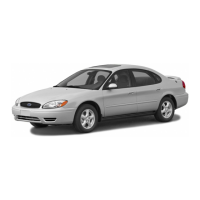
Taurus Taurus Taurus
6
July 2005
Frontal Crash Test Ratings
Emergency Decklid Release
Side-impact Head/Chest Airbags
LATCH System
Head Restraints
Personal Safety System
®
SAFETY/SECURITY
2006 Taurus
Safety/Security
Emergency Decklid Release —
the handle glows in the dark
and is connected to the trunk
lock mechanism. It releases
the decklid from inside the
trunk in case anyone is
accidentally or intentionally
locked in the trunk
Side-impact Head/Chest Airbags —
help protect both the head and chest
of front outboard occupants in certain
side-impact collisions. They inflate out
of the front seat bolster so they are
always in the optimal deployment
position. They are a freestanding option
on all models and are also included in
the Safety and Security Package
LATCH System (Lower Anchors and
Tethers for CHildren)
(1)
— provides lower
anchors and top tether anchors to
securely fasten LATCH-compatible child
safety seats. Standard on all models
(see pg. 7 for more details)
Locking Front Head Restraints — allow
front-seat passengers to position the
head restraints and lock the supports
for protection in a rear collision
Personal Safety System
®
— helps protect
front-seat occupants by considering
several crash factors and determining
the appropriate level of airbag pressure
(see pg. 8 for more details)
Anti-lock Braking System (ABS) —
helps maintain steering control in
hard-braking situations to help avoid
a possible accident. Freestanding option
on all models and also included in the
Safety and Security Package
Key Features
IIHS Frontal Offset Crash Test Ratings
Taurus achieved a Best Pick overall in frontal offset crash test
results by the Insurance Institute for Highway Safety (IIHS) for
2005. 2005 marks the 14th consecutive year that Taurus has
been recommended a Best Pick by the Insurance Institute for
Highway Safety.
• Vehicles undergo a 40-mph offset crash test, in which
40 percent of the total width of each vehicle strikes a
barrier on the driver’s side
• The forces in the test are similar to those involved in a
frontal offset crash between two vehicles of the same
weight, each traveling just less than 40 mph
• Test results can be compared meaningfully only among
vehicles of similar weight
Government Frontal Crash Test Ratings
Ford Taurus’ reputation for safety is well founded. In NHTSA’s
frontal crash tests Taurus received outstanding ratings.
• For 2005, Taurus received a five-star passenger rating and a
four-star driver rating and is anticipated to achieve these same
ratings for 2006 (for information on the differences between
four-star and five-star ratings, refer to the chart below)
• Testing is performed as follows:
– Vehicles with belted front seat test dummies are crashed
into a fixed barrier at 35 mph, which is equivalent to a
head-on collision between two similar vehicles, each
moving at 35 mph
– Ratings can be meaningfully compared only within the
same weight class (within 250 lbs.)
(1) No tether straps, only upper tether anchor provided.
NOTE: For feature availability, refer to the latest Dealer Ordering Guide.
What Do the Stars Mean?
Frontal Impact Testing
✯✯✯✯✯
5 stars = 10 percent or less chance
of serious injury
✯✯✯✯✯
4 stars = 11 percent to 20 percent chance
of serious injury
✯✯✯✯✯
3 stars = 21 percent to 35 percent chance
of serious injury
✯✯✯✯✯
2 stars = 36 percent to 45 percent chance
of serious injury
✯✯✯✯✯
1 stars = 46 percent or greater chance
of serious injury
Security Approach Lamps — lights on
the bottom of exterior mirrors illuminate
the ground when key fob is pressed.
These help customers avoid puddles and
other hazards when approaching the
vehicle
06 Taurus SB 8/31/05 4:02 PM Page 6



 To Next Page