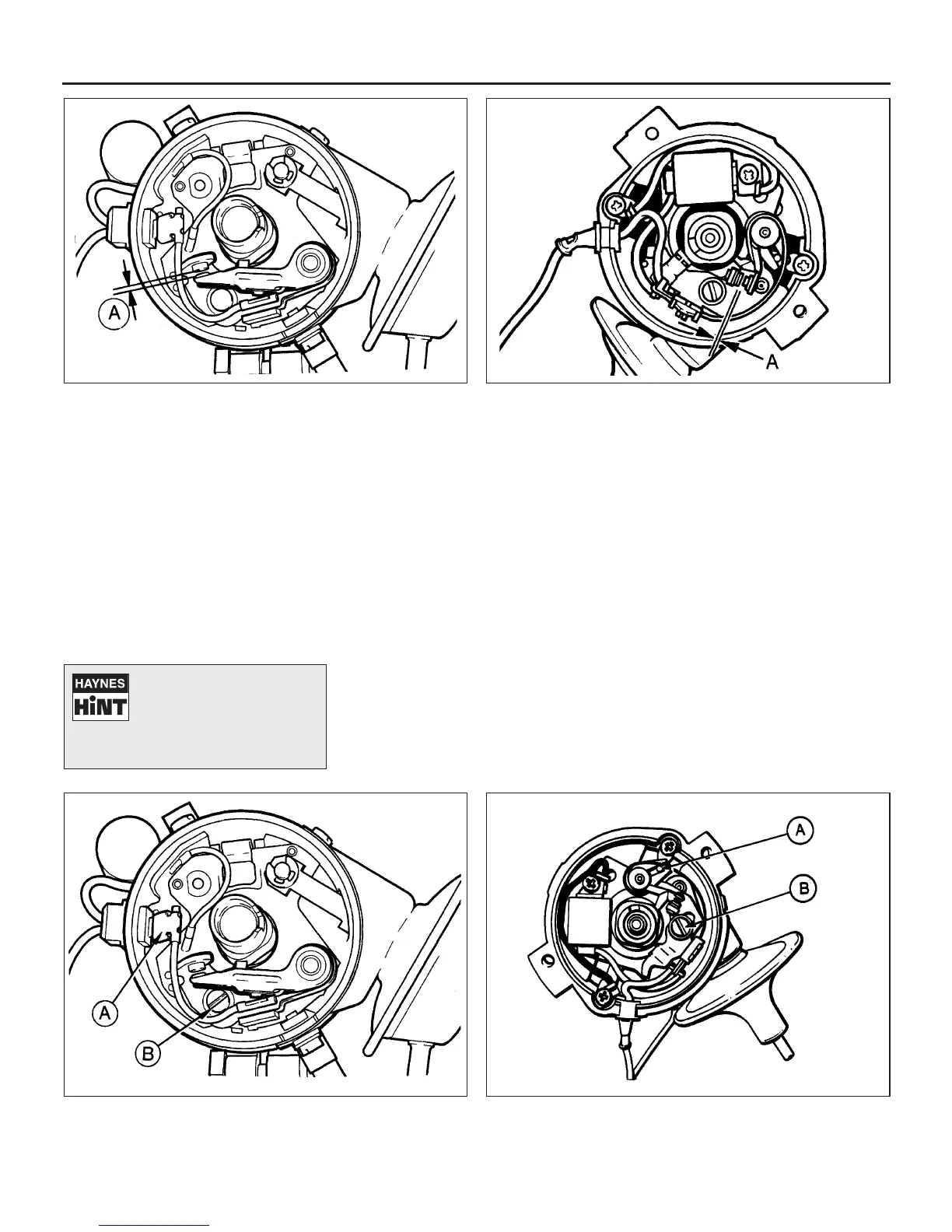
5 To adjust the points using feeler blades,
turn the crankshaft using a spanner on the
crankshaft pulley bolt until the heel of the
contact breaker arm is on the peak of one of
the four cam lobes and the points are fully
open. A feeler blade of thickness equal to the
contact breaker points gap as given in the
Specifications should now just slide between
the point faces (see illustrations).
6 If adjustment is required, slacken the
retaining screw slightly and move the fixed
point as necessary to achieve the desired gap
(see illustrations). After adjustment tighten
the retaining screw and recheck the gap.
7 Refit the rotor arm and the distributor cap.
8 If a dwell meter is available adjust the
contact breaker points by measuring and
setting the dwell angle as follows.
9 The dwell angle is the number of degrees of
distributor cam rotation during which the
contact breaker points are closed; ie the
period from when the points close after being
opened by one cam lobe, until they are
opened again by the next cam lobe. The
advantages of setting the points by this
method are that any wear of the distributor
shaft or cam lobes is taken into account and
the inaccuracies associated with using feeler
blades are eliminated. Also, on 1.1 litre CVH
engines the static ignition timing is accurately
set in production and adjustment of the
ignition timing in service has been deleted
from the maintenance schedule. Therefore
dwell angle adjustment is far more critical on
these engines.
10 In general a dwell meter should be used in
accordance with the manufacturer’s
instructions. However, the use of one type of
meter is outlined as follows.
11 Remove the distributor cap and rotor arm
and connect one lead of the dwell meter to
the “+” terminal on the coil and the other lead
to the coil “-” terminal.
12 Whilst an assistant turns on the ignition
and cranks the engine on the starter, observe
the reading on the dwell meter scale. With the
engine cranking the reading should be equal
to the dwell angle given in the Specifications.
13 If the dwell angle is too small, the contact
breaker points gap should be reduced and if
the dwell angle is excessive the gap should be
increased.
14 Adjust the points gap while the engine is
cranking using the method described in
paragraph 6. When the dwell angle is
satisfactory, disconnect the meter, then refit
the rotor arm and distributor cap.
15 Check the ignition timing (Section 14).
1•12 Every 6000 miles or 6 Months
13.5a Contact breaker points gap (A) - Bosch distributor
13.6a Contact breaker point components - Bosch distributor
A LT lead connector B Contact breaker retaining screw
13.6b Contact breaker point components - Lucas distributor
A Secondary movement cam and peg B Contact breaker retaining screw
13.5b Contact breaker points gap (A) - Lucas distributor
The points can be easily
moved by engaging a
screwdriver in the slot on the
end of the fixed point and
levering against the corresponding slot
or raised pips on the baseplate.


 To Next Page
 Loading...