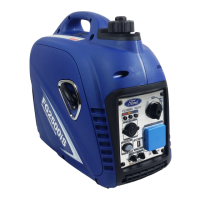
This document is an operator's manual for a Ford Inverter Gasoline Generator, specifically models FG2500i and FG2500iS. It provides comprehensive instructions for the safe operation, assembly, maintenance, and troubleshooting of the portable generator.
The Ford Inverter Gasoline Generator is an engine-driven, portable power source designed to supply electrical power for various applications. It can operate tools, appliances, camping equipment, and lighting, and also serves as a backup power source during outages. The inverter technology ensures a stable and clean power output suitable for sensitive electronic devices.
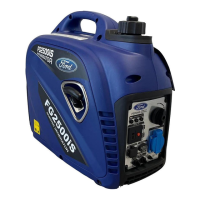
The generator is equipped with a user-friendly control panel that includes an ON/OFF Start Switch with a choke function, a USB outlet, indicator lights, a DC protector, and parallel outlets.
-
Starting and Stopping: The generator features a 3-in-1 Start Switch with "OFF," "CHOKE," and "RUN" positions. The "OFF" position closes the fuel valve, preventing the engine from running. The "CHOKE" position opens the fuel valve and is used for starting the engine, especially when cold. Once the engine warms up, the switch is moved to the "RUN" position for continuous operation. A recoil starter is used to manually start the engine. To stop the engine, the Economy switch should be turned to "OFF," all electronic devices disconnected, the 3-in-1 Start Switch moved to "OFF," and the fuel cap air vent turned to "OFF."
-
Fuel System: The fuel cap is designed with an air vent that must be in the "ON" position for fuel to flow to the carburetor, allowing the engine to run. Turning the air vent to "OFF" stops fuel flow. When adding fuel, it's crucial to place the generator on a level, well-ventilated surface, remove the fuel cap, and carefully pour gasoline into the tank, leaving space for expansion. Overfilling should be avoided, and smoking while fueling is strictly prohibited.
-
Oil System: The generator requires 4-Cycle engine oil (SAE 10W-30). Before first use, oil must be added to the crankcase. The oil warning indicator light illuminates and the engine stops automatically if the oil level falls below the minimum, preventing damage. The engine will not restart until the proper amount of oil is in the crankcase.
-
Grounding: For safety, the generator must be properly grounded before use. This involves connecting the generator's ground terminal on the frame to a driven ground rod using a 14 AWG copper wire. This protects against electric shock from static electricity or undetected ground faults.
-
Connecting Electronic Devices: Before connecting any devices, ensure the generator is grounded, the load is within the generator's rated output, electrical cords and receptacles are in good condition, and all electronic devices are turned "OFF." After starting the engine and allowing it to stabilize, devices should be plugged in and turned on, starting with the largest output devices first to prevent overloading.
-
USB Outlet: A convenient 5V DC 1.5A USB outlet is provided for charging USB-powered devices such as tablets, MP3 players, GPS units, and digital cameras.
-
DC Circuit Breaker: The DC Circuit Breaker, when in the "ON" position, allows power to connected electronic devices. It automatically turns "OFF" if connected devices exceed the generator's rated output. To re-establish power, the breaker must be returned to the "ON" position after reducing the load.
-
Engine Economy Control: The "Economy" switch, when "ON," automatically adjusts engine speed based on the electronic load, leading to superior fuel economy and reduced noise. When "OFF," the engine runs at a rated speed of 4,100 r/min, which is recommended for devices requiring a large starting current, like compressors.
-
Parallel Operation: The FG2500iS model features parallel outlets, allowing two FG2500iS generators to be connected simultaneously using a special parallel cable kit. This increases the available power output (rated output 4.0kVA, rated current 18.2A / 220V AC). It is crucial to use only FORD approved parallel operation cable kits and connect only to another FG2500iS Standard Generator.
-
Overload Protection: The engine overload indicator light illuminates if the generator's wattage/amperage capacity is exceeded. In such cases, the green AC Pilot Indicator Light will turn off, and power to connected devices will cease, though the engine will continue to run. To correct this, disconnect devices, stop the engine, reduce the total wattage, inspect for blockages, and restart.
-
12 Volt Battery Charging: The generator can charge a 12-volt automotive or storage battery. This involves inspecting battery fluid levels, cleaning terminals, securely connecting red and black cable clamps to the positive and negative terminals respectively, and turning the Economy switch to "OFF" to begin charging. Regular monitoring of the battery's gravity level with a hydrometer is recommended to prevent overcharging.
Regular maintenance is essential to extend the generator's life and performance, and to ensure warranty coverage.
-
Maintenance Schedule: The manual provides a detailed maintenance schedule, including tasks to be performed after the first 5 hours, after 8 hours or daily, every 6 months (100 hours of use), and every 12 months (300 hours of use).
-
Pre-Operation Steps: Before each use, operators should check engine oil and fuel tank levels, inspect fuel hoses for damage, ensure the air filter is clean, remove debris from the generator and muffler, and inspect the work area.
-
After Each Use: After operation, the engine should be shut off, and the unit stored in a clean, dry area.
-
Oil Change: Oil should be changed after the first 5 hours and then every 6 months or 100 hours. This involves warming the engine, turning it off, removing the outer casing and crankcase dipstick, draining the old oil into a pan by tilting the generator, and then refilling with new SAE 10W-30 engine oil to the outer edge of the oil fill hole. Care must be taken not to overfill or allow foreign matter into the crankcase.
-
Air Filter Cleaning: A dirty air filter reduces engine life and performance. It should be checked and cleaned every 6 months or 100 hours (more often in dusty conditions). Cleaning involves removing the outer casing and air filter cover, washing the foam element in solvent, letting it dry, adding a small amount of oil, squeezing out excess, and reinserting it. The generator should never be run without the foam element.
-
Muffler and Spark Arrester Inspection: The muffler and spark arrester should be inspected for cracks, corrosion, and carbon deposits every 6 months or 100 hours. Carbon deposits should be removed with a wire brush, and damaged parts replaced with FORD replacement parts.
-
Spark Plug Maintenance: The spark plug should be serviced every 6 months or 100 hours. This involves removing the spark plug cap, cleaning the area around its base, removing the plug, checking for discoloration and carbon deposits, adjusting the electrode gap (0.6 - 0.7mm), reinstalling, and tightening to the specified torque (20.0Nm). The spark plug should be replaced annually.
-
Fuel Filter Cleaning: The fuel tank filter should be cleaned by removing the fuel cap, cleaning the filter with gasoline, wiping it dry, and reinstalling. The internal fuel filter requires removing the outer casing, draining fuel, detaching the hose from the tank, taking out the filter, cleaning it with gasoline, wiping it dry, and reassembling. This should be done every 12 months or 300 hours.
-
Long-Term Storage: For long-term storage, the spark plug should be removed, a teaspoon of 10W30 engine oil poured into the spark plug hole, and the recoil starter pulled several times to coat the cylinder walls. The recoil starter should then be pulled slowly until compression is felt, preventing corrosion. Fuel should be drained from the tank and carburetor, and the fuel cap air vent turned to "OFF." The generator should be stored indoors, upright, and covered to protect from dust.


 To Next Page
 General