— 31 —
Tent Camper Owner’s Manual
BE SURE TO USE WHEEL NUTS THAT ARE COMPATIBLE WITH THE
COIN IN THE WHEEL. IMPROPERLY TORQUED WHEEL NUTS CAN
CAUSE THE WHEEL TO SEPARATE FROM THE WHEEL MOUNTING
SURFACE DURING OPERATION. THIS COULD RESULT IN PROPERTY
DAMAGE, SERIOUS PERSONAL INJURY OR LOSS OF LIFE.
Do not PLACE A JACK AGAINST THE CAMPER UNDERBELLY, WHEN
CHANGING A TIRE. TO AVOID DAMAGE TO YOUR CAMPER, BE SURE
THE JACK IS PLACED FIRMLY AGAINST THE FRAME.
air pressure
Remember that the air pressure in your camper tires will not be the same as the pressure in your tow vehicle tires.
Always inate camper tires to the correct pressure. Do not over or under inate. Under inated tires will run hot,
shortening the tire’s life, and decreasing the camper’s safe load limit. Over inated tires will cause a rough and
bouncy ride that can damage the camper or the cargo. Cold tire ination pressure is dened as a tire that has not
been used for 3 or more hours, or has been driven less than one mile. Tire ination pressure of a hot tire may show
an increase of as much as 6 psi over a cold tire.
Lug bOLTs
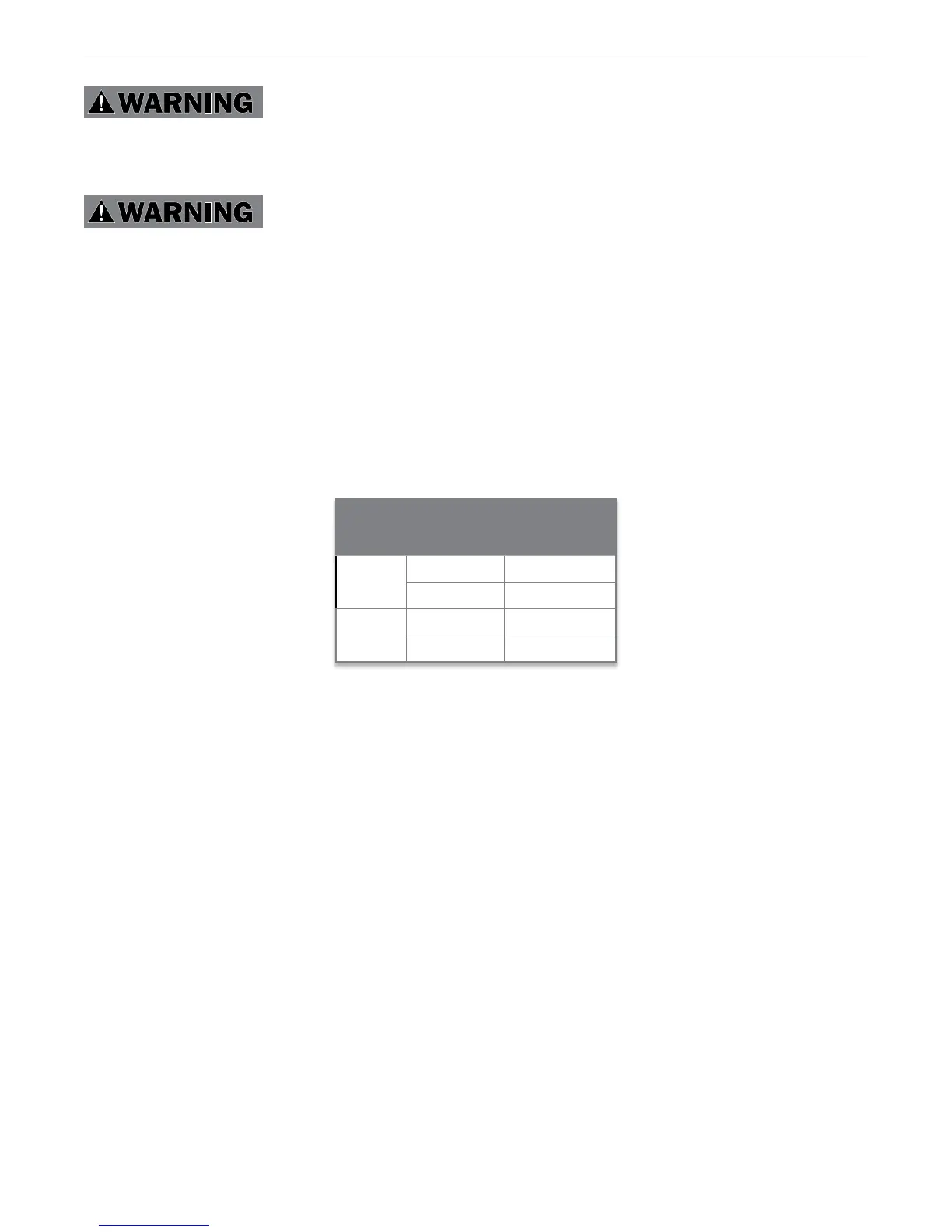
It is also important to check the wheel lug bolts regularly for tightness. Each lug bolt should be torqued according
to the following:
Check the lug bolts per the following schedule:
1. Aer the initial test, check again aer the rst 50 miles.
2. Recheck every 50 miles for the next 200 miles.
3. ereaer, check before each trip.
Check the lug bolts following periods of excessive braking. Be sure the lug bolts are seated in the counter-sunk holes
of the wheel and keep them free of rust. Refer to the axle manufacturer’s operation and maintenance manual for
additional information concerning the camper’s wheels and lug bolts. (If the tire manufacturers information diers
from the above instructions, follow the tire manufacturers’ directions.)
Changing a Tire
Safety is the rst consideration, if it becomes necessary to change a tire while traveling. (If equipped with an op-
tional spare tire, it will be mounted on the outside rear wall of the camper.) Use the following steps when changing
a tire:
1. If the at/damage occurs while driving, bring your tow vehicle and camper to a controlled and gradual stop.
2. Pull o the road as far as safely possible.
3. Turn on hazard warning ashers.
4. If the at/damage occurs at night, use ares or warning lights also.
5. Use a block to stabilize the opposite wheel.
6. If the wheel has a hub cap, remove it.
TORQUE STAGES
1
st
Stage
Aluminum 45 – 50 /lbs
Steel 60 – 65 /lbs
2
nd
Stage
Aluminum 90 – 95 /lbs
Steel 70 - 75 /lbs


 To Next Page