— 32 —
Tent Camper Owner’s Manual
7. Raise the camper slightly, with a hydraulic or scissors style jack placed directly under the camper frame. Do not
use a bumper style jack, or place any jack under the bumper.
8. Loosen the wheel lug bolts.
9. Use the jack to raise the tire o the road.
10. Remove the lug bolts and keep them together, and store them in an easily accessible place.
11. Remove the wheel and replace with the spare wheel and tire.
12. Replace the lug bolts and tighten by hand.
13. Lower the wheel to the ground and tighten the lug bolts in the sequence previously outlined. (If possible, de-
termine that the bolts are tightened to 90-95 lbs. Recheck the torque at 50 miles, and every 50 miles thereaer,
for the next 200 miles.)
14. Replace the hub cap, and store the old tire, jack, and all tools and safety equipment. Aer changing a at, have
it repaired or replaced as soon as possible. If you nd yourself with a at tire and no spare and you must leave
the camper to nd a replacement, be sure to solidly stabilize the camper to prevent it from moving, or falling
o the jack.
Lp gas sysTem
generaL infOrmaTiOn
e liquid petroleum (LP) gas system in your tent camper furnishes fuel for cooking, optional heating, and hot wa-
ter. LP gas can also be used as an alternate energy source for refrigeration. LP gas is a clean, ecient, and safe form
of energy when proper handling and safety precautions are observed. It enables you to enjoy a comfortable lifestyle
when other forms of energy are not easily utilized.
LP gas is stored as liquid in a special storage tank. e tank is mounted on the frame, at the front of the camper
near the hitch. e tank can be enclosed with an optional vinyl gas bottle cover. e cover protects the tank from
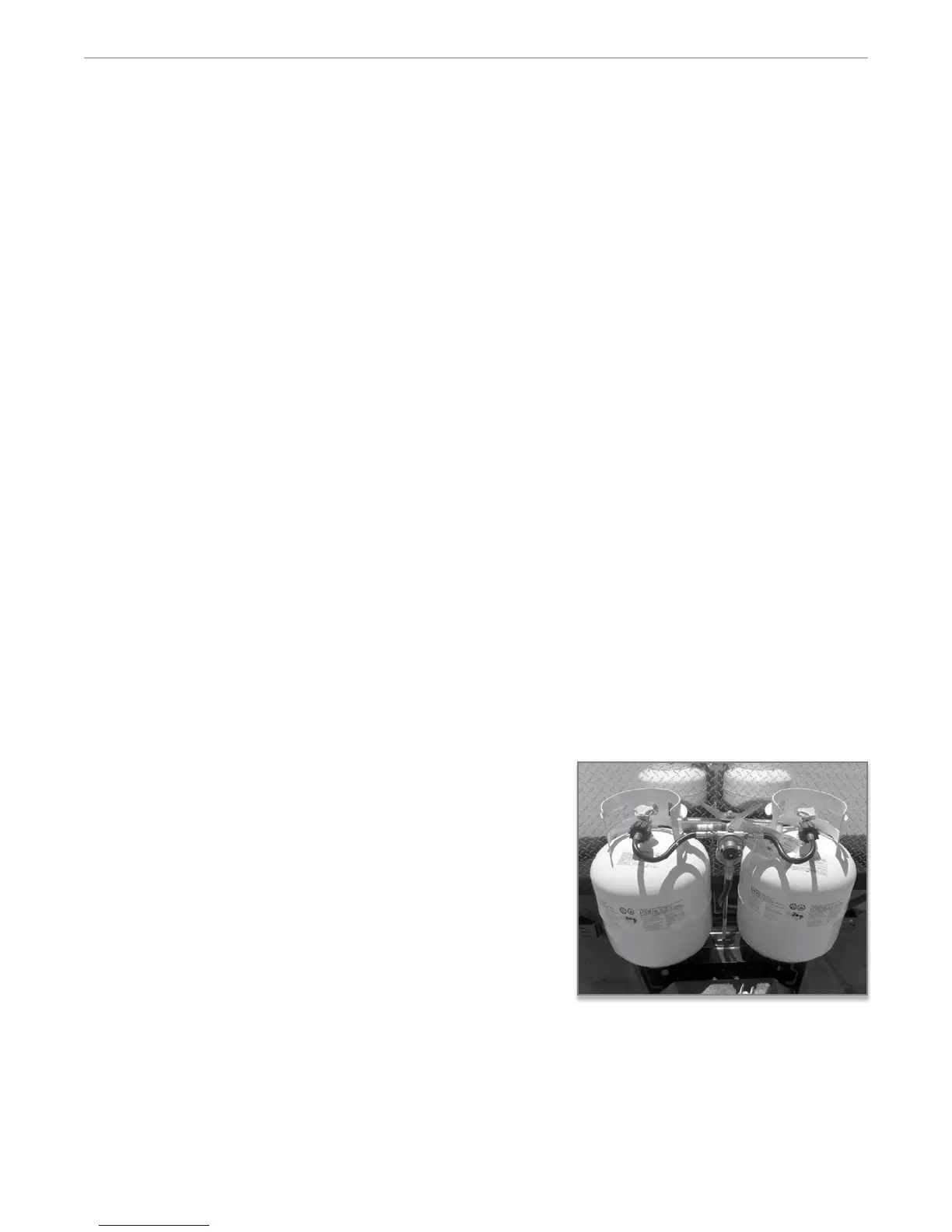
the elements, and objects which may strike the tank while the camper is being towed. Double gas bottles and cover
are also an optional feature.
LP gas is stored in the tank under extreme pressure, leaving space in the tank to allow for expansion into vapor. e
vapor is reduced in pressure, by passing through a regulator. is reduction in pressure is a two step process which
ensures consistent pressure for use, regardless of outside temperatures, weather, or altitude.
Lp gas COnTainers
LP gas containers are tested to withstand pressures in excess of antici-
pated normal usage. Additionally, every LP gas container has a built-in
safety lling feature. e containers are designed to be lled only to
80% of capacity, with liquid LP gas. Filling the container to only 80%
naturally allows 20% for vapor space. e extra space allows vapor
withdrawal through the QCC1 Acme connection, and also allows ex-
pansion space for the liquid. If the tank were completely full, a rise in
outside temperature could result in relief valve discharge of LP gas.
aTTaChing The Lp gas COnTainer TO The Camper (20
L
b. bOTTLe)
1. Attach the LP gas container bracket to the ‘A’ frame using the two ¼ inch 20 NC hex head bolts provided.
2. Place the LP container into the bracket and tighten the clamp ring. Be sure the container is properly seated.
3. Attach the regulator assembly to the service valve. (It is le-hand threaded).
4. Slowly tighten the QCC1 Acme connection. DO NOT OVERT IGHTEN. is is a machined, male, brass tting
which seats against a female tting.


 To Next Page