Cargo Carrying Capacity
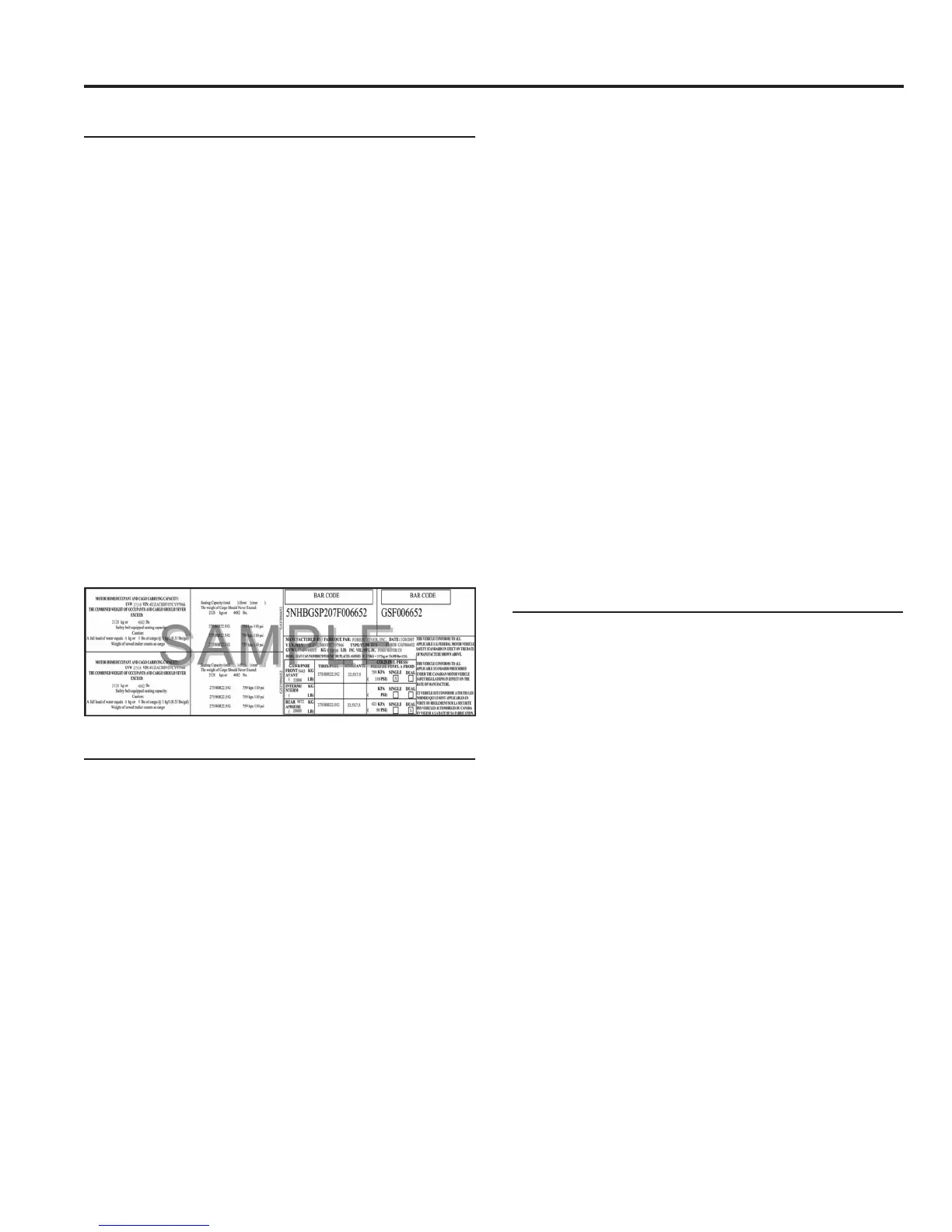
Determining the weight of a vehicle includes more than
understanding the load limits of the tires. A weight certi-
fication label, located or in the driver’s door jam of the
RV, will indicate the gross axle weight (GAWR). This is
the most weight that can be safely supported by each
axle. If there are multiple axles, the GAWR of each axle
will be provided. Look in your Yellow Pages under gravel
pits, storage companies, or recycling facilities to find cer-
tified scales. Call in advance to determine if they offer
public weighing services, their fees, if any, and hours of
operation.
NOTE:
When establishing the cargo capacity, weigh with all
water tanks as empty as possible. (Do not allow anyone
to be in the recreational vehicle when weighing the RV.)
NOTE:
Cargo can be added to the vehicle up to the maximum
weight specified on the weight label. The combined
weight of the RV and its cargo cannot exceed the stated
GVWR.
VEHICLE LOAD LIMITS
Weight Terminology
GVWR - (Gross Vehicle Weight Rating) - Is the maximum
permissible weight of the RV when fully loaded. It
includes all weights, inclusive of all fluids, occupants,
cargo, optional equipment and accessories. For safety
and product performance do NOT exceed the GVWR.
GCWR - (Gross Combined Weight Rating) - Is the maxi-
mum permissible loaded weight of your motor home and
any towed trailer or towed vehicle. Actual GCWR of this
vehicle may be limited by the sum of the GVWR and the
installed hitch receiver maximum capacity rating; see
hitch rating label for detail.
GAWR- (Gross Axle Weight Rating) - Is the maximum
permissible weight, including cargo, fluids, optional
equipment and accessories that can be safely supported
by each axle.
UVW (Unloaded Vehicle Weight)* - Is the typical weight
of the RV as manufactured at the factory. It includes all
weight at the RV’s axle(s), including full fuel, all fluids
and LP Gas. The UVW does not include cargo, fresh
potable water, additional optional equipment or dealer
installed accessories.
*Estimated Average based on standard build optional
equipment.
CCC (Cargo Carrying Capacity) ** - Is the amount of
weight available for fresh potable water, cargo, passen-
gers, additional optional equipment and accessories.
CCC is equal to GVWR minus UVW. Available CCC
should accommodate fresh potable water (8.3 lbs per
gallon). Before filling the fresh water tank, empty the
black and gray tanks to provide for more cargo capacity.
** Estimated average based on standard build equipment
Each Forest River RV is weighed at the manufacturing
facility prior to shipping. A label identifying the unloaded
vehicle weight of the actual RV and the cargo carrying
capacity is applied to every Forest River RV prior to leav-
ing our facilities.
The load capacity of your RV is designated by weight,
not by volume, so you cannot necessarily use all avail-
able space when loading your RV.
Actual towing capacity is dependent upon your particular
loading and towing circumstances, which includes the
GVWR, GAWR and GCWR as well as adequate trailer
brakes. Please refer to the Operator’s Manual of your
vehicle for further towing information.
Weighing Your Motorhome
In order to properly compute your load and load distribu-
tion, you must know both actual scale weights and the
GAWR and GVWR found on the Weight Label on the
motorhome. Weigh the motorhome with all anticipated
passengers, equipment, luggage, and fluids onboard as
if you were beginning your trip. You will also need to
weigh the motorhome periodically to ensure you are
maintaining the correct weight and load distribution.
To properly weigh your motorhome, follow this pro-
cedure:
1. With all passengers in their seats and the RV fully
loaded and level, pull onto the scales until the front
axle ONLY is on the scale. Check the weight
against the front gross axle weight rating.
2. Pull forward until both axles are on the scale. Check
the weight against the gross vehicle weight rating.
3. Pull forward again so that only the rear axle is on
the scale. Check the weight against the rear gross
axle weight rating.
WEIGHING, LOADING AND TOWING
19


 To Next Page