36
|
Chainsaw Operator’s Manual
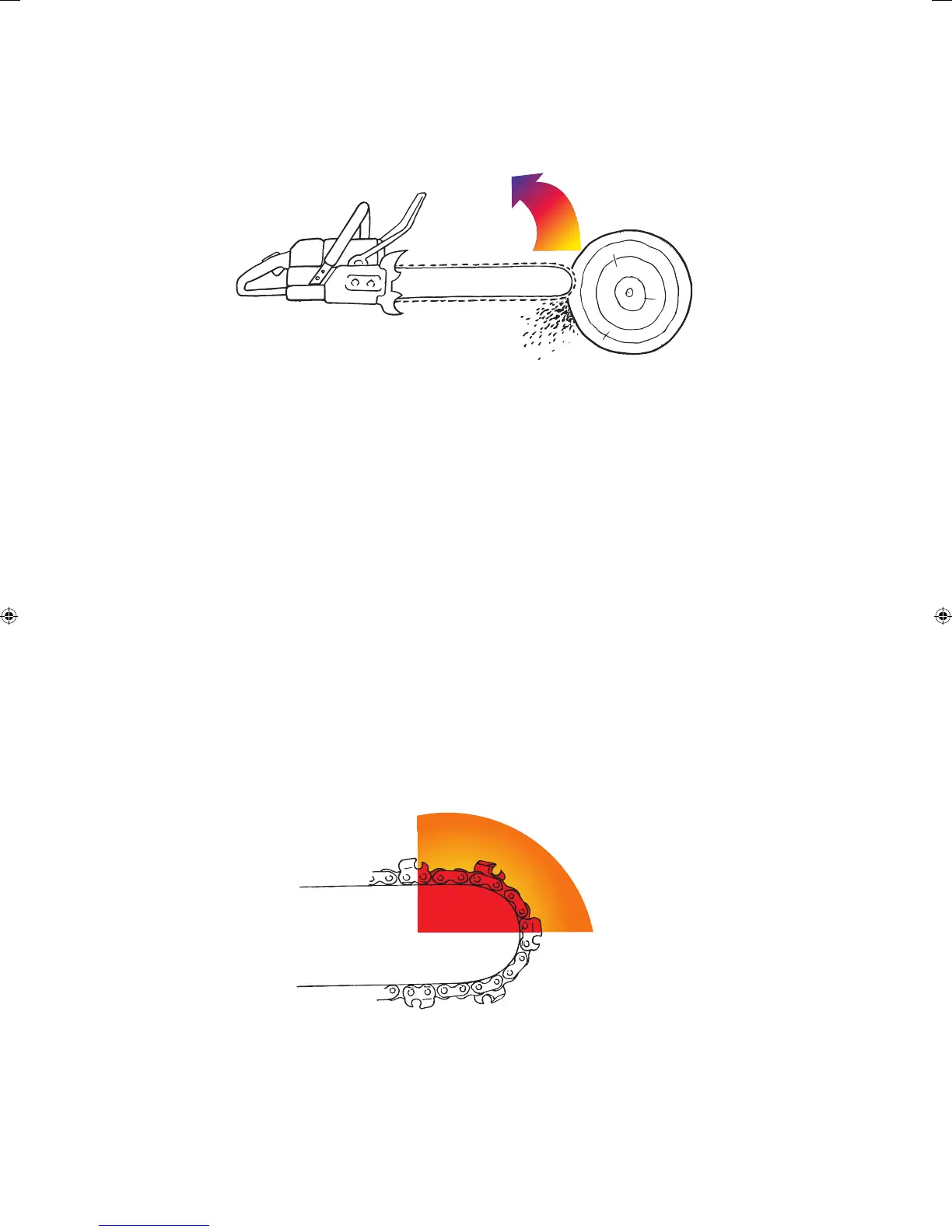
Kickback reaction when contact with the tip or upper quadrant of the guide bar nose results in
the chainsaw being thrust upwards and backwards in an uncontrolled arc. Kickback reaction
generally takes only a fraction of a second to occur.
Figure 55: Chainsaw kickback reaction.
When cutting with the chainsaw guide bar in the vertical position, kickback reaction normally
results in the chainsaw being violently flung back in the direction of the operator.
In the horizontal position, the reaction will result in the chainsaw ‘kicking out’ sideways which could
be potentially dangerous for bystanders.
Kickback is one of the most common causes of chainsaw accidents. You can help reduce kickback
by:
• maintaining a firm grip and balanced stance. The saw must not be in line with your face, but
should be slightly to the right of the body.
• cutting at peak revs
• being aware of where the nose of the bar is at all times
• using correct cutting techniques
• making sure the chain is sharp and correctly tensioned
• ensuring correct depth gauge setting
• selecting a narrow profile sprocket tipped bar. This decreases the risk of kickback by reducing
the size of danger area in the upper quadrant of the nose. There are also less cutters in the
danger area at any one time.
Kickback zone
Figure 56: Kickback reaction zone.
070902 Chainsaw Manual 3pp.indd 36 2/09/09 17:17:19
Chainsaw Operator's Manual:
Chainsaw Safety, Maintenance and Cross-cutting Techniques,
by ForestWorks
Published by CSIRO Publishing, 2009, 64pp
©ForestWorks 2009
http://www.publish.csiro.au


 To Previous Page
 Loading...