Chainsaw Operator’s Manual
|
25
Saw chain sharpening
It is essential that the saw chain is kept sharp. Signs that a saw needs sharpening include:
• you have to apply pressure to make the saw cut
• the cut material is coming out as fine dust rather than ‘chip’
• the saw ‘dishes’ or runs off instead of cutting straight
• damage is present on the chrome surface of top plate or side plate.
Preparation for sharpening
• Don’t attempt to sharpen an oily or wet chain. Cut some dry wood to clean the chain.
• File a little bit often, rather than a lot at once.
The art of sharpening is to ‘hone’ rather than to remove a lot of metal.
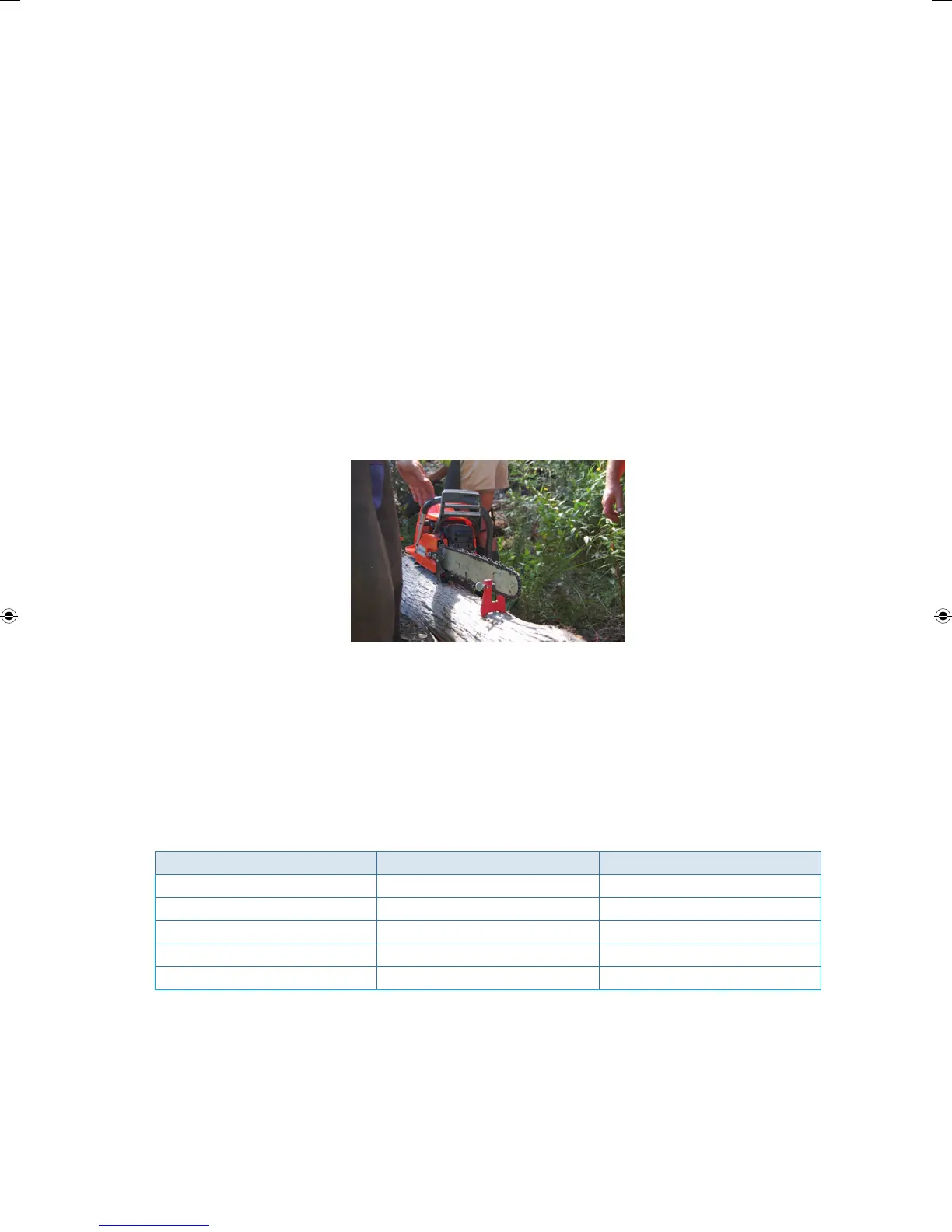
• Make sure the saw is firmly positioned and the bar guide is secured. A stump vice can be used if
working in the bush.
• Position the guide bar in the vice so that your wrists are not over the chain. Generally it is best
to secure the guide bar near the tip, but without force on the sprocket nose.
• Match file diameter to file guide and pitch of chain (refer to Table 4 below).
Figure 38: Using a stump vice.
Round file diameter
Always use the correct diameter file for the particular chain. File diameter is governed by the
chain’s pitch. Generally the larger diameter file is used until the cutter is half worn, then the smaller
diameter file is used.
Table 4: File diameter and chain pitch.
Chain pitch File diameter (round file) Gauge
1/4” 5/32” (4.0 mm) 0.65 mm
0.325” 5/32” (4.0 mm) to 3/16” (4.8 mm) 0.65 mm
3/8” Low Profile 3/16” (4.8 mm) 0.65 mm
3/8” Standard 13/64” (5.2 mm) to 7/32” (5.5 mm) 0.65 mm
0.404” Standard 7/32” (5.5 mm) 0.80 mm
070902 Chainsaw Manual 3pp.indd 25 2/09/09 17:17:18
Chainsaw Operator's Manual:
Chainsaw Safety, Maintenance and Cross-cutting Techniques,
by ForestWorks
Published by CSIRO Publishing, 2009, 64pp
©ForestWorks 2009
http://www.publish.csiro.au



 To Next Page