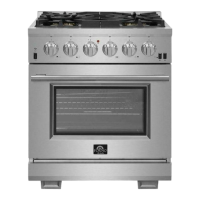
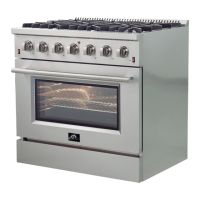
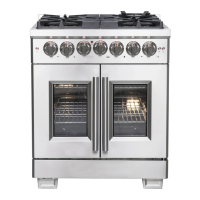
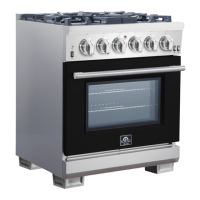
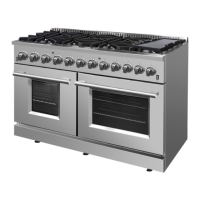
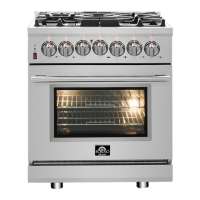
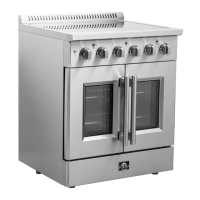
This document is an installation and user manual for FORNO Freestanding French Door Electric Ranges, specifically models FFSEL6917-30 and FFSEL6917-36. It provides comprehensive information on the appliance's functions, usage, and maintenance.
The FORNO electric range is designed for domestic (household) food cooking and is not suitable for non-domestic or commercial applications. It features a cooktop with multiple heating elements and an electric oven with various cooking functions. The range is equipped with safety features such as an anti-tip device and requires proper electrical grounding for safe operation.
Function Description
The electric range serves as a versatile cooking appliance, combining a cooktop for surface cooking and an oven for baking, broiling, and convection cooking.
Cooktop: The cooktop features multiple heating elements of different wattages to accommodate various cooking needs. Model FFSEL6917-30 has four burners: one 100W, one 1200W, one 2200W, and one 3000W. Model FFSEL6917-36 has five burners: two 1200W, one 100W, one 2200W, and one 3000W. These elements are controlled by individual knobs that allow for variable power output from MIN to MAX. An indicator light illuminates when an element is energized.
Electric Oven: The oven offers several cooking functions to achieve different results:
- CONV. HIGH BAKE: This function utilizes both top and bottom heating elements along with a fan for faster heat-up and shorter cooking times. It ensures even heat distribution throughout the oven cavity, making it ideal for baking or cooking on up to three levels. Temperature settings range from 250°F to MAX.
- CONV BAKE: This function uses the bottom heating element and a fan to distribute heat, providing extra bake at the bottom of pastries. Temperature settings range from 250°F to MAX. This function is highlighted as a "Professional Range Oven Cooking quick-start Guide!" and is recommended for batch baking or complete meals, as pre-heating is often unnecessary.
- CONV BROIL: This function employs two strong top heating elements and a fan to spread heat evenly, leading to faster and better cooking results. It is suitable for roasting larger joints of meat or poultry on one level and for browning. The temperature setting should be at Maximum for broiling.
- LOW BAKE: This function uses the bottom heating elements for baking on one level. It is suitable for delicate items like cakes, muffins, pizzas, and egg dishes. Temperature settings range from 250°F to MAX.
- BROIL: This function uses two strong top heating elements to provide direct radiant heat onto the food. It is designed for broiling large quantities of food and cooking faster than the normal baking function. The temperature setting should be at Maximum.
Usage Features
The range is designed for user-friendly operation with several features enhancing its usability:
- Control Knobs: Both the cooktop heating elements and oven functions are controlled by intuitive knobs. For cooktop elements, users push in and turn the knob to the desired power setting. For oven functions, a dedicated oven function knob selects the cooking mode, while a separate temperature control knob sets the desired temperature.
- Oven Racks: The oven includes multiple racks for flexible placement of cookware. Instructions are provided for easy installation and removal of these racks.
- Oven Light: The oven is equipped with an interior light, controlled by a push switch on the control panel, allowing users to monitor cooking progress without opening the oven door.
- French Door Design: The French door design of the oven provides a stylish aesthetic and potentially easier access to the oven cavity.
- Leveling System: The range includes adjustable leveling legs at the bottom, allowing users to ensure the appliance is level with existing countertops for a seamless look and stable operation.
- Door Handle Installation: The door handles are not pre-installed but can be easily attached by aligning them with screws and tightening them with a hexagon socket screwdriver.
Maintenance Features
Regular care and maintenance are crucial for the longevity and optimal performance of the FORNO electric range. The manual provides guidelines for cleaning various parts of the appliance:
- General Recommendation: It is advisable to clean the appliance when it is cold, especially enameled parts. Alkaline or acidic substances (like lemon juice, vinegar) should be avoided on surfaces, as should cleaning products with chlorine or an acidic base. The oven should be cleaned regularly after every use.
- Enameled Parts: These parts should be cleaned with a sponge and soapy water or other non-abrasive products, then dried with a chamois leather. Prolonged contact with acidic substances can etch and dull the enamel.
- Stainless Steel Elements: Stainless steel surfaces can be wiped with a wet cloth. For stubborn dirt, a specific non-abrasive product or a little hot vinegar can be used. Discoloration around the heater may occur due to high temperatures and frequent use.
- Inside of Oven: The oven interior should be cleaned regularly. When the oven is warm, the inside walls can be wiped with a cloth soaked in very hot soapy water or another suitable cleaning product. The self-clean function, if available (though not explicitly detailed for these models, it's mentioned in general safety instructions regarding fire), can also help reduce grime.
- Cooktop: The glass cooktop requires careful handling to avoid scratches and breakage. It should not be used if broken. Items that can melt or catch fire should not be stored on the cooktop, especially when not in use. Cookware should have flat bottoms and match the element size to prevent spills and maximize efficiency.
- Oven Light Replacement: Instructions are provided for safely replacing the 40-watt halogen oven light bulb after disconnecting power and allowing the oven to cool.
The manual also emphasizes important safety precautions, such as installing the anti-tip device, avoiding unattended operation of the cooktop, keeping flammable materials away from the range, and proper grounding of the electrical connection. Troubleshooting tips are included to help users resolve common issues before calling for service.


 To Next Page
 General