EasyManua.ls Logo

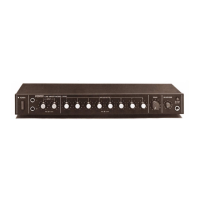
Fostex 250 - Front Panel Features; Rear Panel Features

Fostex 250
28 pages
Print Icon
To Next Page IconTo Next Page
To Previous Page IconTo Previous Page
Loading...
<c)
If
you
press
PLAY
on
the
control
panel,
and
subsequently
press
the
REMOTE
FOOT
SWITCH
(PUNCH-
IN/PUNCH-OUT):
Until
the
first
time
the
REMOTE
FOOT
SWITCH
is
actuated,
which
puts
the
unit
in
the
RECORD
mode,
the
transport
will
be
in
play
mode
(after
the
second
actuation
of
the
switch,
the
unit
returns
to
this
mode).
After
the
REMOTE
FOOT
SWITCH
has
been
actuated
once,
the
transport
will
behave
as
though
the
RECORD
and
PLAY
buttons
had
been
pressed
simultaneously,
as
in
<b)
above,
and
sequentially
alternate
between
RECORD
and
PLAY
modes
with
each
depressing
of
the
FOOT
SWITCH.
17.
STOP
BUTTON
Depressing
the
STOP
button
cancels
any
transport
function
and
stops
tape
motion.
(Whether
tape
is
moving
due
to
ZERO
RETURN,
REWIND,
F.
FWD,
RECORD
or
PLAY,
tape
motion
will
stop.)
18.
PLAY
BUTTON
Depressing
the
PLAY
button
places
the
transport
in
play
mode,
advancing
tape
onto
the
takeup
reel
(from
left
to
right)
at
a
constant
speed
of
3-3/4
ips
(9.5
cm/s),
plus
or
minus
any
deviation
set
with
the
PITCH
control
[22],
19.
FAST
FORWARD
BUTTON
(F.
FWD
/
>
>)
Depressing
this
button
cancels
any
other
transport
function
and
causes
the
tape
to
wind
onto
the
takeup
reel
(from
left
to
right)
at
high
speed.
If
the
transport
had
been
in
rewind
or
ZERO
RETURN
mode,
tape
will
first
stop
mo¬
mentarily,
then
begin
forward
winding.
20.
REWIND
BUTTON
(<
<)
Depressing
this
button
cancels
any
other
transport
function
and
causes
the
tape
to
wind
onto
the
supply
reel
(from
right
to
left)
at
high
speed.
If
the
transport
had
been
in
fast
forward
or
play
mode,
tape
will
first
stop
momen¬
tarily,
then
begin
rewinding.
21.
ZERO
RETURN
BUTTON
Depressing
this
button
cancels
any
other
transport
function
and
causes
the
tape
to
wind
onto
the
supply
reel
(from
right
to
left)
at
high
speed
until
the
INDEX
COUNTER
[15]
displays
0000,
at
which
point
the
tape
automatically
stops.
If
the
transport
had
been
in
fast
forward
or
play
mode,
tape
will
first
stop
momentarily,
then
begin
rewinding
to
0000.
If
the
transport
had
been
in
rewind
mode,
it
will
continue
rewinding
until
the
counter
displays
0000.
22.
PITCH
CONTROL
This
control
can
be
used
to
vary
the
constant
tape
winding
speed
by
±
10%
during
record
or
play
modes.
For
a
nominal
3-3/4
ips
(9.5
cm/s)
tape
speed,
center
the
control
(it
will
‘'click”
into
position).
Turning
the
knob
CCW
decreases
tape
speed,
and
turning
it
CW
increases
tape
speed.
23.
CASSETTE
WELL
AND
COVER
A
transparent
plastic
cover
protects
the
cassette
during
operation.
To
insert
or
remove
a
cassette,
open
the
cover
by
placing
a
finger
under
the
recess
on
the
right
edge
of
the
main
panel
and
lifting
up.
Observe
that
the
raised
edge
of
the
cassette
(where
the
tape
is
visible)
should
face
the
front
of
the
cassette
well.
NOTE:
Use
C-60
or
C-90
cassettes
(not
C-
/20J.
The
bias
and
tape
equalization
are
suitable
for
gammaferric
oxide
tape
that
requires
high
bias
level
and
70
microsecond
EQ.
For
optimum
results,
use
only
this
type
of
tape
(eg.,
TDK-SA,
MAXELL
UD
XL-lt,
or
equivalent).
24.
POWER
SWITCH
Actuating
this
switch,
located
at
right
of
the
rear
panel,
turns
on
the
power
to
the
mixer
electronics
and
the
tape
trans¬
port.
The
VU
meter
faces
will
be
illumi¬
nated
if
power
is
on
and
the
unit
is
plug¬
ged
into
a
‘'live”
AC
outlet.
FRONT
PANEL
FEATURES
Front
Panel
25.
CHANNEL
INPUT
(MIC/LINE)
JACKS
(applies
to
1
through
4)
This
standard
phone
jack
accepts
any
low
or
high
impedance,
unbalanced
input
from
nominal
-60
dB
(mic)
to
-
10
dB
(line),
depending
on
the
setting
of
the
channel’s
LIN
E/M
1C
trim
control
[2],
The
jack
is
“live”
only
when
the
channel's
INPUT
selector
switch
[3]
is
set
to
LINE/MIC
position.
26.
HEADPHONE
JACKS
(two
stereo
phone
jacks)
Two
stereo
HEADPHONE
jacks
are
provided
(parallel
wired)
so
that
two
pair
of
phones
may
be
used
at
once.
Rated
for
8
ohm
or
higher
impedance
phones,
these
outputs
carry
the
signal
from
the
MONMIX.
The
operator
can
use
one
jack
to
monitor
the
mix,
and
a
performer
can
use
the
other
for
cues
during
over¬
dubs
and
inserts.
REAR
PANEL
FEATURES
Rear
Panel
NOTE:
All
rear
panel
input
and
output
jacks
(except
the
REMOTE
PUNCH-IN/
PUNCH
OUT
foot
switch
phone
jack)
are
unbalanced
phono
jacks
(RCA
type
pin
jacks).
They
operate
at
nominal
-10
dBV
levels
(0.3
Vrms)
Inputs
accept
low
or
high
impedance
sources;
outputs
are
intended
to
drive
high
impedance
loads.
These
levels
and
im¬
pedances
are
compatible
with
most
line
level
mixers,
tape
recorders,
power
amplifiers,
and
signal
processors
or
effects
devices.
Refer
to
Section
9
for
additional
interface
information.
27.
TAPE
OUT
JACKS
(applies
to
1
through
4)
These
jacks
carry
an
output
corre¬
sponding
to
the
tape
track
of
the
same
number
(e.g.,
track
3
appears
at
jack
#3).
These
output
signals
will
be
the
record
input
signals
(4
CHAN
BUSS
OUT)
when
the
transport
is
in
record
mode,
and
tape
out
signals
(sync)
when
in
the
play
mode.
In
other
words,
the
playback
signals
are
output
here
when
the
RECORD
TFtACK
button
is
depressed,
then
change
to
the
record
input
signal
when
the
transport
is
put
in
the
record
mode.
28.
AUX
IN
JACKS
(AUX
1
and
2)
These
jacks
apply
a
stereo
signal
to
RCV
1-2
ahead
of
the
MASTER
1-2
FADER
[13].
The
signal
levels
applied
to
CHAN
1
and
CHAN
2
of
the
4
CHAN
BUSS
are
adjustable
by
means
of
the
RCV
control
[11).
29.
LINE
OUT
JACKS
(LINE
OUT
1-2)
These
jacks
carry
the
output
from
the
BUSS
CHAN
1
and
BUSS
CHAN
2
of
the
4
channel
buss.
The
LINE
OUT
signal
level
is
adjustable
by
means
of
the
MASTER
1
-2
FADER
[13].
The
LINE
4

Related product manuals