EasyManua.ls Logo

Fostex G16 - Page 43

Fostex G16
124 pages
Print Icon
To Next Page IconTo Next Page
To Previous Page IconTo Previous Page
Loading...
lissajous
waveform.
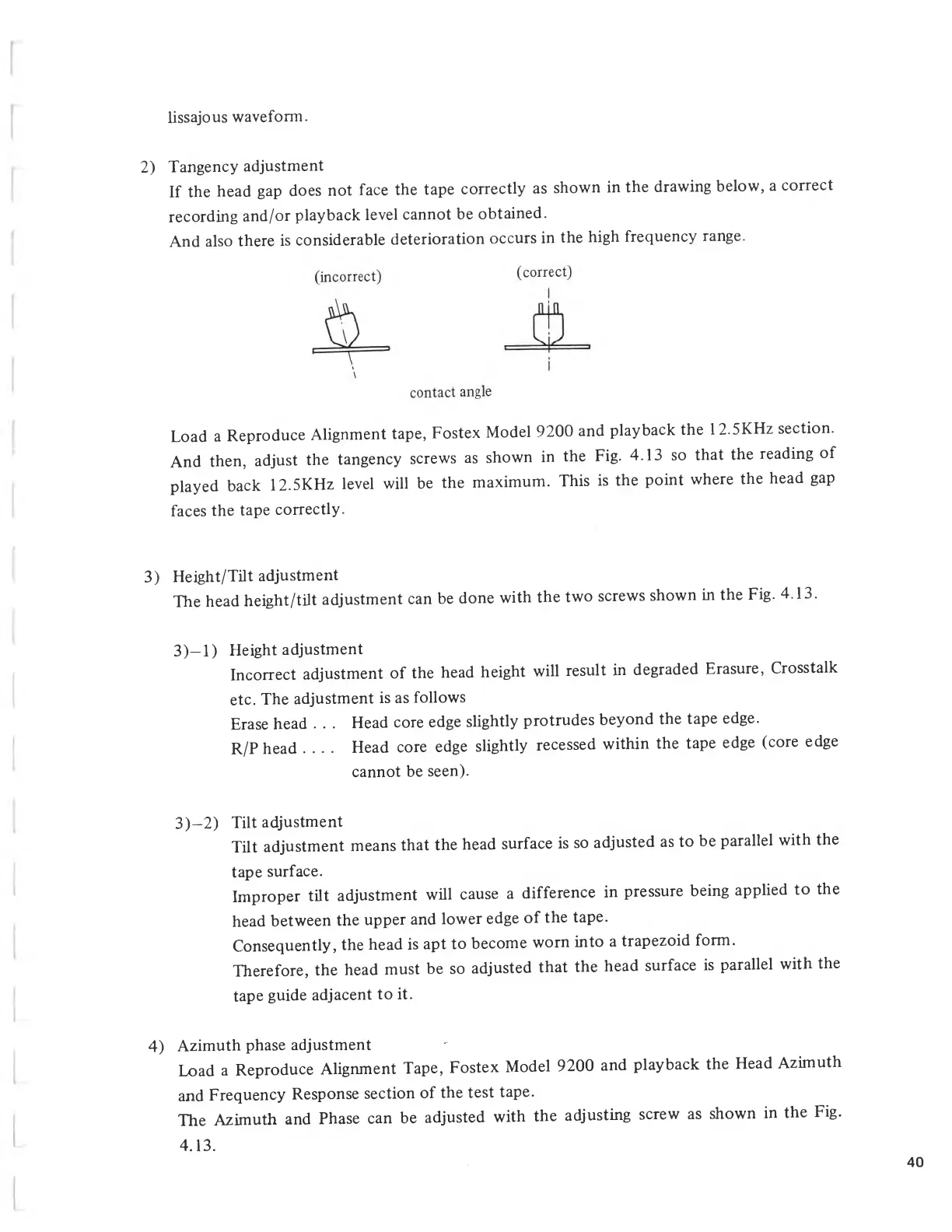
2)
Tangency
adjustment
If
the
head
gap
does
not
face
the
tape
correctly
as
shown
in
the
drawing
below,
a
correct
recording
and/or
playback
level
cannot
be
obtained.
And
also
there
is
considerable
deterioration
occurs
in
the
high
frequency
range.
Load
a
Reproduce
Alignment
tape,
Fostex
Model
9200
and
playback
the
12.5KHz
section.
And
then,
adjust
the
tangency
screws
as
shown
in
the
Fig.
4.13
so
that
the
reading
of
played
back
12.5KHz
level
will
be
the
maximum.
This
is
the
point
where
the
head
gap
faces
the
tape
correctly.
3)
Height/Tilt
adjustment
The
head
height/tilt
adjustment
can
be
done
with
the
two
screws
shown
in
the
Fig.
4.13.
3)-l)
Height
adjustment
Incorrect
adjustment
of
the
head
height
will
result
in
degraded
Erasure,
Crosstalk
etc.
The
adjustment
is
as
follows
Erase
head
.
.
.
Head
core
edge
slightly
protrudes
beyond
the
tape
edge.
R/P
head
....
Head
core
edge
slightly
recessed
within
the
tape
edge
(core
edge
cannot
be
seen).
3)
2)
Tilt
adjustment
Tilt
adjustment
means
that
the
head
surface
is
so
adjusted
as
to
be
parallel
with
the
tape
surface.
Improper
tilt
adjustment
will
cause
a
difference
in
pressure
being
applied
to
the
head
between
the
upper
and
lower
edge
of
the
tape.
Consequently,
the
head
is
apt
to
become
worn
into
a
trapezoid
form.
Therefore,
the
head
must
be
so
adjusted
that
the
head
surface
is
parallel
with
the
tape
guide
adjacent
to
it.
4)
Azimuth
phase
adjustment
*
Load
a
Reproduce
Alignment
Tape,
Fostex
Model
9200
and
playback
the
Head
Azimuth
and
Frequency
Response
section
of
the
test
tape.
The
Azimuth
and
Phase
can
be
adjusted
with
the
adjusting
screw
as
shown
in
the
Fig.
4.13.
40

Related product manuals