Need help?
Do you have a question about the FoxESS F-G2 Series and is the answer not in the manual?
Describes the assembly, installation, commissioning, maintenance and troubleshooting of Fox products.
This manual is for qualified personnel only. Tasks are for professional technicians.
Explains the types of safety instructions and general information used in the document.
Explains the symbols shown on the inverter and type label.
General safety precautions for installation and operation. Must be followed by qualified personnel.
Details current leakage factors in PV systems and the role of Residual Current Devices (RCDs).
Discusses the necessity and installation of SPDs to protect against over-voltage and lightning.
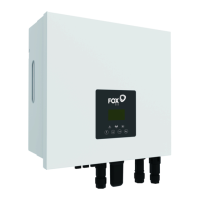
Introduces the series of inverters, covering 3kW to 6kW with 2 MPP trackers.
Lists key features such as DSP control, high-efficiency components, IP65 protection, and HMI.
Identifies and describes the various connectors and ports on the inverter.
Provides the physical dimensions of the inverter unit.
Specifies input parameters including voltage, current, MPPT ranges for different models.
Details AC output specifications such as power, voltage, current, frequency, and THD.
Lists efficiency ratings and built-in safety/protection features of the inverter.
Provides general specifications like weight, operating temperature, altitude, and topology.
Lists all items included in the inverter package for unpacking and verification.
Outlines essential checks and considerations before installing the inverter.
Specifies the minimum clearance dimensions needed around the inverter for installation.
Lists the necessary tools for performing the inverter installation.
Provides step-by-step instructions for mounting the inverter bracket and unit.
Details the procedures for connecting PV strings, DC wiring, and AC grid connection.
Explains how to properly connect the inverter's grounding terminal for safety.
Guides the installation of optional communication modules for monitoring and control.
Describes the inverter's LCD screen, indicator LED, and touch key functions.
Illustrates the menu structure and navigation for inverter settings and operations.
Lists fault codes and provides corresponding solutions for troubleshooting.
Offers guidance on diagnosing and resolving common inverter operational issues.
Details regular checks and cleaning procedures to ensure optimal inverter performance.
Provides instructions for safely disconnecting and removing the inverter.
Specifies requirements for packaging the inverter for transport or storage.
Gives guidelines for storing and transporting the inverter under suitable conditions.


 To Next Page
 General