Need help?
Do you have a question about the Fractal Audio AX8 and is the answer not in the manual?
Explains electromagnetic compatibility and interference guidelines for the device.
Crucial warnings to prevent fire, electric shock, and ensure safe operation.
Welcomes users and introduces the AX8's core features and purpose.
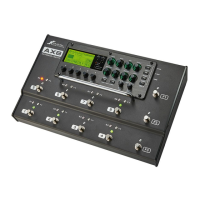
Provides a summary of the AX8's capabilities, presets, footswitches, and connectivity.
Offers tips for existing Axe-Fx users transitioning to the AX8.
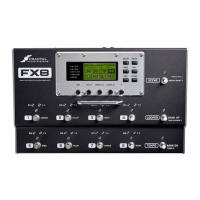
Provides guidance for FX8 owners familiarizing themselves with the AX8.
Step-by-step instructions for basic connection and setup of the AX8.
Essential guide for optimizing input and output signal levels for optimal performance.
Explains the use and benefits of Humbuster cables for reducing ground loop noise.
Details the functions of the AX8's eleven footswitches, divided into F-Switches and numbered switches.
Explains the display and layout of the AX8's default Footswitch Page.
A quick guide on how to assign functions to footswitches 1-8 within a preset.
Introduces the AX8's 12x4 grid system for arranging virtual amp, cab, and effect blocks.
A primer on navigating and editing blocks within the AX8's grid layout.
Describes the controls, display, and indicators on the AX8's top panel.
Details the various input and output connectors located on the back of the AX8.
Covers connecting the AX8 directly to full-range speakers or PA systems.
Explains how to connect the AX8 to a power amp and traditional guitar speakers.
Details how to send separate signals to FOH and a stage amp/cab setup.
Instructions for using the AX8 solely as an effects processor, without amp or cab modeling.
Essential guide for optimizing input and output signal levels for optimal performance.
Guide on connecting and calibrating external expression pedals and footswitches.
Specific instructions for connecting and configuring external footswitches.
Explains how to connect the AX8 to a computer via USB for firmware updates and software editing.
Introduces the three assignable Function Footswitches (F1, F2, F3) and their dual functions.
Details how to assign tap and press-and-hold functions to the F-Switches.
Provides example configurations for assigning functions to the F-Switches.
Defines what a preset is and how it encompasses the entire rig configuration.
Explains the AX8's 12x4 grid system for arranging and connecting effect blocks.
Covers navigating, inserting, and changing effect blocks within the AX8's grid.
Explains the purpose and use of shunts for signal routing in empty grid spaces.
Details how to create and remove cables to connect blocks within the AX8's grid.
Outlines the fundamental rules for creating and connecting blocks using cables in the grid.
Describes how to move blocks, rows, or columns within the AX8's grid layout.
Lists all available effect blocks and their descriptions for use in presets.
Illustrates various preset configurations using the AX8's grid layout.
Guides users on accessing and editing parameters within individual effect blocks.
Explains how to save edited presets, including changing names and locations.
Details how to program the numbered footswitches for specific functions within presets or globally.
Explains how to use X/Y switching to have two sets of parameters for a single block.
Discusses CPU usage, limitations, and automatic block disabling to prevent overload.
Introduces AX8-Edit software for graphical preset editing and management.
Introduces scenes as "mini-presets" that store effect states, X/Y settings, and levels.
Describes the different methods for selecting scenes within a preset.
Guides users on programming effect ON/OFF states and X/Y settings for each scene.
Explains the Scene Revert function and its effect on scene change behavior.
Indicates that the guide is still being developed and refers to other resources.
Comprehensive guide to the AX8's amp modeling capabilities and parameters.
Details how to select different amp models and their associated parameters.
Explains the parameters related to the preamp section of amp models.
Details the parameters for simulating the power amp section of guitar amplifiers.
Covers the cabinet simulation block, including IR loading and microphone selection.
Covers parameters like Cabinet Type and Microphone Type for cab simulation.
Explains input and output modes, and low/high cut filters for cab simulation.
Details the MIX parameters for the Cab block, including Level, Balance, and Bypass.
Guides on loading and using custom impulse response files as User Cabs.
Introduces Cab-Lab software for managing and creating cab files.
Explains the Looper block, its functions, and control modes.
Explains how to operate the Looper block using footswitches and its various functions.
Details parameters for loop mode, quantization, and playback.
Covers manual trimming of loop start and end points for precise control.
Explains MIX parameters like Level, Balance, and Dub Mix for the Looper.
Details how to control Looper functions remotely via MIDI CC messages.
Explains the FX Loop block for integrating external hardware into the signal chain.
Details parameters for routing signals from the FX Loop block to Output 2.
Describes how the FX Loop block can be used for auxiliary output or input routing.
Explains the MIX parameters for the FX Loop block.
Details the Noise Gate block, its parameters, and how to use it to reduce unwanted noise.
Explains how the Output Mixer controls the signal flow from the grid to the main output.
Describes common MIX parameters applicable to various blocks on the AX8.
Introduces modifiers for automating or remote-controlling sound parameters.
Step-by-step guide on assigning sources, MIN/MAX values, and storing modifiers.
A practical tutorial on setting up an expression pedal to control a Wah block.
Lists and explains the various internal and external sources available for modifiers.
Describes built-in controllers like LFOs, ADSR, Sequencer, and Scene Controllers.
Explains how to use MIDI messages or expression pedals as external modifier sources.
Covers advanced settings like MIN/MAX, curves, and shapes for fine-tuning modifiers.
Explains how MIN and MAX parameters define the range of sound changes controlled by modifiers.
Details how START, END, SLOPE, SCALE, and OFFSET create custom modifier response curves.
Explains the Auto-Engage feature for automatically engaging/bypassing effects with a controller.
Guides on synchronizing delay effect timing to the AX8's tempo.
Explains how to sync modulation effects and other RATE parameters to the tempo.
Describes how presets can have their own saved tempo settings or use the global tempo.
Explains how Auto Delay can engage delay blocks when a new tempo is tapped.
Details the built-in metronome function and its level control.
Covers advanced settings for the built-in tuner, including calibration and offsets.
Details parameters for tuner calibration, mute settings, and offset application.
Accesses global settings that affect all presets, like power amp and cab modeling.
Explains global settings for power amp and cab modeling, and global effects mix.
Describes how to globally assign functions to the F-Switches.
Explains how to set footswitches 1-8 to be global or preset-specific.
Covers global EQ and master gain adjustments for outputs 1 and 2.
Allows configuration of custom scales for the Pitch Shifter block.
Accesses settings related to input/output routing, levels, and audio configuration.
Details parameters for setting input and output nominal levels and input padding.
Configures audio routing modes (STEREO, MONO, etc.) for inputs and outputs.
Covers MIDI channel, thru, program change processing, and scene revert settings.
Maps pedals and MIDI CC messages to various AX8 functions and controllers.
Details the functions and calibration of the AX8's pedal jacks.
Provides access to utility functions like LCD contrast, erasing data, status meters, and reset options.
Adjusts the contrast and viewing angle of the built-in LCD display.
Tools for erasing all presets or user cabinets, with a strong caution.
Displays realtime audio meters and CPU utilization percentage.
Shows visual representation of input/output levels and CPU usage.
Resets global, I/O, and tuner settings to factory defaults.
Indicates the current firmware version and provides a link for updates.
How to set up a global volume pedal using an expression pedal without a dedicated block.
Explains how delay and reverb tails can ring out when changing scenes or presets.
Details how to configure footswitch actions for tap and press-and-hold functions.
Answers common user queries regarding operation, troubleshooting, and features.
Guides on transferring individual block settings between Fractal Audio products using editor software.
Explains the Block Library feature for saving and recalling preset block configurations.
A specific tutorial on transferring an Amp block from Axe-Edit to AX8-Edit.
Explains the functions of the A, B, C, D, and E knobs on different menu pages.
Describes context-sensitive functions activated by tapping or double-tapping the EDIT button.
Details the AX8's MIDI protocol, supported messages, and default assignments.
Lists default MIDI CC# assignments for various AX8 functions.
Provides a mapping of MIDI Bank and Program Change messages to AX8 presets.
Outlines the terms, conditions, and limitations of the product warranty.
 General
| Footswitches | 8 |
|---|---|
| Type | Multi-Effects Processor |
| Display | LCD |
| Inputs | 1 x 1/4" Instrument, 1 x XLR Mic |
| Outputs | 2 x XLR |
| MIDI I/O | In, Out/Thru |
| USB | Yes |
| Expression Pedal Inputs | 2 x 1/4" |
| Effects | Drive, Delay, Reverb, Chorus, Flanger, Phaser, Tremolo, Wah, Filter, Pitch, Synth, Compressor, Gate, EQ |

 To Next Page