Need help?
Do you have a question about the Fral DF020 and is the answer not in the manual?
Utilizes refrigeration technology to effectively remove moisture from the air.
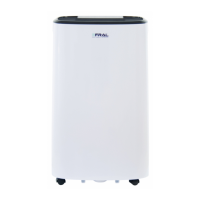
Compact and lightweight unit with casters for easy room-to-room mobility.
Includes automatic defrosting cycles for operation in cooler room temperatures.
Allows users to set and adjust the desired humidity level.
Enables programming the unit to turn on and off automatically.
The dehumidifier operates with a low noise level for comfort.
The unit has low power consumption, making it energy efficient.
Explains the functions and display modes of the 2-digit humidity and timer display.
Details how to power the unit on and off, including child lock function activation.
Describes how to adjust the desired humidity level using the unit's controls.
Explains how to select between high and low fan speeds for operation.
Covers switching between dehumidification and dry clothing modes.
Instructions for setting automatic startup and shutdown timers for the unit.
Provides instructions on how to safely remove and empty the water drainage tank.
Instructions on how to clean the exterior body of the dehumidifier.
Step-by-step guide for removing, cleaning, and reattaching the air filter.
Safety checks for the work area prior to maintenance on systems containing flammable refrigerants.
Instructions for maintenance staff regarding work in local areas and confined spaces.
Ensuring technician awareness of potentially flammable atmospheres using detectors.
Requirement for appropriate fire extinguishing equipment during hot work.
Prohibits ignition sources near refrigerant systems to prevent fire or explosion risks.
Ensuring adequate ventilation before and during work on the system.
Verification of electrical components and refrigeration system charge and ventilation.
Safety checks for electrical components, including capacitor discharge and wiring.
Procedures for disconnecting electrical supplies before working on sealed components.
Guidelines for working on intrinsically safe components in flammable atmospheres.
Checks for wear, corrosion, or adverse effects on equipment cabling.
Prohibits ignition sources when searching for or detecting refrigerant leaks.
Acceptable methods for detecting refrigerant leaks, including electronic detectors.
Procedures for breaking into the refrigerant circuit and removing refrigerant.
Requirements for charging refrigerant systems, including contamination and pressure testing.
Procedures for safely decommissioning the equipment and recovering refrigerants.
Requirements for labeling equipment that has been decommissioned and emptied of refrigerant.
Recommended practices for safely removing and transferring refrigerants during servicing.
Regulations governing the transport of equipment containing flammable refrigerants.
References national regulations for discarded appliances containing flammable refrigerants.
Guidelines for storage package protection to prevent refrigerant leaks in unsold equipment.
 General
| Power Consumption | 330 / 660 W |
|---|---|
| Airflow | 180 m³/h |
| Noise Level | 34 / 48 dB(A) |
| Weight | 6.5 kg |
| Extraction Rate | 20 liters/day |
| Dehumidification Capacity | 20 liters/day |

 To Next Page