
 Need help?
Do you have a question about the Frigidaire FFEC3225MW and is the answer not in the manual?
This document serves as a comprehensive Use & Care Manual for a Frigidaire cooktop, providing detailed instructions for its operation, maintenance, and troubleshooting. It is designed to help users maximize the appliance's performance and longevity while ensuring safety.
The cooktop is primarily designed for surface cooking, offering various heating elements to accommodate different cooking needs. Users can select from single radiant surface elements, dual radiant surface elements (on specific ceramic glass cooktop models), and a warm zone feature (also on some ceramic glass cooktop models). The appliance is equipped with control knobs that allow users to adjust the heat settings from LOW (LO) for keeping food warm, melting, and simmering, to HIGH (HI) for starting most foods, bringing water to a boil, and pan broiling. Intermediate settings like MEDIUM LOW (2-3) are suitable for poaching and stewing, MEDIUM (4-6) for slow boils, thickening sauces, and steaming vegetables, and MEDIUM HIGH (7-8) for rapid boils, frying, and deep-fat frying. The cooktop's radiant surface elements are designed to heat gradually and evenly, glowing red as the temperature rises and cycling ON and OFF to maintain the selected setting. This design allows residual heat to complete the cooking process, promoting energy efficiency.
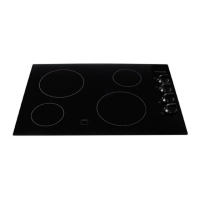
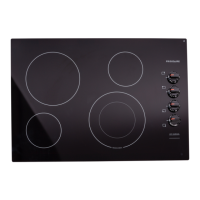
For ceramic glass cooktop models, the surface elements are located beneath the glass, and heat is transferred directly to the cookware. It is crucial to use flat-bottom cookware that matches the diameter of the element outline to ensure efficient heat transfer and prevent damage. The manual warns that areas surrounding the elements can become hot enough to cause burns. Some ceramic glass cooktops feature expandable radiant elements (double or triple circuits) that can be adjusted for different cookware sizes, indicated by symbols around the control knob. The small digits on the knob activate the inner coil, while the large digits activate both inner and outer coils.
The warm zone feature, available on some ceramic glass cooktop models, is designed to keep hot cooked foods at serving temperature. It is not recommended for heating cold food. Foods placed in the warm zone should be covered with a lid or aluminum foil to maintain quality, with an opening for moisture to escape when warming pastries or breads. The warm zone control can be set to HI, MED, or LO, with the hot surface indicator light glowing until the glass cooktop cools down.
Safety is a paramount concern, and the manual includes extensive "Important Safety Instructions." Users are advised to read all instructions before use, save them for future reference, and understand the definitions of WARNING, CAUTION, and IMPORTANT symbols. Key safety practices include proper installation and grounding by a qualified technician, never leaving children alone near the appliance, avoiding touching hot surfaces, wearing proper apparel, and using only dry pot holders. Specific warnings for cooktops with coil elements include not immersing or soaking removable surface heating elements and ensuring drip pans are in place. For ceramic-glass cooktops, users are cautioned against cleaning or operating a broken cooktop, placing hot cookware on cold glass, sliding pans, or letting pans boil dry, as these actions can cause damage or injury. The manual also emphasizes the importance of knowing which knob controls each surface unit, cleaning the appliance regularly to prevent grease fires, using proper pan sizes with handles turned inward, and never leaving surface units unattended.
Maintenance features are detailed in the "Care & Cleaning" section, which provides instructions for various parts of the cooktop. Before cleaning, all controls must be turned OFF, and the cooktop must be cool. Regular cleaning is encouraged to prevent heavy soiling. For aluminum trim pieces, hot, soapy water and a cloth are recommended. Glass, painted, and plastic parts, as well as control knobs, body parts, and decorative trim, should be cleaned with hot, soapy water and a cloth, avoiding abrasive cleaners. The control panel should be wiped clean after each use, with knobs removed for thorough cleaning.
For surface elements and drip bowls, the manual explains that elements clean themselves during normal operation, but food spills on cool elements can be cleaned with a damp cloth. Drip bowls can be washed in hot, soapy water or in a dishwasher. Stubborn, burned-on soils can be removed by soaking in a diluted liquid cleanser or an ammonia-water solution, followed by scrubbing with a nylon scrubber. Abrasive cleansers or steel wool should be avoided to prevent scratching.
Porcelain enamel cooktops can be cleaned with a soapy scouring pad for most spots, followed by rinsing with a 1:1 solution of clear water and ammonia for difficult spots. Spray oven cleaners should not be used on porcelain enamel. Stainless steel and brushed chrome decorative trim should be cleaned with a clean cloth and water, with a soapy nylon mesh scouring pad used carefully on stainless steel. Metal-type scouring pads are not recommended for brushed chrome.
Ceramic glass cooktop cleaning and maintenance require special attention. Before first use, and for ongoing maintenance, users should apply CERAMA BRYTE® Cleaning Creme to the ceramic surface, buffing with a non-abrasive cloth or pad. This creates a protective finish that helps prevent scratches and abrasions and makes cleaning easier. Metal markings from aluminum or copper clad pans should be removed immediately after the cooktop cools to prevent them from becoming permanent. Users are warned not to slide metal or glass objects across the cooktop, use it as a cutting board, cook food directly on the surface without a pan, or drop heavy objects on it. For light to moderate soil, a few drops of CookTop® Cleaning Creme on a paper towel or non-abrasive plastic pad are recommended. For heavy, burned-on soil, the creme should be applied to the soiled area and rubbed with a non-abrasive plastic pad, applying pressure as needed. A metal razor blade scraper, held at a 30-degree angle, can be used for stubborn soils.
For coil elements, cleaning should only be done when they are cold and controls are OFF. Coil elements should never be immersed in water. The cooktop top can be raised for cleaning underneath by grasping the sides and lifting from the front, with some models featuring a lift-up rod for support.
The "Before You Call" section provides a troubleshooting guide for common problems, helping users identify and resolve issues before contacting service. This includes solutions for the cooktop not operating, surface elements not heating or being too hot, uneven food heating, scratches or abrasions on ceramic glass, metal marks, and pitting or rusting of drip bowls. For example, if the entire cooktop does not operate, possible causes include a blown house fuse or tripped circuit breaker, incomplete service wiring, or a power outage. If a surface element does not heat, it could be due to a too-low heat setting or the incorrect control being used. Uneven food heating might be caused by lightweight or warped pans, incorrect voltage, or improper cookware. Scratches on ceramic glass can result from coarse particles between the cooktop and utensil, using unrecommended cleaning materials, or cookware with rough bottoms. Metal marks are typically caused by sliding or scraping metal utensils.
Overall, the manual emphasizes safe and effective use, proper cookware selection, and consistent cleaning practices to ensure the cooktop remains in optimal condition. It also includes a "Major Appliance Warranty" section, outlining the terms and exclusions of the one-year limited warranty provided by Electrolux.
 General
| Brand | Frigidaire |
|---|---|
| Model | FFEC3225MW |
| Product Type | Cooktop |
| Fuel Type | Electric |
| Cooktop Style | Smoothtop |
| Element Type | Radiant |
| Surface Material | Ceramic Glass |
| Color | White |
| Installation Type | Drop-In |
| Voltage | 240 V |
| Power Output | 1200 |


 To Next Page