Need help?
Do you have a question about the Fringer EF-GFX Pro and is the answer not in the manual?
Explains the self-test process for untested lenses, including calibration and troubleshooting steps.
Details managing image cropping for EF lenses on GFX cameras using the 35mm mode setting.
Guides on setting aperture via electronic ring/dial and shutter speed manually for optimal exposure.
Discusses AF on GFX cameras, focus point selection, and AF modes (AF-S, AF-C) for performance.
Explains the interaction between lens IS and camera IBIS, their selection, and mode settings for stabilization.
Covers user-configurable software switches and settings adjustments via the SETTINGS.INI file.
Details enabling focus bracketing via SETTINGS.INI and its impact on other camera/adapter functions.
Explains how to configure AF to move to infinity upon power off/playback mode via SETTINGS.INI.
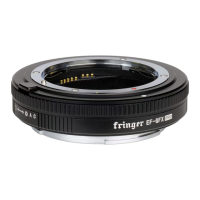
The Fringer EF-GFX Pro is a sophisticated adapter designed to bridge the gap between Canon EF mount lenses and Fujifilm G mount cameras. Its primary function is to enable the use of a vast array of EF lenses on GFX camera bodies, providing electronic control over aperture, autofocus capabilities, and the reporting of lens information for accurate EXIF data recording.
At its core, the adapter facilitates electronic communication between EF lenses and GFX cameras. This includes controlling the lens's aperture electronically, allowing users to adjust it directly from the camera or via the adapter's built-in electronic aperture ring. The adapter also supports autofocus, although its performance can vary depending on the camera model and whether it supports Phase Detection AF (PDAF) or only Contrast Detection AF (CDAF). For GFX100 and GFX100S models, which feature PDAF, the autofocus experience with optimized lenses is significantly enhanced, often mirroring the speed and accuracy of a DSLR. On cameras without PDAF, such as the GFX50s, GFX50r, and GFX50s II, lenses operate in CDAF mode, which may result in slower autofocus speeds and potentially less accuracy, especially since many EF lenses were not originally designed for contrast-based AF. In such cases, manual focus (MF) is often recommended for optimal results.
The Fringer EF-GFX Pro also supports several advanced features. It enables In-camera Lateral Chromatic Aberration (LaCA) Correction, helping to improve image quality by reducing color fringing. Furthermore, it supports both lens built-in image stabilization (IS, OS, VC) and the camera's in-body image stabilization (IBIS) functions. Users can choose which stabilization system to activate, with the lens's IS switch determining the preference upon camera power-on or entry into shooting mode. Generally, IBIS is preferred unless a very long telephoto lens is being used. The stabilization function can be controlled via the "IS MODE" menu, offering "Continuous" (Mode 1) for constant activation or "Shooting only" (Mode 2) for activation during half-press or exposure, respectively.
A unique feature is the adapter's electronic aperture ring, which mimics the functionality of native GF lenses. This contactless design ensures durability and prevents wear issues. The ring allows for precise aperture adjustments in 1/3 EV steps. Turning it right stops down the aperture, while turning it left opens it up. Beyond the smallest aperture, further rotation sets it to 'A' (Auto mode), where the camera determines the aperture, and another step sets it to 'C' (Command mode), allowing aperture control via the camera's command dial.
The adapter also includes a self-test and calibration process for lenses that are not pre-optimized. Upon initial installation of such a lens, the adapter may drive the AF module through its full range, followed by a camera reboot to complete calibration. This process ensures proper AF functionality, and users are advised not to touch the focus ring during this time.
The Fringer EF-GFX Pro offers flexibility in how EF lenses interact with the GFX system. By default, the camera's "35mm mode" is set to "auto," which automatically crops images to 36x24mm when an EF lens is attached. This addresses the fact that EF lenses are designed for full-frame sensors (36x24mm), which are smaller than GFX sensors (44x33mm), thus preventing dark corners, vignetting, and distortion. However, for EF lenses that are known to cover the medium format sensor, users can manually set "35mm mode" to "off" in the camera menu to capture full 44x33mm images.
When setting aperture, while the electronic aperture ring is the preferred method to avoid conflicts with ISO settings on some GFX cameras, control via the camera's command dial is also possible when the aperture ring is set to 'C' mode. For zoom lenses with variable maximum aperture, it's crucial to zoom to the wide end before adjusting the aperture ring between 'A/C' and the smallest aperture setting.
Manual shutter speed setting is suggested to avoid frequent aperture blade movement and associated noise/flashing of the LCD/EVF, which can occur with EF lenses due to their slower and noisier aperture motors compared to native GF lenses.
For autofocus, users are advised to avoid using focus points in the extreme edge areas of the frame, as distortions inherent to EF lenses on GFX cameras can impair AF performance. Focus points in the central 5 or 7 rows are generally more reliable. On PDAF-enabled cameras, adjusting the AF point size can also influence performance, with smaller points potentially offering more accuracy but requiring more light and detail, and larger points potentially increasing success rate at the cost of some accuracy. Both AF-S and AF-C modes are supported on PDAF cameras, along with face/eye detection AF.
The adapter also provides advanced settings accessible via a "SETTINGS.INI" file when connected to a computer. This allows users to configure software switches, such as enabling focus bracketing support, which is disabled by default. When focus bracketing is enabled, it's important to use AF to drive the focus point and avoid manual focus ring adjustments. Enabling focus bracketing also sets the adapter to a "native mode," which may alter some camera functions, such as disabling automatic 35mm mode cropping and potentially affecting IBIS functionality. Another configurable setting is "PowerOffInfinity," which determines whether the lens's AF automatically moves to infinity when the camera powers off or switches to playback mode. This is particularly useful for lenses with external focus designs that are inconvenient to store when not at infinity, though for lenses with heavy front elements, users might prefer to disable this feature to avoid frequent movement.
Firmware updates are a key maintenance feature, allowing users to enhance performance, add support for new lenses, and address any compatibility issues. The update process involves connecting the adapter to a PC or Mac via a Micro B USB cable (provided with the adapter). Users download new firmware files from the Fringer website and copy them to the 'FRINGER' drive that appears when the adapter is connected. The adapter then automatically disconnects and reconnects, applying the update. It's crucial to ensure the adapter is disconnected from the camera body during this process and to only copy official firmware files.
Troubleshooting for firmware updates includes checking the USB cable, as some cables are only for charging and not data transfer. The adapter's firmware version can also be checked on the camera screen by pressing and holding the DISP button while powering on the camera, where it will be displayed as "Lens version." This allows users to verify successful updates and monitor their adapter's software status. The contactless design of the electronic aperture ring also contributes to reduced maintenance needs by eliminating physical wear points.
 General
| Type | Lens adapter |
|---|---|
| Mount Type | EF to GFX |
| Electronic Contacts | Yes |
| Autofocus | Yes |
| Aperture Control | Yes |
| Firmware Updatable | Yes |
| Compatibility | Canon EF lenses to Fujifilm GFX cameras |
| Image Stabilization | Yes (if supported by lens) |
| Material | Aluminum |
| Weight | Approx. 200g |

 To Next Page