Need help?
Do you have a question about the Fringer NF-GFX and is the answer not in the manual?
Guides the automatic calibration process for lenses not in the optimized list.
Explains managing 35mm mode for image cropping and potential vignetting.
Instructions on how to set camera aperture and shutter speed values.
Details AF modes, performance variations, and face/eye detection.
Explains the selection and interaction between lens VR and camera IBIS.
Describes the adapter's support for in-camera optical aberration correction.
Instructions on enabling focus bracketing via SETTINGS.INI file.
Configures the adapter to move AF to infinity when powering off.
Activates lens-specific in-body correction by forcing native lens mode.
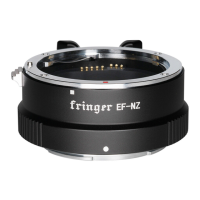
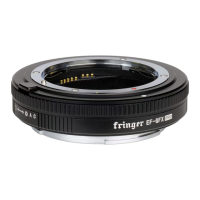
The Fringer NF-GFX User's Manual (Firmware v1.0) describes an adapter designed to bridge Nikon F-mount lenses with Fujifilm G-mount cameras. This device enables electronic control of lens aperture, autofocus, and reports lens information for EXIF recording.
The Fringer NF-GFX adapter is compatible with both Nikon F-mount and Fujifilm G-mount protocols. It features a built-in aperture motor, allowing it to drive the aperture diaphragm of not only Nikon E lenses but also AF, D, and G lenses. This broad compatibility extends to third-party F-mount AF lenses from manufacturers like Sigma and Tamron, supporting electronic aperture control.
A key feature is its support for Phase Detection AF (PDAF) on GFX100 and GFX100S cameras, offering significantly faster and more accurate autofocus performance, akin to using a DSLR. For cameras without PDAF support (e.g., GFX50s, GFX50r, GFX50s II), adapted lenses operate in Contrast Detection AF (CDAF) mode, primarily in AF-S. AF speed and accuracy may be slower in CDAF mode, and AF-C mode is not supported in this configuration. Face/eye detection AF is supported in both PDAF and CDAF modes.
The adapter also supports in-body image stabilization (IBIS) on compatible GFX camera models (like GFX100(S) and GFX50S II), as well as lens built-in Vibration Reduction (VR/OS/VC) functions. However, IBIS and lens VR cannot be activated simultaneously; the choice is determined by the VR switch on the lens when the camera powers on or enters shooting mode. IBIS is automatically enabled if the lens lacks VR. The stabilization function is controlled via the camera's "IS MODE" menu, with "Continuous" (Mode 1) activating IS all the time, and "Shooting only" (Mode 2) enabling lens IS when the shutter release button is half-pressed and IBIS during exposure. Due to the age of some F-mount lenses, "Shooting only" mode may not be reliable, suggesting "Continuous" mode for better performance.
In-body vignetting and distortion correction profiles are embedded in the adapter for specific lenses, as detailed in Table 1 of the manual. These corrections are activated by setting the camera to "native lens mode." However, this mode may degrade IBIS performance for some lenses, particularly those marked "N" in the "Keep IBIS" column. Users can choose to prioritize IBIS by disabling the native lens mode via the SETTINGS.INI file.
The adapter handles the difference in sensor size between full-frame F-mount lenses (36x24mm image circle) and GFX cameras (44x33mm sensor). By default, the camera's "35mm mode" is set to "auto," cropping images to 36x24mm to mitigate vignetting and distortion. Users can force 44x33mm capture by setting "35mm mode" to "off" if the lens covers the medium format sensor. This auto-cropping is bypassed if focus bracketing or in-body vignetting/distortion correction is enabled in SETTINGS.INI.
Focus bracketing is supported but is grayed out by default in the camera menu. It can be enabled by modifying the SETTINGS.INI file, which also sets the camera to "native lens mode," potentially affecting other camera functions. When using focus bracketing, users are cautioned not to manually turn the focus ring, relying instead on AF to set the desired focus position.
An advanced setting allows users to configure whether the AF module moves to infinity when the camera powers off or switches to playback mode. This is particularly useful for lenses with external focus designs, preventing them from being stored with the lens extended.
Lens Self-Test: When a non-tested/non-optimized lens is first installed, the adapter may perform a self-test and calibration, driving the AF module from close end to infinity. During this process, the focus ring should not be touched. Issues with self-test can be cleared by cycling camera power or installing another lens.
Setting Aperture and Shutter Speed: Aperture values are set via the camera's command dial. For Nikon AF/AF-D lenses, the aperture ring on the lens should be set to its minimum position (maximum F number) to avoid interference with the adapter's diaphragm control. Manual shutter speed setting is suggested to prevent frequent aperture blade movement, noise, and LCD/EVF flashing that can occur with auto shutter speed, especially with F-mount lenses' slower aperture motors.
AF Point Selection: Due to potential distortions in edge areas with F-mount lenses on GFX cameras, users are advised to avoid using focus points in the extreme edges, preferring the central 5 or 7 rows for better AF accuracy. On PDAF-supported cameras, different AF point size settings can be experimented with to balance AF success rate and accuracy.
Working Modes: The camera operates in two modes: "adapter mode" and "native lens mode." In adapter mode, focus bracketing is not supported, IBIS is fully supported, and vignetting/distortion correction is not supported. The "Mount adapter setting menu" is available, and "35mm format mode AUTO" crops to 35mm. In native lens mode, focus bracketing and vignetting/distortion correction are supported, but IBIS performance may be degraded for some lenses. The "Mount adapter setting menu" is grayed out, and "35mm format mode AUTO" keeps the 44x33mm frame.
Firmware Update: Firmware updates are performed using a PC or Mac and the Micro B USB cable provided with the adapter. The process involves downloading the firmware file from Fringer's website, connecting the adapter (off the camera) to the computer, copying the firmware file to the "FRINGER" drive that appears, and waiting for the adapter to disconnect and reconnect. The current firmware version can be checked via a "VERSION.TXT" file on the drive or by holding the DISP button on the Fujifilm camera during power-on to view the "Lens version."
Troubleshooting: If the "FRINGER" drive does not appear when connected to the computer, users should check their USB cable, as some cables are for charging only and do not support data transfer.
Advanced Settings (SETTINGS.INI): The adapter contains a "SETTINGS.INI" file in its root folder when connected to a computer. This file allows for advanced configuration, such as enabling focus bracketing, controlling AF movement to infinity, and forcing native lens mode for specific lenses. Users are cautioned against modifying this file unless they understand the implications. Removing the file restores default settings, as the adapter will regenerate it.
The manual includes a comprehensive list of tested and optimized Nikon and third-party F-mount lenses, indicating their compatibility and whether they support in-body vignetting and distortion correction while maintaining IBIS performance. This list is crucial for users to understand the expected behavior and performance of their lenses with the Fringer NF-GFX adapter.
 General
| Brand | Fringer |
|---|---|
| Model | NF-GFX |
| Category | Camera Accessories |
| Language | English |

 To Next Page