Adjusting
top
tensions
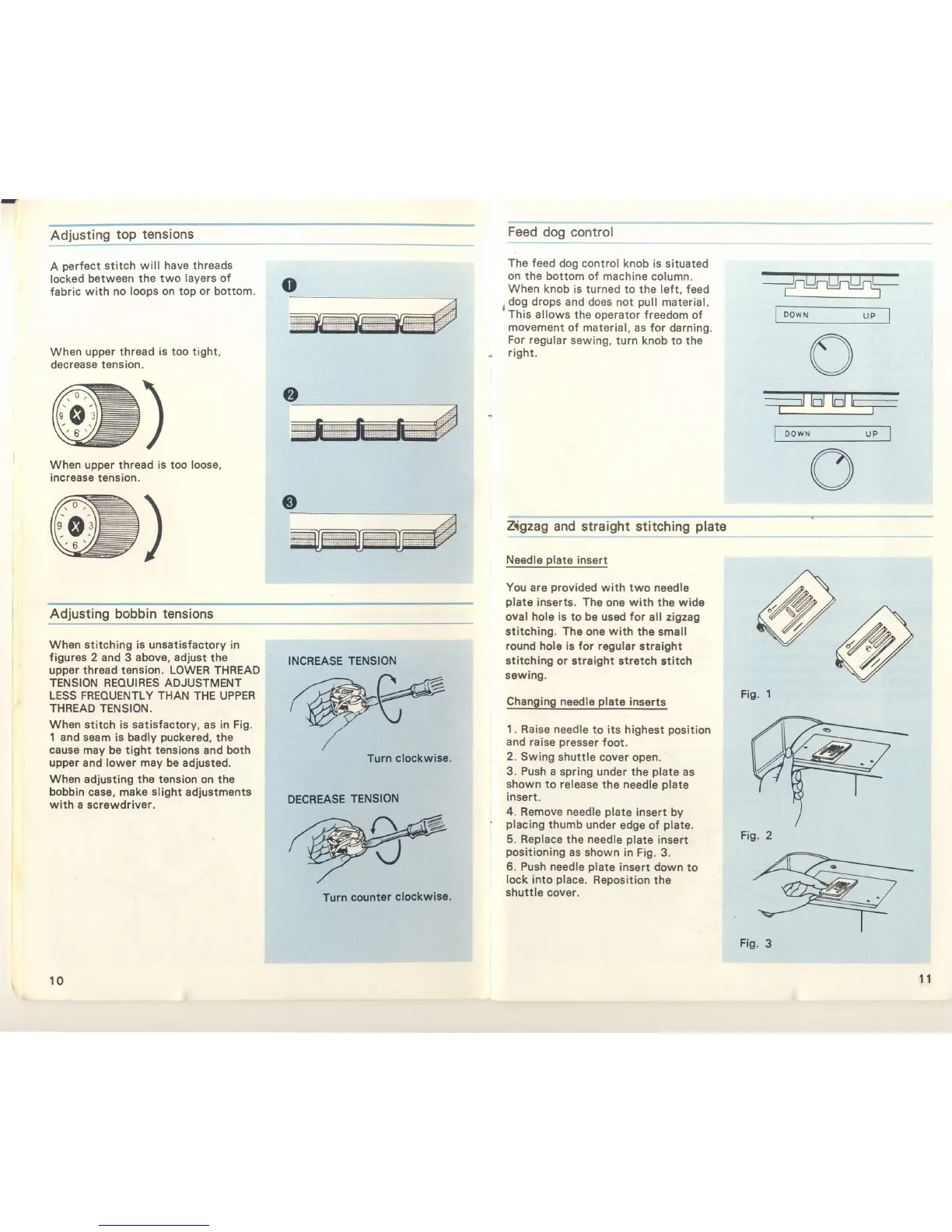
A oerfect
stitch will have
threads
locked
between the two
layers of
fabric
with no loops on top
or
bottom.
o
Feed
dog control
The
feed dog control
knob is situated
on the bottom of
machine column.
When knob
is turned to the left. feed
,
dog drops and
does not
pull
material.
'This
allows
the operator f reedom of
movement
of material,
as for darning.
For regular
sewing,
turn knob to the
right.
Zigzag
and straight
stitching
plate
Needle
plate
insert
You are
provided
with
two needle
plate
inserts.
The
one
with the wide
oval hole
is
to be used for
all zigzag
stitching.
The
one
with
the
small
round hole is for regular
straight
stitching or straight
stretch stitch
sewing.
Changing needle
plate
inserts
1 . Raise needle
to its highest
position
and
raise
presser
foot.
2. Swing
shuttle
cover open.
3. Push a
spring under the
plate
as
shown to
release the needle
plate
insert.
4. Remove needle
plate
insert by
placing
thumb
under
edge
of
plate.
5. Replace the needle
plate
insert
positioning
as shown in Fig.
3.
6.
Push needle
plate
insert
down
to
lock
into
place.
Reposition
the
shuttle cover.
When
upper thread is too tight,
decrease tension.
When upper thread
is
too
loose,
increase
tension.
€\
qFJ
Adjusting bobbin tensions
When
stitching
is unsatisfactory in
figures 2 and
3
above, adjust
the
upper thread tension. LOWER THREAD
TENSION REOUIRES ADJUSTMENT
LESS FREOUENTLY THAN THE UPPER
THREAD TENSION.
When stitch
is
satisfactory,
as in
Fig.
1 and seam is badly
puckered,
the
cause
may be tight tensions and both
upper
and lower
may
be adjusted.
When
adjusting the tension on the
bobbin
case, make
slight
adjustments
with
a screwdriver.
A
{(tl
\r'
-
--ll-l
l-l l-
--E-*-*----r-
l=pov'N------
utl
A
ttll
\r'
DECREASE
TENSION
DOWN
UP
INCREASE TENSION
Turn
clockwise.
@6
Fig.
1
Fig. 2
Turn
counter
clockwise,
10
11



 To Next Page