30
6More about WLAN
AVM and WLAN
WLAN (Wireless Local Area Network) is a radio technology that allows
networks and access to the Internet to be provided without cable con-
nections. This allows multiple users to share one wireless Internet con-
nection.
6.1 Standards
The WLAN standards IEEE 802.11a, IEEE 802.11b,
IEEE 802.11g, IEEE 802.11n and IEEE 802.11i were devel-
oped by the Institute of Electrical and Electronic Engineers
(IEEE).
The standards IEEE 802.11a, IEEE 802.11b, IEEE 802.11g
and IEEE 802.11n define the transmission rate within a
wireless LAN. The IEEE 802.11i standard is a security stan-
dard.
Standards for the Throughput Rate
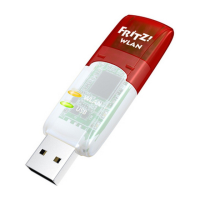
The FRITZ!WLAN USB Stick N supports the IEEE 802.11n
wireless standard and is downward compatible to
802.11a, b and g networks. The standard used in a given
WLAN depends on the settings of the WLAN access point.
Data Throughput The throughputs listed differentiate between gross and
net transmission rates. The net speed describes the trans-
mission rate of the user data. The standards are intended
for different frequency bands.
In order to communicate with each other, the
FRITZ!WLAN USB Stick N and the WLAN access point must
work in the same frequency band.
Standard Frequency Band /
Frequency Bands
Gross Data
Throughput
Net Data Throughput
up to
802.11a 5 GHz 54 Mbit/s 25 Mbit/s
802.11b 2.4 GHz 11 Mbit/s 5 Mbit/s
802.11g 2.4 GHz 54 Mbit/s 25 Mbit/s
802.11n 2.4 / 5 GHz 300 Mbit/s 100 Mbit/s


 To Next Page
 Loading...