
 Need help?
Do you have a question about the FrSky ARCHER PLUS Series and is the answer not in the manual?
Lists dimensions, weight, operating voltage, current, and range.
Details altitude and vertical speed measurement range and resolution for GR6.
Guides on how to register and bind the receiver with the transmitter.
Steps for performing a range check to ensure signal integrity.
Explains No Pulse, Hold, and Custom failsafe modes and their setup.
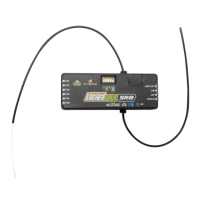
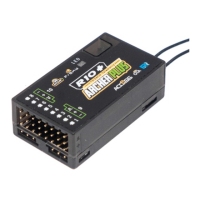
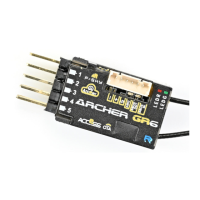
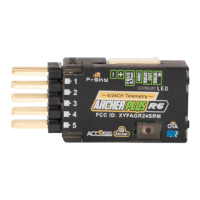
The FrSky ARCHER PLUS R6/GR6 Receiver is an advanced radio control receiver designed to enhance the performance and reliability of remote-controlled models, particularly gliders. This device is part of the new Archer Plus Series, which introduces several key improvements over previous generations.
The primary function of the ARCHER PLUS R6/GR6 Receiver is to receive control signals from a FrSky ACCESS-enabled transmitter and translate them into commands for the model's servos and other components. It supports 6 high-precision PWM channels, making it suitable for controlling various aspects of a glider, such as ailerons, elevators, rudder, and other auxiliary functions.
A significant enhancement in the Archer Plus Series is its improved anti-RF-interference capability, which ensures a more solid and reliable RF performance, even in environments with potential signal disruptions. This is particularly beneficial for models operating near sources of electrical noise, such as spark ignition systems. The receiver is compatible with both ACCESS and ACCST D16 RF protocols, intelligently matching the protocol during the binding process with the radio.
For redundancy and enhanced reliability, the R6/GR6 can be used as a primary receiver in a redundant setup. This is achieved by connecting its SBUS In port to the SBUS Out port of another FrSky receiver, creating a robust signal path. The integration of the FBUS protocol further expands its capabilities, allowing for seamless pairing with multiple telemetry devices, such as XACT servos and ADV sensors, which simplifies the overall build setup of the model.
The ARCHER PLUS GR6 variant includes an upgraded high-precision variometer. This integrated sensor provides pilots with more accurate and quicker altitude and vertical speed data. It also offers more precise and faster variometer audio feedback directly to the pilot's FrSky ACCESS-enabled transmitter, aiding in flight awareness and control, especially during thermal soaring.
A "Black-Box" function is also incorporated, which allows for the preservation of basic flight data, including power and signal-related information. This feature can be invaluable for post-flight analysis and troubleshooting, helping pilots understand their model's performance and identify any potential issues.
The ARCHER PLUS R6/GR6 Receiver is designed for ease of use and flexibility in various flight scenarios. It supports full-range signal strength, ensuring reliable control over long distances. The receiver features dual detachable antennas, which contribute to optimal antenna reception and range, allowing pilots to position them for the best possible signal acquisition.
Binding the receiver to a transmitter is a straightforward process. For ACCESS mode, the receiver can be registered to the radio, and then bound. The LED indicators provide clear feedback on the binding status: green and red LEDs on indicate registration status, flashing LEDs indicate successful registration, and a solid green LED indicates successful binding and normal operation. Once registered, subsequent binding operations in ACCESS mode do not require holding the button on the receiver, simplifying the process.
The receiver offers configurable PWM speed modes. By default, the high PWM speed mode is off. Users can activate it in the receiver's options menu. It's crucial to note that high PWM speed mode is exclusively for digital servos; using it with analog servos can cause them to overheat and potentially burn out.
Telemetry data, especially for the ARCHER PLUS GR6 with its variometer, is easily accessible and configurable. After binding, the receiver's built-in variometer sensor transmits altitude and vertical speed data to the transmitter. Pilots can discover new sensors via the transmitter's telemetry tool, and the altitude data will be displayed. The range and unit of the variometer can also be customized to suit specific preferences.
The receiver supports various telemetry port configurations, including S.Port, F.Port, and FBUS. Users can select their preferred protocol in the receiver's settings, offering flexibility for integrating different telemetry devices and simplifying wiring.
SBUS channel mode is also configurable, allowing users to switch between SBUS-16 and SBUS-24 modes, depending on the number of channels required for their setup. This provides versatility for models with varying complexity.
The ARCHER PLUS R6/GR6 Receiver incorporates features that facilitate maintenance and ensure long-term reliability.
The Over-The-Air (OTA) firmware update function allows for convenient updates without the need for physical connections to a computer. Users can select the firmware file on their transmitter, initiate the flash process, and the receiver will update wirelessly. This ensures that the receiver can always run the latest firmware, benefiting from new features, bug fixes, and performance improvements. It's important to note that binding operations should not be performed in close proximity while a firmware upgrade is in progress, and the firmware should be updated after the receiver has been registered (OTA).
A pre-flight range check is a critical maintenance step to ensure safe operation. This procedure helps identify potential signal loss issues caused by environmental factors such as nearby metal fences, concrete, buildings, or trees. During a range check, the model should be placed at least 60 cm (2 feet) above non-metal ground, and the receiving antenna should be in a vertical position. By entering the "RANGE" mode in the ETHOS system, the effective distance of the radio signal is reduced to 1/30, allowing pilots to walk away from the model and verify signal integrity at a reduced range.
Failsafe settings are crucial for model safety and are highly configurable. The receiver offers three failsafe modes: No Pulse, Hold, and Custom.
It is strongly advised to set failsafe, as an unset failsafe will cause the model to continue operating based on the last received commands, which could lead to damage. If failsafe is disabled on the RF module side, the receiver defaults to Hold mode. For the SBUS port, it is recommended to use "Hold" or "Custom" mode instead of "No Pulses Mode" to ensure continuous signal output.
FrSky continuously adds features and improvements, so checking the FrSky website for the latest firmware and manuals is recommended to get the most out of the product.
 General
| Frequency | 2.4GHz |
|---|---|
| Firmware Upgradeable | Yes |
| Telemetry | Yes |
| Compatibility | ACCESS |
| Channel Number | 16 |


 To Next Page