Need help?
Do you have a question about the FTX Carnage 2.0 Brushless and is the answer not in the manual?
Essential safety guidelines for operating the RC model responsibly and avoiding hazards.
Procedures for safe driving, maintenance, and handling of the model and its components.
Lists essential tools needed for assembly, setup, and maintenance of the RC truck.
Specifies additional consumables required for the RC truck's operation, such as batteries.
Crucial safety instructions and guidelines for handling, charging, and disposing of LiPo batteries.
Step-by-step guide on how to charge the LiPo battery correctly using the provided charger.
Important cautionary notes, features, and specifications for the electronic speed controller.
Details on connecting the ESC and performing initial setup, including throttle calibration.
Explains the optional LED program card and how to interpret ESC status and protection indicator LEDs.
Describes various built-in protection mechanisms like voltage, thermal, and signal loss protection.
Detailed explanation of all programmable ESC settings for performance tuning and customization.
Common ESC issues and their corresponding solutions to help diagnose and fix problems.
Introduction to the transmitter layout, controls, and battery installation requirements.
Procedures for binding the transmitter to the receiver and calibrating steering and throttle controls.
Steps for powering on the car and radio system, and performing initial steering and throttle checks.
Guide to adjusting steering trim, throttle trim, and steering dual rate for optimal performance.
Explanation of how to reverse the direction of steering and throttle inputs for proper control.
Procedures for after-run care, cleaning, and regular maintenance to ensure longevity.
Information regarding the product warranty, terms, and environmentally responsible disposal methods.
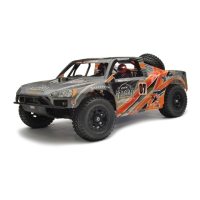
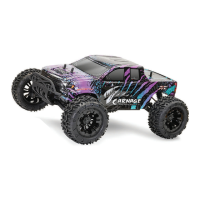
The FTX Carnage 2.0 Brushless is a 1/10th scale 4WD electric-powered ready-to-run off-road monster truck, designed for ease of use and immediate enjoyment. It comes factory assembled with all electronics installed and set up, making it an accessible entry point into the RC car hobby.
The Carnage 2.0 Brushless is designed for off-road driving, offering robust performance and durability. Its 4WD system ensures excellent traction and handling across various terrains. The "Ready-To-Run" designation means it comes with everything needed to start driving, including the truck itself, a 2.4GHz steerwheel transmitter, a 2S/3S 800mA balance charger, a 3250mAh 7.4V 2S LiPo battery, and a Voltz LiPo Safety Charge Sack.
The electronic speed controller (ESC), an Etronix Photon 3.0, is a new-generation brushless unit designed for high-power RC models. It features a 32-bit microprocessor for powerful processing and accurate motor output, along with excellent start-up, acceleration, and linearity. The ESC is completely waterproof and dustproof, allowing for driving in various conditions, though extended moisture exposure or submersion should be avoided to prevent permanent damage. It includes multiple protection features such as low voltage cut-off, over-heat protection, and throttle signal loss protection, and can be easily programmed with an optional LED Program Card.
The 2.4GHz steerwheel transmitter provides precise control over the truck's steering and throttle. It features steering and throttle trim adjustments, steering dual rate control, and steering/throttle reverse switches to fine-tune the vehicle's response to the driver's preferences. The transmitter and receiver are pre-bound at the factory for immediate use.
Before operating the Carnage 2.0 Brushless, it is crucial to read the entire instruction manual to familiarize oneself with the product's features and safety precautions. This model is not a toy and requires caution and common sense during operation.
The included LiPo battery must always be charged in a LiPo sack or metal tin, away from flammable materials, and monitored during the charging process. The supplied 900mAh mains LiPo balance charger is designed for 2S or 3S LiPo batteries, with the included battery being a 2S. The charger's LEDs indicate charging status (red for in progress, green for fully charged). It's important to disconnect the charger from the mains supply and the battery pack when not in use. For installation, the body clips and bodyshell are removed, velcro straps loosened, the charged battery inserted, and straps tightened to secure it. The model should be switched off before connecting the battery.
To start, ensure the receiver switch on the model is turned on, then power on the radio controller. The radio and car are automatically bound. For optimal signal quality, the receiver's antenna should be mounted in an upright, vertical position. The transmitter has a low battery alarm, indicated by a slow flashing green LED when the battery voltage drops below 4.2V.
The ESC requires throttle calibration to ensure proper response to the transmitter's throttle input. This involves holding the power button until the blue LED is solid, then pulling the throttle trigger to full throttle, pushing it to full brake, and finally releasing it to neutral. The ESC confirms each step with LED blinks and motor beeps.
The steering trim buttons on the transmitter allow for fine-tuning the front wheels to run straight when the steering wheel is centered. The throttle trim buttons adjust the car's idle speed. The green LED on the transmitter flashes slowly for short presses and quickly for long presses, indicating adjustment. It flashes twice slowly when the adjustment is at the midpoint and stops flashing when at its maximum or minimum.
The steering dual rate control dial (ST/DR) adjusts the servo travel, allowing the user to set the maximum steering angle without straining the servo. The adjustment range is 0-120%, with a default of 100%.
The ST.REV/TH.REV switches adjust the direction of movement for the steering (CH1) and throttle (CH2) channels. An "up" position indicates reverse, while "down" indicates normal operation.
After turning on the receiver and transmitter, check steering performance by turning the wheel right and left. To accelerate, pull the trigger back; to decelerate, release it to neutral. Pushing the trigger forward activates reverse. For slow-speed maneuverability, the model can switch between forward and reverse instantly, but excessive use of this feature can cause transmission and ESC damage.
Regular checks for loose or missing fixings are essential. Thread lock should be used on any replacement screws into metal threads. Rotating parts, such as gears and axles, should be kept free from grass, string, or other debris that could bind their motion and overstress the motor or speed controller. Wheels should be removed occasionally to check behind the mounting hex for obstructions. The gear mesh should be checked frequently, and any stones or grit removed from gear teeth to prevent premature wear. If the motor is moved or removed, the gear mesh must be reset by slackening the motor retaining screws and adjusting the motor until there is just discernible backlash between the pinion and spur teeth. Incorrect gear mesh can lead to noise and damage. Shock absorbers will wear prematurely in dirty or dusty conditions, so oil and seals should be replaced as needed to maintain smooth dampening action.
After use, switch off the receiver power, then the transmitter. Disconnect and remove the battery from the vehicle, allowing it to cool before recharging. Even if a second charged battery is available, the vehicle should still be allowed to cool before continuing operation.
The manual provides a comprehensive troubleshooting guide for common issues:
FTX warrants its products to be free of material and workmanship defects for 30 days from the date of purchase. This warranty does not cover wear and tear, crash damage, modifications, water damage, or improper use. Proof of purchase is required for warranty claims. For disposal, LiPo batteries should be submerged in a salt water solution for two weeks to safely discharge them before being disposed of in general waste. The crossed-out wheeled bin symbol on the product indicates that it should not be disposed of in ordinary domestic waste but taken to a local collection point for recycling electrical and electronic equipment. Batteries should be removed from the device and disposed of at a local battery collection point.
 General
| Scale | 1/10 |
|---|---|
| Drive Type | 4WD |
| Motor Type | Brushless |
| Battery Type | LiPo |
| Battery Voltage | 7.4V |
| Charger Type | USB Charger |
| Suspension | Independent |
| Body Material | Polycarbonate |
| Radio System | 2.4GHz |
| Shock Absorbers | Oil Filled |
| Tire Type | All Terrain |
| Waterproof | Yes |

 To Next Page