Need help?
Do you have a question about the Fubag TR 180 and is the answer not in the manual?
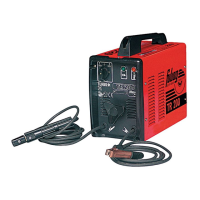
This document describes the FUBAG MMA Electrode Welding Machine, a portable arc welder designed for manual metal arc (MMA) welding. It is suitable for both professional and home use, offering a compact structure, reasonable design, low noise, excellent performance, and convenient maintenance.
The FUBAG MMA Electrode Welding Machine is a portable arc welder that utilizes manual metal arc (MMA) welding. It is designed for welding with coated electrodes, providing a stable and reliable current for various welding tasks. The machine is equipped with an automatic control system for welding current and cooling, ensuring efficient and safe operation. It supports both 220V and 380V power supplies at 50Hz or 60Hz, making it adaptable to different electrical environments.
The manual provides a table of technical specifications for several models: TR 180, TR 200, TR 220, TR 260, and TR 300. Key specifications include:
The device operates within an ambient temperature range of -10 to +40°C. During transport or storage, it can withstand temperatures from -25 to +55°C. Relative humidity should not exceed 50% at 40°C, 90% at 20°C, and 90% at 20°C. The dust and corrosive dirt in the air should not exceed the amount required by the norm. No violent vibration should occur at the operation area. The voltage oscillogram should display actual sine wave, and the oscillation of the supplied voltage should not exceed ±10% of the rated value.
The complete set specification includes:
Safety Operation: Before using the welding machine, it is crucial to read and understand the manual. Safety precautions include wearing protective clothing and special means to avoid injuries to eyes and skin, using a welding mask with special protective glasses, and ensuring proper ventilation. The machine should not be operated under water or in humid places. Fumes and gases produced during welding are hazardous to health, so work should be done in places with exhaust or ventilation facilities. Arc rays can cause interference to nearby people, so they should be kept away. High temperature on the output connection or other electrification parts while welding is normal. Do not touch the electrification parts after turning on the power. Cut off the power supply after operation or before leaving the welding site. Welding in a dangerous zone requires an electrical shock safety certificate. No welding should be performed in containers loaded with flammable or explosive materials. Safety measures should be adopted while operating in high-place to avoid accidents. No entering the welding site for persons not concerned. Welders should be aware of electromagnetism and frequency interference, keeping people with heart pace or articles that can be interfered by electromagnetism and frequency away.
Connection and Power Source: Before maintenance or cable connection, ensure the welding machine is out of power supply. Choose the proper place for operation, ensuring sufficient ventilation and no hindrance for fresh air input and output. Ensure that no dust, vapors, moisture, etc., come into the ventilation. The welder needs a larger input current when operating, so if the power net cannot provide sufficient power source, it will negatively influence the welding quality. Consult with an electrical specialist if you have any problem relevant to this. Always make sure before connecting that the voltage must be in conformity with the voltage given on the welder's indication plate. The plug of input power cable must be adapted to socket. Before making any electrical connection, check for the main voltage ratings to correspond to available voltage and main frequency. The socket used must be equipped with fuses or an automatic switch of adequate capacity corresponding to the information given on the data plate of the machine. One end of the welder's output cable is connected with the welder as shown on the panel, the other end is connected with work piece (1) and electrode holder (2). If the end of the welder's output cable is quick connector (option), it must be touched by clockwise, if loose, the quick connector and welding cable will be ruined.
Welding Operation: Before starting work, set the current adjustment knob to the desired position. Before welding, ensure the workpiece is thoroughly cleaned of rust, paint, or varnish. Replace the electrode when 2-3 cm remain to the holder. To increase the welding current, turn the knob clockwise; to decrease it, turn counter-clockwise. When the current value approaches maximum or minimum, turn the knob smoothly to avoid damage to the regulator. After each electrode, remove slag with a special hammer and brush, then carefully check the quality of the welded parts before continuing. Slag should only be removed after it has cooled and hardened. When removing slag, direct the hammer blows away from people nearby. Always consult the electrode packaging instructions for proper current and polarity selection. Remember that for the same electrodes, higher current values are used for welding on the floor, while lower values are used for vertical or overhead welding. Mechanical characteristics of the weld joint, current intensity, electrode diameter and quality, arc length, operation speed, electrode position relative to the workpiece surface, and proper storage of electrodes (protected from moisture) all determine the weld quality. After selecting welding parameters, it is essential to determine the duty cycle of the machine. The duty cycle should not exceed the maximum permissible value to prevent premature wear of components and potential failure. If the over-heat protection sensor inside the welder triggers, the power will be cut off, and an indicator will light up. After the over-heat protection activates, identify and eliminate the causes of overheating before restarting the machine.
General Maintenance: Never remove the cover or operate the machine without unplugging the main power supply. Moreover, consider that some time after switching off the machine, some components remain under voltage and can cause electrical shocks. Regularly check the connection of input and output cables and the earth (ground) connection. Maintenance should be conducted by trained personnel. The newly installed machine or the welder not in use for some time needs to be checked by a multimeter for the right insulation resistance between each winding and the case, which should not be less than 1 MOhm. When the welder is used outdoors, it should be kept from rain or long exposure to the sun. Check the welding cable frequently to ensure good condition. If the welding machine is in frequent use, check at least once a month if the welder is in regular use. It is necessary to check when the welder is in mobile use. If the welder is not in use either for a long time or temporarily, it should be kept dry and have good ventilation to free it from moisture, corrosive or toxic gas. The tolerable temperature ranges are from -25 to +55°C, and the relative humidity cannot be more than 90% (25°C). Dust removal is needed every year. Check the machine's fasteners, moving-iron, current regulation screws, etc., to make sure there are no loose connection problems. The dust, acid, and corrosive dirt in the air at the job site cannot exceed the amount required by the norm (excluding the emission from the welder). The welder must be installed in the place where it can not be exposed to sun and rain. Also, it must be stored in less humid place with the temperature range at -10 to 40°C. There should be 50 cm space about for the welding machine to have good ventilation. Make sure that there is no metallic foreign body to enter the welding machine. Electrode must be taken down from holder when no welding. No violent vibration in the welder's surrounding area. Make sure that there is no interference with the surrounding area at the installation site.
Safety Check: Each item listed below must be carefully checked before operation:
Transport & Storage: When the welder is in storage and transportation, keep it from being exposed to the rain. When loading, attach attention to the welder packing. It is recommended to free it from moisture, corrosive gas, and dust in storage where it must be kept dry and have good ventilation. The tolerable temperature ranges from -25 to +55°C, and the relative humidity can not be more than 90% (25°C). After the package has been opened, it is suggested to repack the product as per requirement for future storage and transport.
Warranty: The manufacturer warrants the normal working of the machine within 12 months from the date of its sale through retail network. Its repair and components replacement untimely broken through manufacturer's fault providing observance of all requirement by installation, operation, and periodic maintenance. Warranty refers to defects of materials and components and do not refer to components subject to natural wear and maintenance work. Only machines cleaned from dust and dirt in original factory packing fully completed, provided with instruction manual, warranty card with fixed sales date with a shop stamp, factory serial number and originals of sales and warranty receipt issued by salesman are subjects of warranty. Within the warranty period, the service center eliminates free of charge all detected production defects. The manufacturer disclaims warranty and legal responsibilities if nonobservance of the instruction manual by user, unqualified disassembling, repair or maintenance of the machine as well does not bear responsibility for caused injury to persons or damages.
 General
| Brand | Fubag |
|---|---|
| Model | TR 180 |
| Category | Welding System |
| Language | English |

 To Next Page