EasyManua.ls Logo

Fujitsu AOT9LSAC - User Manual

Fujitsu AOT9LSAC
16 pages
Print Icon
To Next Page IconTo Next Page
Loading...
KEEP THIS OPERATION MANUAL
FOR FUTURE REFERENCE
FUJITSU GENERAL LIMITED
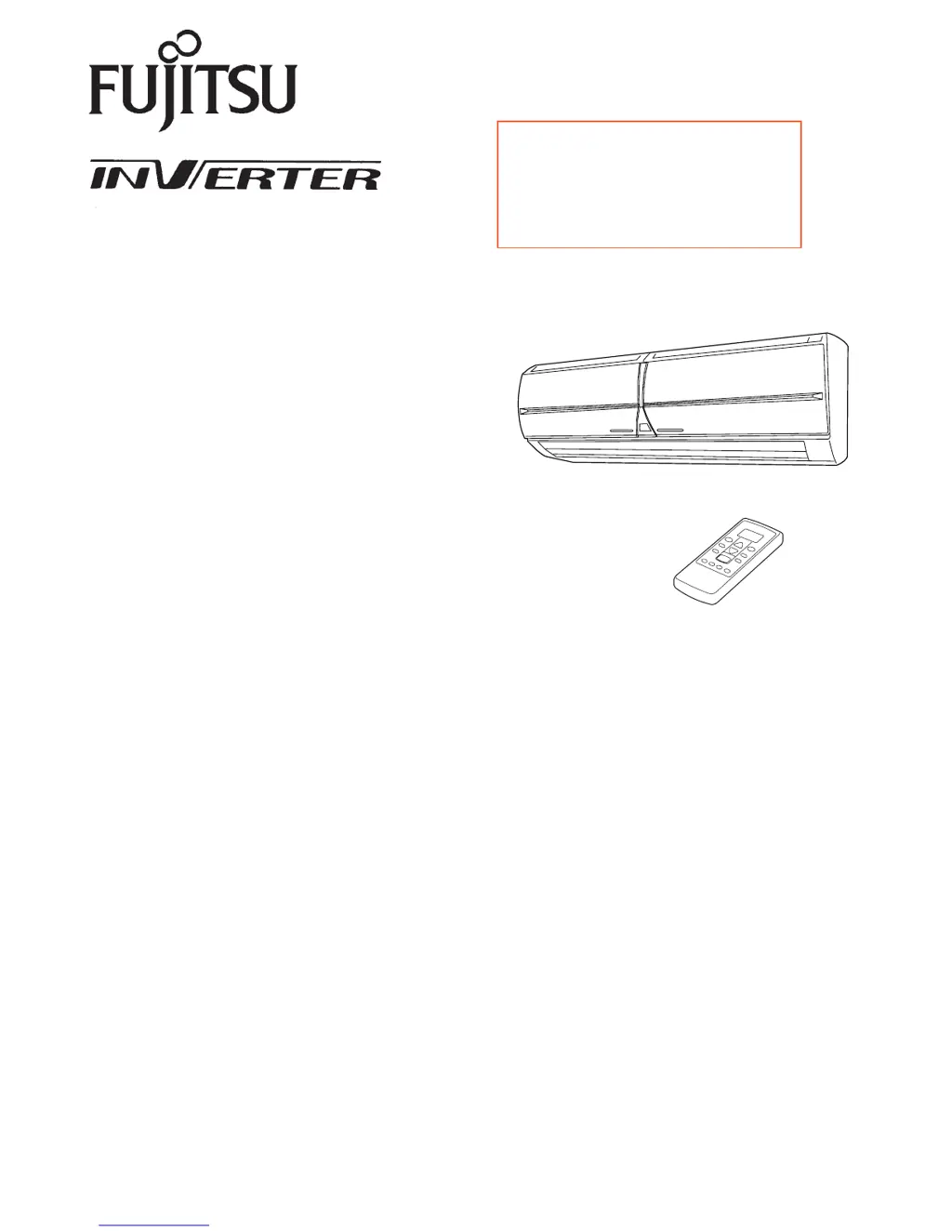
OPERATING MANUAL
P/N9312556052-01
Indoor Unit
AST9LSACW
AST12LSACW
Outdoor Unit
AOT9LSAC
AOT12LSAC
HEAT & COOL MODEL
(REVERSE CYCLE)
ROOM AIR CONDITIONER
WALL MOUNTED TYPE
On account of measuring the
distance from margin to
content,Cover and P16 are
printed as A4 size,The others
are printed as B5(Scale 86.5%).

Questions and Answers

  • N
    Nicholas DaltonAug 12, 2025
    What to do if my Fujitsu AOT9LSAC has poor cooling performance?
    • A
      Andrew MartinezAug 12, 2025
      If your Fujitsu Air Conditioner isn't cooling well, several factors could be the cause. First, check if the air filter is dirty and clean it if necessary. Make sure that the air conditioner's intake grille or outlet port isn't blocked. Ensure that you've correctly adjusted the thermostat settings. Also, check for open windows or doors, and close them. If it's during cooling operation and sunlight is entering the room, close the curtains. Consider if there are heat-generating appliances or too many people in the room. Finally, check if the unit is set to SUPER QUIET operation, as this can reduce cooling performance.
  • K
    kphelpsAug 16, 2025
    What to do if my Fujitsu AOT9LSAC doesn't operate at all?
    • T
      taylordavidAug 16, 2025
      If your Fujitsu Air Conditioner isn't operating, start by checking if the power supply plug is properly connected to the outlet. Also, verify whether there has been a power failure. Finally, check if a fuse has blown out or a circuit breaker has been tripped.
  • S
    Sean ReedAug 23, 2025
    Why is water produced from the outdoor unit of my Fujitsu Air Conditioner?
    • M
      Melissa SchroederAug 25, 2025
      During heating operation, water may be produced from the outdoor unit of your Fujitsu Air Conditioner due to the automatic defrosting operation.
  • V
    Vanessa FergusonAug 27, 2025
    Why does my Fujitsu AOT9LSAC smell?
    • R
      robinsonsusanAug 27, 2025
      A smell may be emitted from your Fujitsu Air Conditioner's indoor unit because room odors (from furniture, tobacco, etc.) have been drawn into the unit.
  • J
    janetholtAug 31, 2025
    Why does my Fujitsu AOT9LSAC Air Conditioner not operate immediately?
    • R
      Richard MillerAug 31, 2025
      If your Fujitsu Air Conditioner is stopped and then immediately started again, the compressor will not operate for about 3 minutes to prevent fuse blowouts. Also, whenever the Power Supply Plug is disconnected and then re-connected to a power outlet, the protection circuit will operate for about 3 minutes, preventing unit operation during that period.
  • D
    Devon EatonSep 3, 2025
    Why does my Fujitsu AOT9LSAC emit mist or steam?
    • J
      jermainejonesSep 3, 2025
      During cooling or dry operation, a thin mist may be seen emitted from the indoor unit of your Fujitsu Air Conditioner. This results from the sudden cooling of room air by the air emitted from the air conditioner, leading to condensation and misting. During heating operation, the outdoor unit’s fan may stop, and steam may be seen rising from the unit due to automatic defrosting operation.
  • B
    bgibsonSep 7, 2025
    Why does my Fujitsu AOT9LSAC Air Conditioner make noise?
    • C
      Cody JohnsonSep 7, 2025
      During operation and immediately after stopping the unit, the sound of water flowing in the air conditioner’s piping may be heard. Also, noise may be particularly noticeable for about 2 to 3 minutes after starting operation (sound of coolant flowing). During Heating operation, a sizzling sound may be heard occasionally which is produced by the Automatic Defrosting operation.
  • K
    Kim Foster MDSep 10, 2025
    Why does my Fujitsu AOT9LSAC Air Conditioner airflow become weak or stop?
    • J
      Jessica SosaSep 12, 2025
      There are several reasons why the airflow in your Fujitsu Air Conditioner might weaken or stop. When heating operation is started, fan speed is temporarily very low, to allow internal parts to warm up. During heating operation, if the room temperature rises above the thermostat setting, the outdoor unit will stop, and the indoor unit will operate at very low fan speed. During heating operation, the unit will temporarily stop operation (between 7 and 15 minutes) as the Automatic Defrosting mode operates. The fan may operate at very low speed during Dry operation or when the unit is monitoring the room’s temperature. During SUPER QUIET operation, the fan will operate at very low speed. Also, in the monitor AUTO operation, the fan will operate at very low speed.

Summary

SAFETY PRECAUTIONS

FEATURES AND FUNCTIONS

INVERTER

Explains the inverter operation for quick temperature control and energy efficiency.

AUTO CHANGEOVER

Describes automatic switching between cooling, dry, and heating modes to maintain set temperature.

SLEEP TIMER

Details how the sleep timer adjusts temperature settings for comfort and automatic shutdown.

SWING OPERATION

Explains the automatic up-and-down movement of louvers for even air distribution.

SUPER QUIET OPERATION

Covers the quiet mode that reduces airflow for reduced noise levels.

NAME OF PARTS

PREPARATION

Turn on the Power

Instructions for connecting the power supply and turning on the unit.

To Use the Remote Control Unit

Guidance on pointing the remote at the signal receiver and basic operation.

OPERATION

To Select Mode Operation

Steps to start the unit and select operating modes like AUTO, COOL, DRY, HEAT, or FAN.

To Set the Thermostat

How to adjust the desired temperature using the SET TEMP button.

To Set the Fan Speed

Guide to changing fan speed settings, including AUTO, HIGH, MED, LOW, and QUIET.

OPERATION MODES

To Stop Operation

Instructions for stopping the air conditioner's operation.

About AUTO CHANGEOVER Operation

Detailed explanation of the automatic mode selection process.

About Mode Operation

Explains the specific functions and considerations for Heating, Cooling, Dry, and Fan modes.

TIMER OPERATION

To Use the OFF TIMER

Steps for setting the timer to turn the unit off automatically.

To Use the ON TIMER

Steps for setting the timer to turn the unit on automatically.

SLEEP TIMER OPERATION

To Use the SLEEP timer

How to set the sleep timer for gradual temperature adjustment and automatic shutdown.

About the SLEEP timer

Explains the sleep timer's automatic thermostat adjustment for heating and cooling modes.

ADJUSTING THE DIRECTION OF AIR CIRCULATION

Vertical Air Direction Adjustment

Guide on using the remote control to adjust vertical airflow direction louvers.

Right-Left Adjustment

Instructions for manually adjusting the horizontal airflow direction louvers.

SWING OPERATION

COIL DRY OPERATION

MANUAL AUTO OPERATION

CLEANING AND CARE

Cleaning the Open Panel

Step-by-step guide on how to remove and clean the indoor unit's open panel.

Cleaning the Air Filter

Instructions for cleaning the air filters using a vacuum cleaner or washing.

When using the optional Air Cleaning Filter

Information on installing and using the optional air cleaning filter accessory.

TROUBLESHOOTING

OPERATING TIPS

Operation and Performance

Explains heating performance principles and microcomputer-controlled automatic defrosting.

AUTO Restart

Details how the unit restarts automatically after a power interruption or timer fault.

OPERATING TIPS

Temperature and Humidity Range

Lists the recommended operating temperature and humidity ranges for Cooling, Dry, and Heating modes.

Fujitsu AOT9LSAC Specifications

General IconGeneral
TypeSplit System
Cooling Capacity2.5 kW
Cooling Capacity (BTU)8530 BTU/h
Heating Capacity3.2 kW
RefrigerantR410A
Voltage220-240 V
Weight (Indoor Unit)8 kg
Power Supply220-240V, 50Hz

Related product manuals