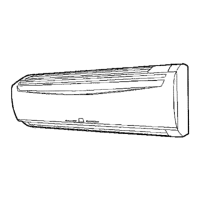
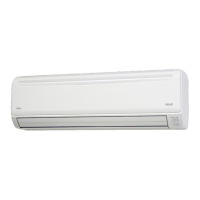
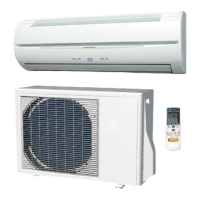
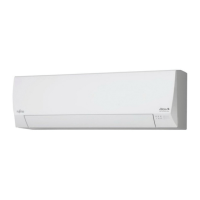
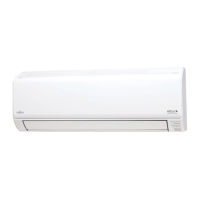
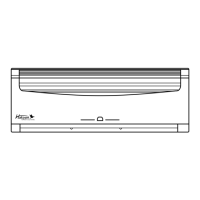
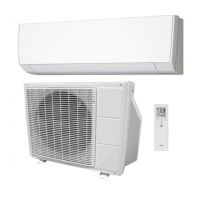
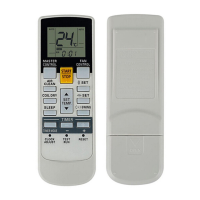
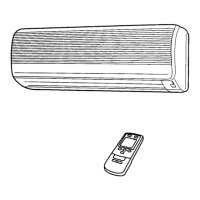
This document is an operating manual for a Fujitsu Room Air Conditioner, specifically a wall-mounted type with indoor unit models ASU9C1 and ASU12C1, and outdoor unit models AOU9C1 and AOU12C1. It provides comprehensive information on safety precautions, features, functions, parts, preparation, operation, timer functions, air circulation adjustment, swing operation, manual auto operation, cleaning, care, troubleshooting, and operating tips.
Function Description
The Fujitsu Room Air Conditioner is designed to provide cooling, dehumidification (dry mode), and air circulation (fan mode) for indoor spaces. It features an automatic operation mode that selects the appropriate cooling, dry, or fan mode based on the thermostat setting and actual room temperature. The unit is controlled via a wireless remote control unit, offering convenient adjustment of various settings.
Operating Modes:
- Automatic Operation: The unit automatically selects between cooling, dry, or fan modes based on the room temperature and thermostat setting. It runs at a very low fan speed for about one minute at the start to detect and select the proper operating mode. Once set, the mode does not change even if the room temperature fluctuates. If restarted within two hours of stopping automatic operation, it will resume in the same mode.
- Cooling Mode: Used to cool the room. The thermostat should be set lower than the current room temperature for this mode to operate.
- Dry Mode: Used for gentle cooling while dehumidifying the room. The unit operates at a low fan speed, and the fan may stop intermittently to adjust room humidity. Manual fan speed changes are not possible in this mode. Heating is not available in dry mode.
- Fan Mode: Used to circulate air throughout the room, especially warm air from ceiling areas when using space heaters. The fan operates when the room temperature rises above the set thermostat temperature and stops when it drops.
Timer Functions:
- ON Timer: Allows the user to set a specific time for the air conditioner to start operation.
- OFF Timer: Allows the user to set a specific time for the air conditioner to stop operation.
- Program Timer: Integrates both OFF and ON timer operations in a single sequence within a twenty-four-hour period. The unit will execute the timer function set nearest to the current time.
- Sleep Timer: Prevents excessive cooling during sleep by gradually raising the thermostat setting. In cooling/dry mode, the thermostat setting is automatically raised by 2°F every sixty minutes, up to a total of 4°F. Once the set time elapses, the air conditioner automatically turns off.
Airflow Control:
- Vertical Airflow Direction: Adjustable via the AIR FLOW DIRECTION button on the remote control unit. It offers multiple ranges, including horizontal flow for cooling/dry mode and downward flow for fan mode. The vertical airflow direction is automatically set based on the selected operation type.
- Horizontal Airflow Direction: Manually adjusted by moving the Right-Left Louvers.
- Swing Operation: Automatically swings the Air Flow Direction Louvers up and down to distribute air throughout the room. This operation may temporarily stop if the fan is not operating or is running at very low speeds. Airflow direction cannot be manually adjusted during swing operation.
Usage Features
- Wireless Remote Control Unit: Provides convenient control over all air conditioner functions. It has a range of about 7 meters and emits a beep when a signal is successfully received by the air conditioner.
- Manual Auto Operation: Available on the main unit control panel (located inside the intake grille) in case the remote control unit is lost or unavailable. When operated manually, the unit runs in AUTO mode with "AUTO" fan speed and standard thermostat settings.
- Removable Intake Grille: Designed for easy cleaning and maintenance.
- Mildew-Resistant Filter: The air filter is treated to resist mildew growth, promoting cleaner use and easier care.
- Super Quiet Operation: When selected via the FAN CONTROL button, the indoor unit's airflow is reduced for quieter operation. This mode is not available during Dry mode and may slightly reduce cooling performance.
Important Technical Specifications
- Thermostat Setting Range:
- Cooling/Drying: 64°F to 88°F (18°C to 31°C)
- Fan: 62°F to 88°F (17°C to 31°C)
- Operating Temperature and Humidity Range (Cooling and Dry Mode):
- Indoor Temperature: Maximum 95°F DB / 71°F WB; Minimum 64°F DB / 55°F WB
- Outdoor Temperature: Maximum 115°F DB; Minimum 32°F DB
- Indoor Humidity: About 80% or less (for temperatures 68°F or above); About 50% or less (for temperatures below 68°F).
- Operating outside these ranges may trigger built-in protection circuits, cause freezing of the heat exchanger, or lead to water leakage.
- Remote Control Unit Batteries: Requires 2 AAA batteries. Batteries should be replaced when the operating range is reduced, and the ACL button should be pressed.
Maintenance Features
- Cleaning the Indoor Unit: The indoor unit should be wiped with a cloth dipped in cool or warm water, then dried with a soft, clean cloth. Avoid using water hotter than 100°F (38°C) or chemical agents like gasoline, benzine, thinners, or insecticides.
- Cleaning the Intake Grille: The intake grille can be opened, unlocked, removed, cleaned with water (or a vacuum cleaner), and then reinstalled. It is crucial not to operate the unit with an open intake grille.
- Cleaning the Air Filter: The air filter should be cleaned every two weeks under normal use. It can be cleaned with a vacuum cleaner or by washing it in a mild detergent and warm water solution. If washed, it must be thoroughly dried in a shady place before reinstallation. Accumulation of dirt on the filter reduces airflow, operating efficiency, and increases noise.
- Optional Air Cleaning Filter: The unit supports an optional Air Cleaning Filter set (UTR-FA03), which comes with its own instruction manual for installation.
- Extended Periods of Non-Use: If the unit will not be used for a month or more, operate it in fan mode for about half a day on a clear weather day to dry internal parts. Disconnect the power for safety.
- Professional Maintenance: Regular professional maintenance is recommended every two to three seasons, as internal parts can accumulate dirt and affect performance.
Safety Precautions
The manual emphasizes several safety precautions:
- Installation and Repairs: Should only be performed by authorized service personnel. Users should not attempt to install, remove parts, or service the unit themselves due to the risk of electrical shock.
- Direct Airflow: Avoid prolonged direct exposure to chilled air, especially for infants, the aged, or sick people.
- Obstruction: Do not insert fingers or objects into outlet ports or intake grilles due to high-speed fan operation. Do not block or cover intake grilles and outlet ports, as this reduces efficiency and can cause damage.
- Malfunction: In case of burning smell or other malfunctions, immediately stop operation, disconnect power, and consult authorized service personnel.
- Ventilation: Ensure adequate ventilation, especially when using the unit with other heating apparatus, to prevent oxygen starvation.
- Placement: Do not climb on or place objects on the air conditioner. Do not place animals or plants in the direct path of airflow. Do not direct airflow at fireplaces or heating apparatuses. Avoid installing near fireplaces or other heating apparatuses to prevent deformation.
- Water and Liquids: Do not expose the unit directly to water or operate with wet hands. Do not set flower vases or water containers on top of the unit to prevent electrical insulation damage from leaks. Do not use inflammable gases or sprays (like lacquer or hairspray) near the unit.
- Batteries: Keep batteries away from infants. Remove batteries from the remote control unit during extended non-use to prevent leakage. Do not mix new and used batteries or different types. Dispose of dead batteries properly.
- Power: Turn off the power source when not using the unit for extended periods or when cleaning/changing the air filter. Always disconnect power or turn off the circuit breaker for safety.
- Installation Check: Periodically check the installation condition for damage after lengthy use.
- Water Drainage: Do not drink the water drained from the air conditioner.
- Applications: Do not use the unit for storing foods, plants, animals, precision equipment, or artworks, as it may deteriorate their quality.
- Air Filter: Always operate the unit with the air filter installed to prevent dirt accumulation on internal parts.
- Heat Exchanger Fins: Do not touch the heat exchanger radiator fins to avoid personal injury and ensure unit efficiency.
- Interference: Install the indoor unit and remote control unit at least one meter away from televisions or radios to prevent signal interference.
- Infant Access: Take precautions to prevent infants from accessing the indoor and outdoor units during installation.


 To Next Page
 General