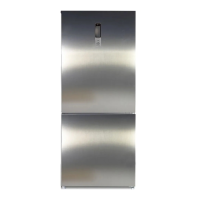
This document is the User Manual for the Fulgor Milano 24" Free Standing Bottom Freezer Refrigerator, model FM4FBM24SS-D. It provides essential information for the safe and effective operation, installation, and maintenance of the appliance.
Function Description
The Fulgor Milano FM4FBM24SS-D is a 24-inch free-standing bottom freezer refrigerator designed for household use. It features separate compartments for refrigeration and freezing, with a fresh convertible box for flexible storage. The appliance is designed to store food items at appropriate temperatures to maintain freshness and prevent spoilage.
Important Technical Specifications
Model: FM4FBM24SS-D
Type: 24" Free Standing Bottom Freezer Refrigerator
Electrical Requirements:
- This refrigerator requires a standard 115/120 Volt AC ~/60Hz electrical ground outlet with three-prong.
- The appliance must be properly grounded to reduce the risk of electrical shock. The power cord has a grounding wire with a 3-prong plug.
- Improper use of the grounding plug can result in a risk of electric shock.
- Do not connect the appliance to extension cords or together with another appliance in the same wall outlet.
- Do not splice the power cord.
- Do not cut or remove the third ground prong from the power cord.
- If the power supply cord is damaged, it must be replaced by the manufacturer, its service agent, or a similarly qualified person.
Refrigerant and Insulation:
- The appliance does not contain gases that could damage the ozone layer in its refrigerant circuit or insulation materials.
- The insulation foam contains flammable gases.
- The cooling unit should not be damaged, especially the heat exchanger.
Storage Capacity:
- The freezer compartment is suitable for freezing fresh food and storing frozen and deep-frozen food for a long time.
- The maximum amount of food that can be frozen in 24 hours is specified on the rating plate.
- The freezing process lasts 24 hours; during this period, do not add other food to be frozen.
Usage Features
User Interface and Control Panel:
The refrigerator features a control panel with buttons and a display for managing settings.
- Buttons:
- Temperature Control of Fridge Compartment (A): Adjusts the temperature of the refrigerator.
- Temperature Control of Freezer Compartment (B): Adjusts the temperature of the freezer.
- Mode (C): Cycles through different operating modes.
- LED Display:
- Indicates the temperature of the fridge and freezer compartments.
- Displays Super Mode and ECO Mode status.
- The panel lights up for 2 minutes when the door of the fridge compartment is opened or any button is pressed.
- During normal operation, the display shows the current temperature settings for both compartments.
Operating Modes:
- FRIDGE (Super Mode): Pressing the FRIDGE button adjusts the temperature of the fridge compartment. Repeated presses cycle through temperature settings (e.g., 2°C, 3°C, 4°C, 6°C, 8°C). The selection is confirmed after 5 seconds of no button press.
- FREEZER (Super Mode): Pressing the FREEZER button adjusts the temperature of the freezer compartment. Repeated presses cycle through temperature settings (e.g., -14°C, -16°C, -18°C, -20°C, -22°C). The selection is confirmed after 5 seconds of no button press.
- ECO Mode:
- Press the MODE button to select ECO mode. The ECO icon flashes for 5 seconds and then stays lit.
- In ECO mode, the appliance automatically sets the temperature of the freezer and fridge compartments to ambient temperature.
- Press the MODE button again to exit ECO mode.
- Super Mode:
- Press the MODE button to select Super mode. It is confirmed after 5 seconds of no button press.
- In Super mode, the "FREEZER" button will not respond to any press.
- To exit Super mode, adjust the mode by the MODE button.
- After 50 hours of Super mode, the refrigerator automatically stops it and reverts to the previous setting.
- Super mode is helpful when freezing a large number of food items, setting Super mode 24 hours ahead.
- Warning: In Super mode, the refrigerator will work hard, and the noise of the refrigerator will be slightly higher than normal running.
Door Open Alarm:
- If the fridge (upper) door is open for 60 seconds, an audible alarm will activate until the door is closed.
Freezing Fresh Food:
- Place fresh food to be frozen in the bottom freezer compartment.
- The maximum quantity of food that can be frozen in 24 hours is indicated on the rating plate.
- The freezing process takes 24 hours; avoid adding more food during this period.
- For best results, freeze small portions of food quickly and completely.
- Wrap food in aluminum foil or polythene bags to ensure airtight packaging.
- Do not allow fresh, unfrozen food to touch already frozen food to prevent a rise in temperature.
- Do not store food for longer than fatty ones; salt reduces the storage life of food.
- Water ices, if consumed immediately after removal from the freezer compartment, can cause freeze burns.
- It is advisable to label and date each individual pack to track storage time.
- To prevent freezer burn, ensure the freezer compartment is full.
Storing Frozen Food:
- When first starting up or after a period out of use, allow the appliance to run for at least 2 hours on higher settings before putting products in the compartment.
- In the event of accidental defrosting, for example, due to a power cut, the defrosted food must be consumed quickly or cooked immediately and then re-frozen (after cooking).
Thawing:
- Deep-frozen or frozen food should be thawed in the freezer compartment or at room temperature, depending on the time available.
- Small pieces may even be cooked directly from the freezer.
Hints for Refrigeration:
- General: Wrap all types of food in polythene bags and place on the glass shelves above the vegetable drawer. Store food in this way for one or two days at most.
- Cooked Food: Cover and place on any shelf.
- Fruit and Vegetables: Clean thoroughly and place in the special drawer(s) provided.
- Butter and Cheese: Store in special airtight containers or wrapped in aluminum foil or polythene bags to exclude air.
- Milk Bottles: Should have a cap and be stored in the balconies on the door.
- Bananas, Potatoes, Onions, and Garlic: Do not keep in the fridge.
Fresh Zone Temperature Control:
- The temperature of the fresh zone can be adjusted according to the type of storage food.
- When the knob is pulled upward from the "CRISPER" position, the fresh zone temperature will gradually decrease.
- When the knob is placed in the "CRISPER" position, the fresh zone can be functioned as a crisper zone and maintain the appropriate temperature and humidity for fruits and vegetables.
- When the knob is placed at the "CHILLER" position, it is suitable for short-term storage of fish or other fresh food. This food will keep fresh but not frozen, making it the best choice for storing fresh food.
- When choosing the "CHILLER" function, it is recommended to set the refrigerator temperature below 4°C and preserved lead-time no more than 3 days to keep the best freshness.
Installation
Placement:
- Place the refrigerator on a flat floor that is strong enough to support the refrigerator when it is fully loaded.
- Adjust the legs at the front of the refrigerator to level it.
- Allow 6 inches of space between the back and sides of the refrigerator, which allows proper air circulation to cool the compressor.
- Locate the refrigerator away from direct sunlight and sources of heat (stove, heater, radiator, etc.).
- Direct sunlight may affect the acrylic coating and heat sources may increase electrical consumption.
- Extreme cold ambient temperatures may also cause the refrigerator not to perform properly.
- Avoid locating the refrigerator in moist areas. Too much moisture in the air will cause frost to form quickly on the evaporator, requiring more frequent defrosting.
Door Reversibility:
The door can be reversed from right-hand to left-hand opening. This process involves several steps:
- Unscrew top hinge cover and disconnect connectors of door switch and harness.
- Unscrew top hinge.
- Remove the pin with a screwdriver and flip the hinge bracket.
- Move the door switch from the right hinge cover to the left hinge cover (found in the accessory bag).
- Detach the cover on top of the upper door and move the harness from the right side to the left side, then replace the cover.
- Move the top left cover to the right side.
- Take off the upper door, remove the screw from the middle hinge by a cross screwdriver, then take off the lower door.
- Move the hinge hole covers from the left side to the right side.
- Unscrew the bottom hinge and remove the adjustable feet from both sides.
- Unscrew and remove the bottom hinge pin, turn the bracket over, and replace it.
- Refit the bracket fitting the bottom hinge pin. Replace both adjustable feet.
- Remove aid-closers from the bottom of the upper and lower doors, then take new aid-closers from the accessory bag and install them to the left side.
- Detach the Fridge and the Freezer door gaskets and then attach them after rotating.
- Install the lower door, adjust and fix the middle hinge onto the cabinet.
- Replace the upper door, ensuring the door aligns with the cabinet to make sure the door gasket seals tightly. Connect the door with the cabinet by tightly fixing the top hinge.
- Connect harnesses from the door and cabinet. Replace the top hinge cover. Before screwing the cover, connect the terminals of the door switch.
Maintenance Features
Daily Use:
- Do not put anything hot on the plastic parts of the appliance.
- Do not place food products directly against the rear wall.
- Frozen food must not be re-frozen once it has been thawed out.
- Store pre-packed frozen food in accordance with the frozen food manufacturer's instructions.
- Adhere to the manufacturer's storage recommendations.
- Do not place carbonated or fizzy drinks in the freezer compartment as it creates pressure on the container, which may cause it to explode, resulting in damage.
- Ice lollies can cause frost burns if consumed straight from the appliance.
Care and Cleaning:
- Before maintenance, switch off the appliance and disconnect the mains plug from the mains socket.
- Do not clean the appliance with metal objects.
- Do not use sharp objects to remove frost from the appliance. Use a plastic scraper.
- Regularly examine the drain in the refrigerator for defrosted water. If necessary, clean the drain. If the drain is blocked, water will collect at the bottom of the appliance.
- The appliance interior and interior accessories should be cleaned regularly.
- Before cleaning, switch off the appliance and remove the plug from the mains, or switch off or turn out the circuit breaker or fuse.
- Never clean the appliance with a steam cleaner, as moisture could accumulate in electrical components, posing a risk of electrical shock. Hot vapors can lead to damage of plastic parts.
- The appliance must be dry before it is placed back into service.
- Important: Ethereal oils and organic solvents can attack plastic parts (e.g., lemon juice or juice form orange peel, butyric acid, cleanser that contain acetic acid).
- Do not allow such substances to come into contact with appliance parts.
- Do not use any abrasive cleaners.
- Remove food from the freezer. Store them in a cool place, well covered.
- Switch the appliance off and remove the plug from the mains, or switch off or turn out the circuit breaker or fuse.
- Clean the appliance and the interior accessories with a cloth and lukewarm water. After cleaning, wipe with fresh water and dry.
- After everything is dry, place the appliance back into service.
Replacing the Lamp:
- The internal light is an LED type. To replace the lamp, please contact a qualified technician.
Troubleshooting:
- Caution: Before troubleshooting, disconnect the power supply. Only a qualified electrician or competent person should do the troubleshooting that is not in this manual.
- Important: Some sounds during normal use (compressor, refrigerant circulation) are normal.
- The manual provides a table of common problems, possible causes, and solutions (e.g., appliance not working, appliance freezes or cools too much, food not frozen enough, heavy build-up of frost on the door seal, appliance not level, unusual noises, side panel is warm).
Environment Protection:
- The appliance should not be discarded with urban refuse and rubbish.
- It should be taken to an appropriate collection point for the recycling of electrical and electronic equipment.
- Ensure proper disposal to prevent potential negative consequences for the environment and human health.
- Contact your local council, household waste disposal service, or the shop where you purchased the product for detailed information on recycling.
Packaging Materials:
- Packaging materials are recyclable. Dispose of them in suitable collection containers.
Disposal of the Appliance:
- Disconnect the mains plug from the mains socket.
- Cut off the mains cable and discard it.
Service
- Any electrical work required to service the appliance should be carried out by a qualified electrician or competent person.
- This product must be serviced by an authorized Service Center, and only genuine spare parts must be used.
Energy Saving
- Do not put hot food in the appliance.
- Do not pack food close together as this prevents air circulating.
- Make sure food doesn't touch the back of the compartments.
- If electricity goes off, don't open the doors.
- Don't open the door frequently.
- Don't keep the doors open for too long time.
- Don't set the thermostat on exceeding cold temperatures.
- Some accessories, such as drawers, can be removed to get larger storage volume and lower energy consumption.

 Need help?
 General

 To Next Page