This document is an instruction manual for the Full Boar Drywall Sander Kit, model FBDWS-75225. It provides comprehensive information on the device's function, technical specifications, usage, and maintenance.
Function Description
The Full Boar Drywall Sander Kit FBDWS-75225 is designed to quickly sand plasterboards to achieve a smooth finish, preparing surfaces for painting. It features a powerful motor, a pivoting sanding head for optimal surface contact, and a telescopic extension handle for reaching high or distant areas. The sander utilizes a hook & loop paper fitment system for easy sanding sheet changes and includes a dust extraction hose for efficient dust management.
Important Technical Specifications
- Model No.: FBDWS-75225
- Voltage: 230-240V~50Hz
- Power: 750W
- Sanding paper size: Ø225mm
- Paper fitment: Hook & Loop
- No load speed: 600-1800/min
- Telescopic adjustment: 1100-1650mm
- Tool weight: 10.32kg
- Contents: 1 x Drywall sander, 1 x Extension handle, 1 x Dust extraction hose, 6 x Sanding sheets (2 x 60, 80, 120 grit), 1 x Carry case, 1 x Instruction manual.
Usage Features
The drywall sander is designed for user comfort and efficiency.
- Collapsible Handle: The handle (4) is collapsible, allowing for compact storage within the included carry case (13). To operate, the handle is unfolded and secured using the collapsible handle lock (fig. 2).
- Extension Handle: An extension handle (8) can be fitted to provide additional support and reach for high or distant surfaces. It is inserted into the extension handle lock (7) and secured by rotating the lock clockwise (fig. 3, fig. 4). The extension handle can be adjusted or rotated to suit various positions, but it should not be extended beyond the "Max" mark on the shaft.
- Dust Extraction: The sander comes with a dust extraction hose (2) that connects to a dust extraction unit or vacuum. This system helps minimize airborne dust, ensuring a cleaner working environment and preventing filter clogging and overheating of the unit (fig. 5).
- Sanding Sheet Fitment: The round sanding head (1) features a hook & loop fastening system for quick and easy attachment and removal of Ø225mm sanding sheets (12). The sanding sheets have 8 holes for efficient dust extraction (fig. 6).
- On/Off Switch & Speed Controller: The sander is switched on by sliding the on/off switch (6) to the "I" ON position, which displays "00" on the speed controller (5) (fig. 7). The speed can be adjusted from 01 to 06 using the "+" or "–" buttons on the speed controller (fig. 8). To switch off, slide the on/off switch (6) to the "O" OFF position (fig. 9).
- Pivoting Sanding Head: The round sanding head (1) has a 2-axis pivoting feature, which enables greater user comfort and full surface contact in any sanding position (fig. 10).
- Sanding Sheet Selection: Selecting the correct grit of sanding sheet (12) is crucial for optimal results. Coarse grit removes more material, while finer grit produces a smoother finish. The higher the grit number, the finer the grade of sanding sheet. Users should start with coarse grit for rough surfaces, then move to medium and fine grits to achieve a uniform, smooth finish. Testing on an inconspicuous area is recommended to ensure the chosen grit is suitable.
- Sanding Tips: Avoid forcing the sander, as excessive pressure can slow the motor, wear out sanding sheets quickly, and reduce sanding speed and quality. Regularly check the working surface to prevent removing too much material, especially with coarse paper, which can create an uneven surface.
- Optional Triangular Sanding Head: An optional triangular sanding head (1) is available (p/n FBTDWH-285, 0335364) for large surfaces, round sanding, and corners/edges (fig. 12).
Maintenance Features
Proper maintenance ensures the longevity and safe operation of the drywall sander.
- Removing the Sanding Head: The round sanding head (1) can be removed for maintenance, cleaning, or replacement if damaged. This involves pulling the locking lever (a) and pushing it left to unlock (fig. 13), then pulling the round sanding head down and away from the motor housing (fig. 14). To refit, align the guides (b & c) and push the locking lever (a) back to the right to secure (fig. 15).
- Carbon Brushes: The carbon brushes are a wearing component and should be replaced when worn out to prevent damage to the motor. Discontinue use if the sander sparks or stops. Replacement should be done by an electrician or a power tool repairer.
- Cleaning: Keep the ventilation vents clean for efficient operation. Use compressed air to blow dust particles from the motor housing. If the enclosure is dirty, use a soft cloth with mild soap; never immerse any part of the sander in liquid.
- Storage: Store the sander and its accessories in the carry case (13) in a dry, frost-free location, out of children's reach. The ideal storage temperature is between 5 and 30°C.
- General Maintenance: Replace worn or damaged parts for safety. The manufacturer's liability is void if the machine is modified in any way.

 Need help?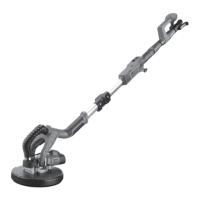

 To Next Page
 General