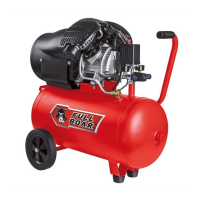
This document outlines the operation, maintenance, and safety guidelines for the Full Boar Air Compressor, a robust tool designed for various applications requiring compressed air up to 10 bar. The compressor is equipped with a 2.5HP motor and a 50-liter tank, ensuring a consistent supply of air for demanding tasks. Its free air delivery rate of 120 liters per minute allows for efficient operation, while dual pressure gauges provide precise monitoring of both tank and regulated output pressure. For enhanced versatility, the unit features two air outlets, enabling the use of multiple tools or accessories simultaneously.
Function Description
The Full Boar Air Compressor functions by drawing in ambient air, compressing it, and storing it in its 50-liter pressure tank. The 2.5HP motor drives the compression mechanism, building pressure within the tank until it reaches a preset maximum of 10 bar. Once this pressure is achieved, an automatic pressure switch halts the motor. As compressed air is consumed by connected tools, the tank pressure gradually decreases. When the pressure drops to a preset minimum of 8 bar, the motor automatically restarts to replenish the tank, ensuring a continuous supply of air.
The compressor features both regulated and unregulated quick-lock couplings. The regulated coupling allows users to precisely control the output air pressure using a pressure regulator knob, which is monitored by a dedicated pressure gauge. This is crucial for tools that require specific operating pressures to function correctly and safely. The unregulated coupling provides direct tank pressure, which may fluctuate, and is suitable for tools that can tolerate varying pressure levels or have their own internal pressure regulation.
A safety valve is integrated into the system to prevent over-pressurization of the tank. Should the tank pressure exceed a safe limit, the safety valve automatically opens to release excess air, safeguarding both the equipment and the user. An overload switch protects the motor from damage by automatically shutting off the compressor if it becomes overloaded.
Usage Features
Before initial use, the compressor requires assembly of its wheels and supporting feet, as well as the transport handle. Crucially, the air compressor must be filled with oil before its first operation. The oil level should be checked and maintained at the mid-point of the red circle in the oil level window, requiring approximately 230ml of SAE 5W/40 or an equivalent compressor oil. The intake air filter also needs to be screwed into place.
To operate the compressor, first plug it into a power outlet and switch on the power. The compressor is then activated by pulling up the on/off switch. The tank will begin to pressurize, and the tank pressure can be observed on the dedicated pressure gauge. For applications requiring a specific pressure, the pressure regulator knob can be adjusted. To increase pressure, turn the knob clockwise; to decrease it, turn it anti-clockwise. A locking collar secures the regulator knob to prevent accidental pressure drift. The regulated output pressure is displayed on a separate adjustable pressure gauge. It is important to note that air must be flowing through the quick-lock regulated air outlet to obtain an accurate reading on this gauge. When adjusting to a lower pressure, it is recommended to go slightly below the desired pressure and then adjust back up for precision.
When connecting air tools, ensure they are compatible with the compressor's output pressure and that their maximum pressure rating is not exceeded. The unregulated quick-lock coupling can be used for tools that do not require precise pressure control.
To turn off the compressor, press down the on/off switch. After switching off, allow the pressurized air to bleed from the tank via the release valve located under the pressure switch cover. Finally, disconnect the electrical plug from the power supply. For complete depressurization, pull the ring on the safety valve outwards to release any remaining compressed air from the tank, then release the ring to close the valve.
Maintenance Features
Regular maintenance is essential for the longevity and safe operation of the Full Boar Air Compressor. Before performing any cleaning or maintenance, always ensure the compressor is switched off, disconnected from the power supply, and fully depressurized. Allow hot parts to cool down to prevent burns.
Daily Checks:
- Drainage of Condensed Water: Moisture accumulates in the tank due to compression. This condensed water must be drained daily by opening the drainage screw at the bottom of the tank. Turn the screw anti-clockwise to open and remember to re-tighten it before the next use.
- Safety Valve Check: The safety valve's functionality must be checked daily. Pressurize the tank close to its maximum pressure, then pull the ring on the safety valve outwards. Air should discharge from the valve. Upon releasing the ring, the air discharge should stop. If the safety valve does not operate as described, the compressor must not be used.
Regular Maintenance (as needed or at specified intervals):
- Cleaning: Keep the compressor free of dirt and dust. Wipe the equipment with a clean, damp cloth and mild soap, or blow it with low-pressure compressed air. Avoid using aggressive cleaning agents or solvents, as these can damage plastic parts. Ensure no water enters the interior of the appliance. Disconnect hoses and spraying tools before cleaning.
- Air Filter Cleaning: The intake air filter prevents dust and dirt from entering the compressor. It should be cleaned after every 300 hours of service, or more frequently in dusty environments. To clean, unscrew the plastic cover, remove the filter, and carefully clean it by tapping or blowing with low-pressure compressed air (approx. 3 bar). Reassemble in reverse order. A clogged filter significantly reduces compressor performance.
- Oil Change: The lubricating oil should be changed after the first 100 hours of operation, and subsequently every 500 hours. To change the oil, switch off the compressor, unplug it, and depressurize the tank. Unscrew the oil drainage screw from the compressor pump and collect the old oil in a suitable vessel. Tilt the compressor slightly if needed to ensure complete drainage. Once drained, re-fit the oil drainage screw. Remove the oil sealing plug and pour new SAE 5W/40 or equivalent compressor oil into the oil filler opening until the level reaches the mid-point of the red circle in the oil level window (approximately 230ml). Finally, replace the oil sealing plug firmly. Dispose of old oil responsibly.
Storage:
Before storing, always pull the mains plug, discharge any unused air pressure from the appliance and connected pneumatic tools, and ensure the compressor cannot be accidentally started. Store the compressor in a dry location, inaccessible to unauthorized persons. Always store the unit upright; never tilt it during storage.
Adherence to these maintenance procedures and safety warnings will ensure the safe and efficient operation of the Full Boar Air Compressor, prolonging its lifespan and maintaining its performance.


 To Next Page
 General