Broadcast
FM
is
a
fairly
wideband
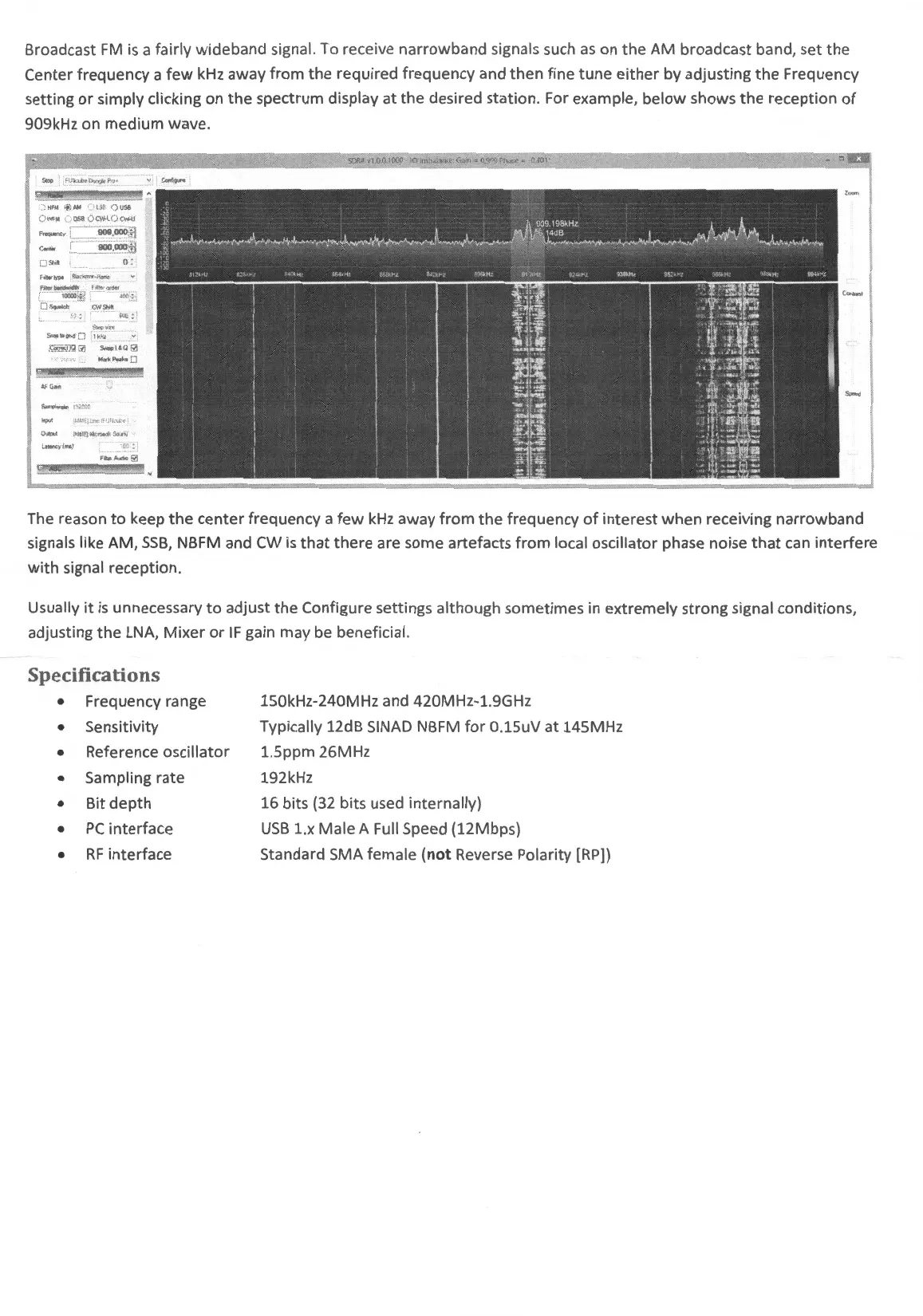
signal. To receive
narrowband
signals such
as
on
the
AM
broadcast band, set
the
Center
frequency
a
few
kHz away
from
the
required frequency and
then
fine
tune
either
by adjusting
the
Frequency
setting
or
simply clicking on
the
spectrum display
at
the
desired station. For example,
below
shows
the
reception
of
909kHz on
medium
wave.
~
i&l'i'
............
11!··
:)
~/r•~\
,p)
UA
(}
LS~
()
USS<
(;
\'<'f~ c,osa ccw-1.r)c,\-1-11
~'fiu
~'4•.}t,~c,-,\'!'
[J
[fkt~
..
:
Z,:~}},';l
R}
S..Ul'l~fl
~
"-"'.''".:K f.",,1'1-"P~k.CJ
The reason
to
keep
the
center
frequency a
few
kHz
away
from
the
frequency
of
interest
when
receiving
narrowband
signals like AM,
SSB,
NBFM and CW
is
that
there
are some artefacts
from
local oscillator phase noise
that
can
interfere
with
signal reception.
Usually
it
is
unnecessary
to
adjust
the
Configure settings although sometimes in
extremely
strong
signal conditions,
adjusting
the
LNA,
Mixer
or
IF
gain may be beneficial.
Specifications
•
Frequency range
•
Sensitivity
•
Reference oscillator
•
Sampling rate
•
Bit
depth
•
PC
interface
•
RF
interface
150kHz-240MHz and 420MHz-1.9GHz
Typically 12dB SINAD NBFM
for
0.15uV
at
145MHz
l.Sppm
26MHz
192kHz
16 bits (32 bits used internally)
USB
l.x
Male
A Full Speed (12Mbps)
Standard SMA female
(not Reverse Polarity [RP])


 To Previous Page
 Loading...