Connecting your loudspeakers
Normal power ampliers have a coil in parallel with a resistor between the amplier and the output
connector. Its purpose is to protect the amplier against capacitive speaker and cable loads.
However, this will slightly reduce the delity of the sound in the treble range, when the amplier is
used with normal loudspeakers. So we have added a direct output in addition to the normal lter
protected output.
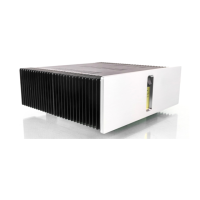
The red terminal closest to the heat sinks is the direct output. The other red terminal is the lter output.
The white terminals are ground.
Biwiring: This also gives you the ability to connect biwiring nicely, using the lter output for the bass
and the direct output for the treble. However, you will achieve the best possible sound and the most
correct tonal balance when biwiring both bass and treble from the same pair of output terminals,
choosing either direct or normal.
NB: When biwiring an electrostatic loudspeaker, please connect both cables to the normal
(lter) output.
Inside the cabinet the ground terminals are kept biwired until they meet at the main star ground
point.
So please do not connect them together.
The red terminals go positive when there is a positive signal on the Pin 2 on the input XLR. In other
words, GamuT ampliers are noninverting. Some other brands of ampliers do not follow this
standard.
Loudspeaker impedance
Most loudspeaker are 8 or 4 Ohm, and they are specied so by the manufacturer.
Unfortunately, some loudspeakers have an impedance, which is much lower than specied. They
will not damage the GamuT power amplier, because it will simply mute.
In the GamuT D200i, we use a gem of a MOSFET transistor. It handles 500 Watts, and a peak
current of 500 Ampere and 100 Ampere longterm.
Such high currents will destroy any HiFi loudspeaker we know of.
The lower the impedance, the higher the current will be.
Somewhere, we have to draw a line between what is a loudspeaker load, and what is a short circuit.
We have set this line at 1.5 Ohm, which will draw about 47 Ampere peak.
The impedance of a few electrostatic loudspeakers does go down below 1.5 Ohm at high frequencies.
The protection circuit will not allow this long-term on test signals. However, it works well with Quad
ELS-63 and most Martin Logan electrostatic loudspeakers.
Please also note that a Quad ELS-63 electrostatic loudspeaker cannot handle more than 55V peak,
and the GamuT can give more than 70V peak. So be careful.


 To Next Page