Need help?
Do you have a question about the gascraft MONZA 6 BURNER BBQ and is the answer not in the manual?
Critical safety advice for user, including hot parts, children, and outdoor use.
Instructions on gas leaks, storage, and handling of gas bottles.
Mandatory leak test for all gas joints and connections before operation.
Comprehensive guide on safe operation, assembly, and maintenance.
Specific instructions for connecting and using the gas supply and regulator.
Instructions for fixing regulators and performing leak tests.
Step-by-step guide to lighting burners and preheating the barbecue.
Strategies for controlling flare-ups and responding to fat fires.
Step-by-step instructions for safely extinguishing a fat fire.
This document provides comprehensive instructions for the assembly, operation, and maintenance of the Gascraft Monza barbecue, available in both 4-burner and 6-burner models. It emphasizes safety precautions and proper usage to ensure a long lifespan for the appliance.
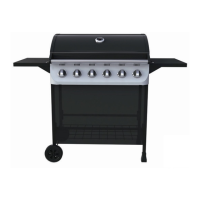
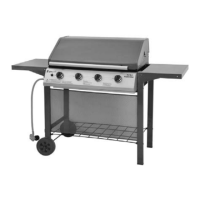
The Gascraft Monza barbecue is designed for outdoor cooking using LPG (Liquefied Petroleum Gas) bottled gas. It functions by heating cast iron grills and plates via multiple burners, allowing for direct grilling. A warming rack is included for keeping food warm, and a lid helps to cook food indirectly and retain heat. The barbecue features a grease tray to collect drippings, and flame tamers are positioned above the burners to vaporize food juices, imparting a unique barbecued flavor to the food. The appliance is equipped with control knobs for adjusting burner intensity and an ignition system for easy lighting. Its mobile design, with wheels and a cart assembly, allows for convenient placement and storage.
The Monza barbecue is intended for outdoor use only, in a well-ventilated area, and on a stable, flat, and incombustible surface. It is crucial to maintain a minimum distance of 1 meter from any combustible structures or surfaces. The appliance is designed to be used with NZ LPG bottled gas, and a suitable low-pressure regulator and flexible hose are required for connection.
Before each use, a leak test must be performed, especially after assembly or when reconnecting the gas bottle, by applying a soap and water solution to all gas system joints. The lid must be open before lighting the burners. To light, users push in and turn the ignition burner control knob anti-clockwise to the MAX position until the burner is fully alight, then ignite adjacent burners. If manual ignition is necessary, a lit match can be inserted through the match-lighting hole.
Preheating the barbecue at the high position for 3-5 minutes before each cooking session is recommended. During cooking, the burner directly under the food should be turned to the OFF position, and other burners set to LOW to MEDIUM for indirect cooking. The hood should be kept closed as much as possible to retain heat. Oven gloves and long, heat-resistant barbecue tools are advised when handling hot parts.
To prevent food from sticking, a light coat of cooking or vegetable oil should be applied to the cooking surface before each session. The drip pan should be lined with aluminum foil, ensuring the drain hole remains unblocked, to facilitate cleanup.
Important safety warnings include keeping young children away from accessible hot parts, not moving the appliance during use, and turning off the gas supply at the gas bottle after use. The gas bottle should always be placed at the side of the appliance, as far away as possible without straining the hose, and never stored indoors or directly underneath the barbecue. The appliance should not be modified, as this can be dangerous and will void the warranty.
In the event of a fat fire, all control knobs should be turned to 'off,' the gas supply at the bottle turned off, and everyone kept at a safe distance until the fire burns out. The hood should not be closed, and water should never be used to douse a barbecue fire. A powder-type extinguisher is recommended if needed, and the drip tray should not be removed during a fat fire.
Regular cleaning and maintenance are essential for the longevity and safe operation of the Monza barbecue. After each cooking session, the burners should be turned to the "high" position for 5 minutes with the hood open to burn off cooking residue, making subsequent cleaning easier. Once the barbecue has cooled, the gas supply should be turned off at the cylinder, followed by the gas control knobs.
All joints and connections should be leak tested annually and whenever the gas bottle is removed or replaced. The barbecue should be cleaned regularly between uses and especially after extended storage periods, ensuring all components are sufficiently cool before cleaning.
Cooking surfaces (cast iron grills and plates) should be cleaned with hot soapy water and a mild cream cleaner on a non-abrasive pad. Scouring pads or powders should be avoided to prevent damage. Surface rust on cooking surfaces is normal and can be cleaned with a soft brass wire brush, then re-oiled and cured.
Burners should be removed and cleaned annually to ensure no blockages from debris or insects. A pipe cleaner can be used to clear obstructions. When refitting, it's crucial to ensure the burner neck fits over the valve outlet. Surface rust on burners is normal and can be cleaned with a soft brass wire brush.
Flame tamers should be cleaned of food residue using a plastic or wooden scraper or brass wire brush, avoiding steel scrapers. Deterioration of flame tamers with use is normal, and periodic replacement may be necessary.
The drip tray must be emptied and cleaned after every use to prevent excessive fat build-up, which can lead to fat fires. The barbecue body should be cleaned of excess grease and fat using a cloth wrung out in hot soapy water. For stainless steel parts, a stainless steel cleaner can be used.
All screws and bolts should be checked and tightened regularly. For storage, the barbecue should be properly cooled, covered, and stored in a cool, dry, well-ventilated area. If stored indoors, the gas bottle must be disconnected and left outside. Cooking grills should be coated with cooking oil, and burners covered with aluminum foil to prevent obstructions. Regular inspection during storage is necessary to address dampness, condensation, or mold. Any rust not in contact with food should be treated with a rust inhibitor and barbecue paint. Chrome parts can be cleaned with a chrome cleaner and wiped with cooking oil after rinsing to prevent rusting.


 To Next Page
 General